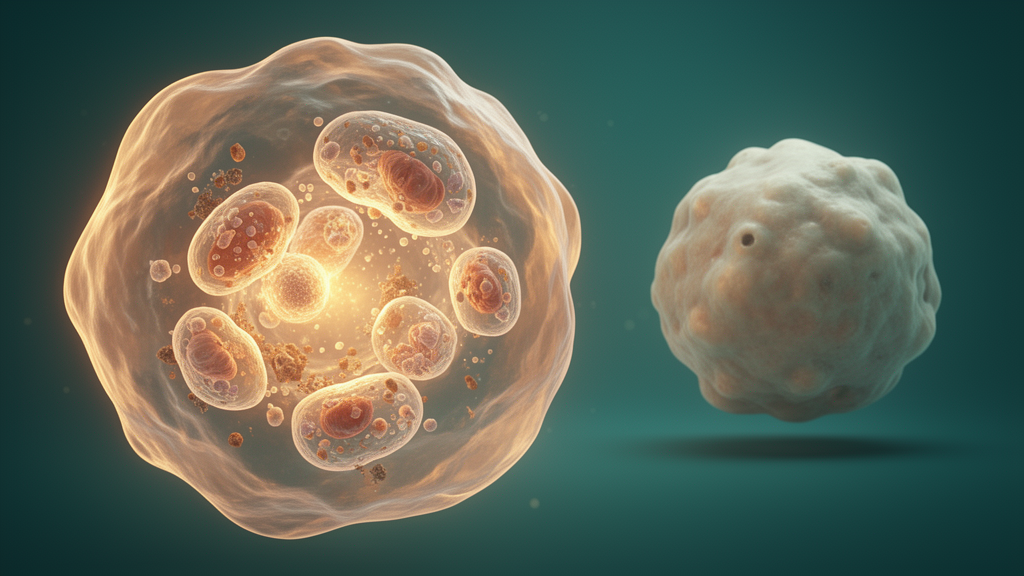
Deep inside nearly every cell, a molecular cleanup crew works around the clock to keep the interior tidy. One of its most specialized branches, chaperone-mediated autophagy, or CMA, does not engulf bulky debris like conventional autophagy. Instead, it plucks individual damaged proteins out of the cytoplasm, unfolds them, and threads them one by one into the lysosome for destruction. A new analysis published in Nature Aging argues that this highly selective recycling system does far more than maintain protein quality: as it wanes with age, it allows senescent cells to accumulate, undermining the immune system’s ability to clear them and thereby driving tissue dysfunction and systemic aging.
The commentary, written by Shweta S. Dipali and Matthew J. Yousefzadeh of Columbia University Medical Center, highlights a study by Sereda and colleagues showing that CMA activity declines during aging and that this decline leads to an enhanced burden of senescent cells. Senescent cells are those that have permanently stopped dividing, usually in response to stress such as DNA damage or telomere shortening. Rather than simply being idle, they remain metabolically active and secrete a potent cocktail of inflammatory cytokines, growth factors, and matrix-remodeling enzymes known collectively as the senescence-associated secretory phenotype. In youth, the immune system patrols tissues and eliminates these cells efficiently. With advancing age, that immunosurveillance falters, senescent cells pile up, and their secretions begin to corrode the surrounding tissue environment.
The mechanistic link between CMA and senescence rests on the peculiar biology of the pathway itself. CMA was first described in 1982, when J. Fred Dice observed that lysosomes could degrade specific cytosolic proteins bearing a particular peptide sequence. Decades later, Ana Maria Cuervo and colleagues defined the machinery: cytosolic chaperones recognize target proteins carrying a KFERQ-like motif, deliver them to the lysosomal membrane protein LAMP2A, which assembles into a translocation complex that threads the unfolded substrate into the lysosomal lumen. Unlike macroautophagy, which sequesters whole regions of cytoplasm into vesicles, CMA is substrate-selective and can be upregulated selectively when cells face proteotoxic stress. This selectivity makes it uniquely suited to degrading the specific proteins that, if left to linger, push cells toward senescence.
Among the substrates that CMA is known to handle are proteins central to senescence signaling. Prior work has shown that CMA can degrade components that stabilize the cell-cycle arrest program, and that loss of CMA activity permits these factors to accumulate. Experimental studies in mice have demonstrated that boosting CMA, for example through gene delivery of LAMP2A, improves function in aging liver, improves cardiac performance, and slows functional decline in models of neurodegeneration. Conversely, blocking CMA in young animals accelerates the appearance of aging-like phenotypes in several tissues. The new analysis by Sereda and colleagues extends this picture by connecting CMA decline to the senescent cell burden itself, positioning the pathway as a gatekeeper that normally restrains the senescence program rather than merely cleaning up after it.
Perhaps the most striking element of the new work is its immunological dimension. The commentary emphasizes that the senescent cell accumulation driven by CMA decline is attributable, in part, to failed macrophage-mediated immunosurveillance. Macrophages are the tissue-resident scavengers of the innate immune system, and in healthy tissue they recognize and engulf senescent cells through a process called efferocytosis, the same engulfment mechanism used to clear apoptotic cells. When macrophages themselves age, their efferocytic capacity diminishes. The new study suggests that CMA decline within macrophages contributes to this failure, creating a vicious cycle: senescent cells accumulate because macrophages cannot clear them, and the inflammatory secretions of those senescent cells further impair macrophage function, deepening the surveillance deficit.
This intersection between autophagy and immunosurveillance reframes how scientists think about the aging immune system. Monocytes and macrophages are not merely passive bystanders in tissue aging; they are active participants whose internal protein quality control determines whether the senescent cell burden is kept in check. If CMA activity in macrophages falls, the cells lose the ability to degrade the proteins that impede their engulfment program, and the tissue loses one of its primary defenses against senescence-driven inflammation. The commentary situates the findings within the broader hallmarks of aging framework articulated by Lopez-Otin and colleagues in 2023, which lists loss of proteostasis, cellular senescence, and altered intercellular communication among the defining features of biological aging. The new work shows how these hallmarks are mechanistically intertwined rather than independent.
The implications for intervention are considerable. Senolytic drugs, which selectively kill senescent cells, have shown promise in early clinical trials for conditions ranging from frailty to diabetic kidney disease. But senolytics address the consequence of senescent cell accumulation, not its cause. If CMA decline is a root driver of that accumulation, then restoring CMA activity could prevent senescent cells from reaching the burden at which they cause harm. Several strategies are already under investigation, including small molecules that upregulate LAMP2A expression, gene therapy approaches that deliver LAMP2A to aging tissues, and lifestyle interventions that have been reported to modulate autophagy pathways. The commentary suggests that such approaches might need to target not only parenchymal cells but also the macrophages whose engulfment program depends on intact CMA.
The findings also raise questions about how CMA decline is regulated during aging. Prior studies have shown that CMA activity falls in many tissues with advancing age, and that this decline correlates with the accumulation of damaged proteins and proteostasis failure. But the signals that trigger the decline, whether oxidative damage to LAMP2A itself, changes in lipid composition of the lysosomal membrane, or systemic factors circulating in aged plasma, remain incompletely understood. The new work adds a layer of complexity by showing that the consequences of CMA decline extend beyond the cell in which it occurs. A macrophage with failing CMA does not merely accumulate damaged proteins; it loses the ability to perform its tissue-level function of clearing senescent cells, and the entire tissue environment deteriorates as a result.
For the aging research community, the study represents a convergence of two previously parallel lines of investigation. Autophagy researchers have long documented the age-related decline of CMA and its role in proteostasis. Senescence researchers have mapped the senescence-associated secretory phenotype and the immune mechanisms that normally clear senescent cells. The new analysis brings these threads together, showing that a single molecular pathway sits at the intersection of proteostasis loss, senescence burden, and immunosurveillance failure. Whether pharmacological restoration of CMA can break the cycle of senescent cell accumulation and macrophage dysfunction in living organisms remains to be tested, but the conceptual framework it provides is likely to shape the design of future studies for years to come.
As the global population ages, the burden of age-related diseases driven by chronic inflammation and tissue dysfunction continues to grow. Understanding the molecular mechanisms that normally restrain senescence, and the reasons those mechanisms fail, is a critical step toward interventions that preserve healthspan rather than merely extending lifespan. The new commentary in Nature Aging makes a compelling case that chaperone-mediated autophagy is one such mechanism, and that its decline with age is not simply a passive consequence of cellular wear but an active contributor to the senescent cell burden that drives systemic aging. If future studies confirm and extend these findings, the pathway may emerge as a promising target for therapies aimed at keeping aging tissues cleaner, calmer, and more functional for longer.
Subject of Research: Cell biology
Article Title: Chaperone-mediated autophagy curbs senescence
Article References: Dipali, S. S., & Yousefzadeh, M. J. (2026). Chaperone-mediated autophagy curbs senescence. Nature Aging. https://doi.org/10.1038/s43587-026-01264-2
Image Credits: AI Generated
DOI: 10.1038/s43587-026-01264-2
Keywords: chaperone-mediated autophagy, cellular senescence, aging, macrophages, immunosurveillance, LAMP2A, proteostasis, senolytics, Nature Aging, efferocytosis, Chaperone-mediated, autophagy
News Source: Beatrice Stafford. (October 19, 2026). Cellular Recycling Pathway Slows Aging by Keeping Senescent Cells in Check. Scienmag.