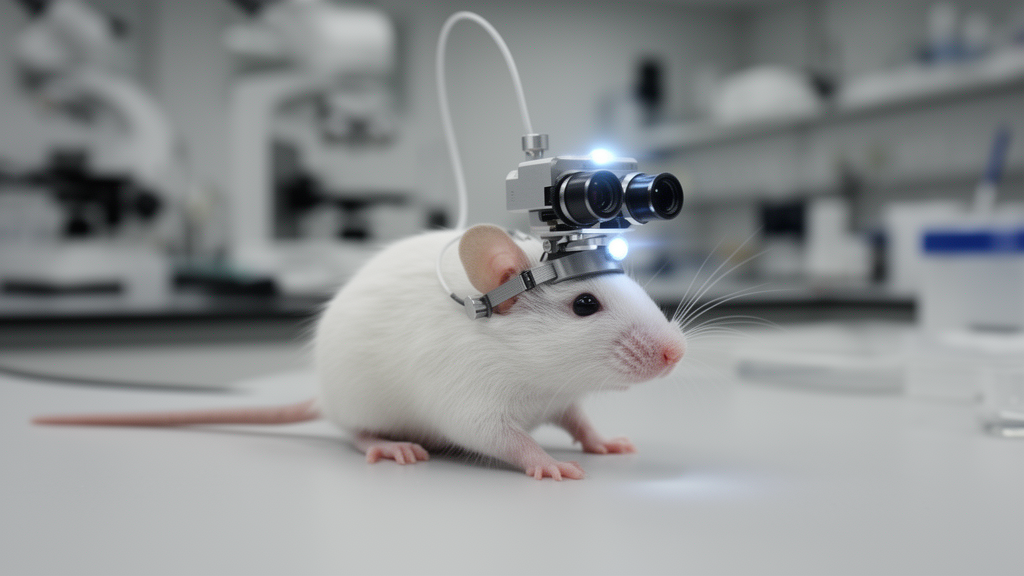
For decades, neuroscientists have faced a fundamental dilemma: the very instruments that allow them to watch individual neurons fire often prevent the animals they study from behaving naturally. Head-mounted microscopes, even when miniaturized, have typically required cables that tether mice to recording equipment, restricting movement and distorting the social and exploratory behaviors researchers most want to understand. Now, a team led by researchers at Tsinghua University has unveiled a wireless mesoscope weighing just 1.0 gram that records cortex-wide neural activity at cellular resolution in freely moving mice, removing one of the last major constraints on systems neuroscience.
The device, called Airscope, delivers a lateral resolution of 4 micrometers across a 6-millimeter field of view at 12.5 hertz, matching the neuron yield of benchtop one-photon mesoscopes while being light enough for a mouse to carry without measurable impairment of its natural behavior. A tailored wireless link supports cable-free calcium imaging from more than 8,500 neurons per animal, a 25-fold increase over previous wireless approaches. The achievement, published in Nature, represents a convergence of optical engineering, wireless communication, and computational analysis that many in the field had considered years away.
The central optical challenge was to fit a mesoscope—typically a benchtop instrument—into a package light enough for a mouse to wear while maintaining a field of view large enough to capture distributed cortical circuits. The team solved this with an aspheric-lens design that achieves a total track length 2.84 times shorter than previous miniaturized microscopes. Aspheric lenses correct for spherical aberration without requiring multiple corrective elements, allowing the designers to compress the optical path dramatically while preserving image quality across the full 6-millimeter field.
Calcium imaging works by detecting fluorescence changes from genetically encoded indicators whose brightness rises when neurons fire. The Airscope uses LED illumination and fluorescence collection to capture these signals, storing data on an onboard SD card while simultaneously streaming a real-time neuronal preview to a computer via Wi-Fi. A rapid battery exchange system allows continuous recording across extended sessions, and the device’s compact design permits unrestricted animal movement even within the confined space of a behavioral tube test.
Beyond the hardware itself, the team developed a zero-shot behavior analyzer called SAM2Mice that automatically segments and tracks multiple animals across diverse behavioral environments without requiring task-specific training data. Built on the Segment Anything Model architecture, SAM2Mice maintains robust segmentation and consistent identity tracking even under crowded conditions with five freely interacting mice, using prompt-free approaches that combine YOLO v11-generated identity prompts with zero-shot segmentation capabilities.
The researchers demonstrated the system’s versatility across an extraordinary range of behavioral paradigms. In room-scale enriched arenas spanning 2.3 by 2.3 meters—containing sandy, floral, and grassland zones with tree hollows, shelters, staircases, and running wheels—multiple mice wearing Airscopes explored freely while their cortical activity was recorded simultaneously. In social dominance experiments using the tube test, paired animals wore Airscopes while competing, revealing cortical activity patterns across multiple dorsal regions that correlate with behavioral signatures of social hierarchy.
Perhaps most strikingly, the team showed that dorsal-cortical population activity could prospectively decode competition outcomes across paired animals, meaning that neural activity recorded before a contest began contained information about which animal would ultimately win. This finding suggests that the neural underpinnings of social dominance are not merely reactive but may reflect stable internal states that shape behavioral outcomes before they unfold.
In maze exploration experiments, the researchers observed reward-location-associated cortical activity patterns as mice navigated a 15 by 8 binary maze, tracking how neural representations of choice points evolved as animals made sequential decisions. The system also enabled a technically demanding dual-implantation approach: two Airscopes mounted on a single mouse recorded cortical and spinal cord activity simultaneously, allowing the team to characterize Granger-causal influence from spinal cord to cortex during fear conditioning—a direction of information flow that has been nearly impossible to measure in behaving animals.
The implications extend well beyond the specific experiments reported. By uniting large-scale, cellular-resolution recording with unconstrained behavior, Airscope makes naturalistic, multi-animal cortical recording experimentally practical for the first time. The technology is described as broadly accessible, suggesting the team intends it to become a standard tool rather than a bespoke instrument. As wireless neural recording continues to advance, the boundary between laboratory observation and natural behavior grows increasingly thin, promising a future in which the brain’s activity can be watched in real time as animals live, compete, explore, and remember.
The weight constraint that shaped the Airscope design reflects a well-documented physiological reality of mouse research. A laboratory mouse typically weighs between 20 and 30 grams, and head-mounted loads exceeding roughly ten percent of body weight have been shown to alter gait, rearing, and social behavior. At 1.0 gram, the Airscope sits comfortably below this threshold, and the team’s open-field comparisons of mice with and without the device showed that motion trajectories were not measurably affected by wearing it. This matters because even subtle behavioral artifacts can propagate into neural data, confounding interpretations of activity patterns that researchers attribute to social or cognitive processes rather than to the burden of the instrument itself.
The choice of one-photon calcium imaging over two-photon approaches was central to making the device feasible. Two-photon microscopy, while offering superior optical sectioning, requires pulsed infrared lasers and scanning optics that are impractical to miniaturize to a wearable format. One-photon imaging sacrifices some depth discrimination but collects light from a wide field simultaneously, which suits a fixed-focus head-mounted design. The tradeoff is that one-photon systems are more susceptible to contamination from out-of-focus fluorescence and hemodynamic signals, so the neuron yield of more than 8,500 cells per animal—matching benchtop instruments—represents a substantial computational as well as optical accomplishment, likely relying on source extraction algorithms to separate overlapping signals from densely labeled cortical tissue.
The 12.5-hertz frame rate deserves attention in light of calcium indicator kinetics. Genetically encoded calcium indicators such as those in the GCaMP family produce fluorescence transients lasting hundreds of milliseconds, so sampling at 12.5 hertz is sufficient to capture the rising phase and peak of individual events, though fast spike trains will be undersampled. For cortex-wide population dynamics, where the quantities of interest are often sustained activity patterns and coordinated shifts across regions rather than millisecond-precision spike timing, this rate is well matched to the biology. The 4-micrometer lateral resolution is also appropriate for resolving individual somata, which in mouse cortex typically measure 8 to 15 micrometers in diameter, while remaining coarse enough to keep data volumes manageable over a 6-millimeter field.
The wireless link is arguably as significant an engineering feat as the optics. Streaming raw fluorescence video from thousands of neurons at video rate would demand bandwidth beyond most consumer wireless protocols, which likely explains the hybrid storage strategy: full-resolution data written to an onboard SD card while a compressed preview streams over Wi-Fi for real-time monitoring. This architecture means experiments are not hostage to wireless dropouts, an important consideration when animals move through enriched arenas with obstacles that can obstruct line-of-sight transmission. The rapid battery exchange system similarly addresses the practical reality that wireless operation trades tethering for finite power, allowing sessions to continue across battery swaps without disturbing the animal.
The demonstration of simultaneous recording from five mice—yielding 21,397 neurons in a single session—opens experimental designs that were previously impractical. Social neuroscience in rodents has long suffered from an asymmetry: neural recordings were typically made in one animal at a time, while its partner’s behavior was observed only externally. Recording from multiple interacting animals simultaneously allows researchers to ask whether neural activity in one animal predicts or mirrors activity in another, a question central to understanding contagion, coordination, and competition. The prospective decoding of tube-test outcomes from pre-contest dorsal cortical activity exemplifies this approach, hinting that dominance-related neural states may be measurable before behavioral encounters begin.
The dual-implantation experiment recording cortex and spinal cord simultaneously addresses a long-standing gap. Spinal cord circuits are increasingly recognized as active participants in processing, not merely conduits for motor commands, but their activity has been difficult to observe in behaving animals. The reported Granger-causal influence from spinal cord to cortex during fear conditioning provides a directional measure of inter-regional communication that correlational analyses cannot offer, though Granger causality applied to calcium signals carries caveats, since the slow and indirect relationship between calcium fluorescence and underlying spiking can complicate causal inference and warrants careful interpretation.
Several limitations inherent to the approach will shape its adoption. The fixed focal plane of a head-mounted mesoscope means that brain motion during vigorous movement, grooming, or postural changes can degrade image quality, and one-photon imaging limits recordings to superficial cortical layers and dorsal structures accessible through a cranial window. The 12.5-hertz acquisition rate and onboard storage also constrain session length and the temporal precision of behavioral-neural alignment. Nonetheless, by demonstrating that cellular-resolution, cortex-wide imaging can coexist with room-scale naturalistic behavior, multi-animal social paradigms, and even spinal recordings, the work establishes a practical template that other laboratories can adapt, potentially accelerating a shift in systems neuroscience from constrained, single-animal preparations toward studies of distributed neural dynamics in animals behaving as they would in the wild.
Subject of Research: Neuroscience
Article Title: Cortex-wide imaging in naturally behaving mice with 1-gram wireless mesoscopes
Article References: Zhang, Y., Li, A., Yuan, L., Wang, M., Zhao, W., Wang, Z., Zang, B., Zhou, Y., Yu, T., Gao, L., Wu, Y., Zhu, R., Tian, M., Li, K., Wu, J., Dai, P., & Dai, Q. (2026). Cortex-wide imaging in naturally behaving mice with 1-gram wireless mesoscopes. Nature. https://doi.org/10.1038/s41586-026-11293-x
Image Credits: AI Generated
DOI: 10.1038/s41586-026-11293-x
Keywords: Cortex-wide, imaging, naturally, behaving, mice, gram, wireless, mesoscopes, scientific research
News Source: Cassandra Pierce. (October 19, 2026). Wireless 1-gram mesoscope reveals brain activity in freely moving mice. Scienmag.