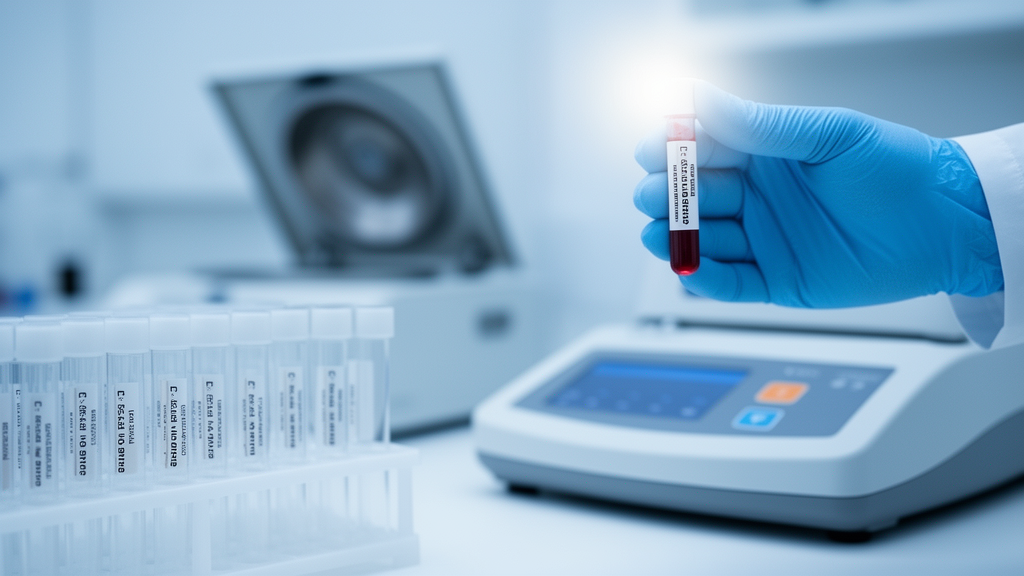
A simple blood draw may soon be able to detect amyotrophic lateral sclerosis, one of the most feared neurodegenerative diseases in medicine, with near-perfect accuracy. A team at Emory University has shown that the levels of just ten proteins circulating in plasma can separate people with ALS from healthy individuals with a balanced accuracy of 98.3 percent and an area under the curve of 0.992, according to a study published in Nature Communications. The finding, drawn from more than 750 ALS cases, moves the field closer to a clinically deployable blood-based screening tool for a disease that currently has no definitive diagnostic test.
ALS, also known as Lou Gehrig’s disease, destroys the motor neurons that control voluntary movement, leading to progressive paralysis and typically death within two to five years of diagnosis. Diagnosis today relies on clinical evaluation, electromyography, and the painstaking exclusion of other conditions, a process that often delays confirmation by many months. That delay matters enormously. Every month of diagnostic uncertainty is a month in which potentially disease-modifying therapies cannot begin, and clinical trials have long been hampered by the enrollment of patients whose disease is already too advanced to benefit. A reliable plasma biomarker panel could compress that timeline dramatically.
The Emory researchers profiled plasma from 632 ALS patients and 160 healthy controls using the NULISA central nervous system and inflammation panels, a proteomic platform capable of quantifying proteins at extremely low concentrations. The NULISA technology uses affinity reagents engineered to capture proteins across a wide dynamic range, allowing detection of scarce neural proteins that leak into the bloodstream when the nervous system is damaged. This sensitivity is critical because many of the most informative ALS biomarkers, such as neurofilament light chain, exist in plasma at concentrations thousands of times lower than abundant liver or muscle proteins.
With hundreds of proteins quantified across the cohort, the team turned to machine learning to find the molecular signature of disease. They applied eXtreme Gradient Boosting, or XGBoost, an algorithm that builds an ensemble of decision trees optimized to classify samples based on subtle patterns in high-dimensional data. To guard against overfitting, the researchers used nested cross-validation, a rigorous scheme in which an inner loop selects model parameters while an outer loop evaluates performance on data the model has never seen. This two-layer structure is considered the gold standard for assessing whether a predictive model will generalize beyond its training set.
Interpreting what the model had learned was the next challenge. The researchers used SHAP, or SHapley Additive exPlanations, a technique borrowed from game theory that assigns each protein a numerical contribution to every individual prediction. SHAP values reveal which features drive the model’s decisions rather than leaving the algorithm as an opaque black box. By ranking proteins according to their SHAP feature importance and confirming their behavior with absolute quantification, the team refined an initial 12-protein candidate panel down to a final set of ten that delivered the strongest and most stable classification performance.
The ten proteins that survived the refinement tell a coherent biological story. The panel includes NEFL and NEFH, the light and heavy chains of neurofilament, structural proteins of neurons that are released when axons degenerate and long regarded as the most robust fluid biomarkers of ALS. It also contains pTau-181, a phosphorylated form of the tau protein more commonly associated with Alzheimer’s disease, along with FOLR1, the folate receptor alpha; TREM1, an immune activation marker; VEGFA, a vascular growth factor; CALCA, the precursor of calcitonin-related peptides; NRGN, a calcium-binding protein expressed in neurons; LAMP3, a lysosomal membrane protein; and PTX3, an acute-phase inflammatory protein. Together they span axonal damage, glial activation, inflammation, and lysosomal dysfunction, reflecting the multiple pathological processes that converge in ALS.
Crucially, the panel’s power does not rest on neurofilament light chain alone. Neurofilament levels rise in many neurodegenerative and even systemic diseases, which limits their specificity for ALS. The Emory model achieved its performance through the combined plasma proteomic signature rather than through any single clinical variable, and the authors report that performance was driven by proteomic data rather than by demographic or clinical characteristics. This multi-protein architecture is what gives the panel its specificity: while one protein may flag general neural injury, the pattern across ten proteins appears to encode a signature particular to the disease.
To test whether the model would hold up outside its training data, the researchers evaluated the ten-protein panel in an independent validation cohort of 144 ALS patients and 37 healthy controls. The panel achieved a balanced accuracy of 98.3 percent and an AUC of 0.992 in this unseen cohort, a result that suggests the signature is stable rather than an artifact of the discovery sample. Balanced accuracy, which averages the sensitivity and specificity of the classifier, is particularly important in biomarker studies because it prevents a model from appearing accurate simply by favoring the larger group.
The implications for clinical trial design are substantial. Predictive biomarkers are increasingly used to guide diagnosis, stratify patients, and manage people with neurodegenerative diseases, and a blood-based ALS screen could transform enrollment into therapeutic studies. Trials could screen potential participants with a simple blood test, identify patients earlier in their disease course, and even monitor whether an experimental therapy alters the protein signature over time. Because the panel is built from plasma rather than cerebrospinal fluid, which requires a lumbar puncture, it could be deployed at scale in ordinary clinical settings.
The study, funded by Hop On A Cure, the American Brain Foundation, the ALS Association, the American Academy of Neurology, and the Muscular Dystrophy Association, represents one of the largest plasma proteomic efforts in ALS to date. The authors caution that the work is an early step toward a deployable screening tool and that further validation in broader and more diverse populations, including people with other neurodegenerative diseases that could mimic ALS, will be needed before the panel enters routine practice. Still, the combination of a large cohort, rigorous machine learning methodology, and independent validation marks a milestone in the quest to detect a relentless disease from a vial of blood, offering hope that ALS may one day be identified in time for therapies to change its course.
Subject of Research: Ten protein panel predicts ALS from plasma with high accuracy
Article Title: Ten protein panel predicts ALS from plasma with high accuracy
Article References: Kim, W. J., Chung, M., Asress, S., Trautwig, A. N., Dammer, E., Fournier, C. N., Seyfried, N. T., McEachin, Z. T., Glass, J. D., & Thomas, E. V. (2026). Ten protein panel predicts ALS from plasma with high accuracy. Nature Communications. https://doi.org/10.1038/s41467-026-78766-5
Image Credits: AI Generated
DOI: 10.1038/s41467-026-78766-5
Keywords: protein, panel, predicts, plasma, high, accuracy, scientific research
News Source: Ophelia Keating. (October 19, 2026). Ten plasma proteins flag ALS with near-perfect accuracy in blood test. Scienmag.