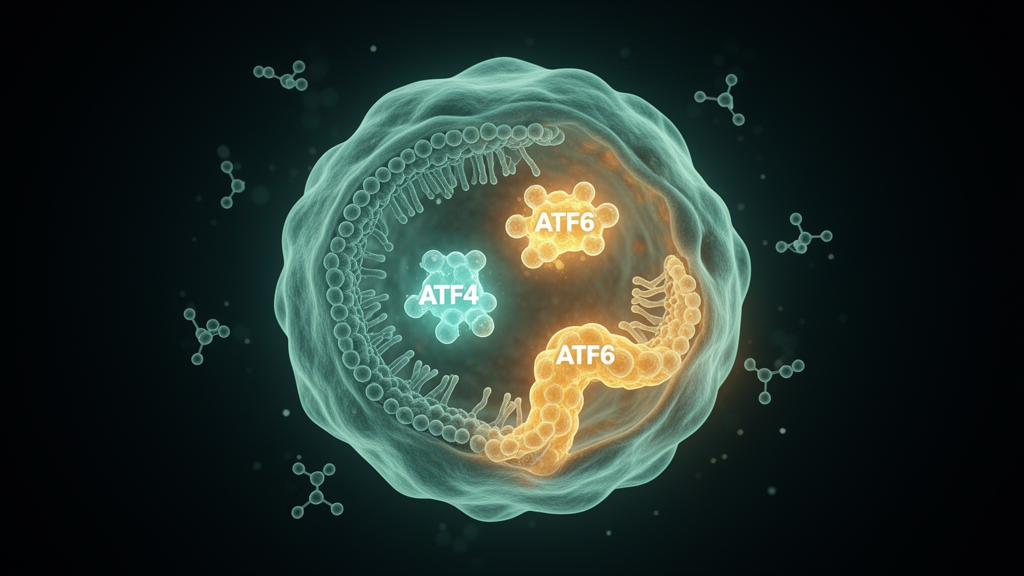
Lung cancer cells facing a shortage of glucose do not simply shut down. According to a new open-access study published in Cancer & Metabolism on 12 October 2026, two stress-activated transcription factors, ATF4 and ATF6, coordinate the transcriptional and metabolic changes that non-small cell lung carcinoma (NSCLC) cells deploy when their sugar supply is cut off.
Tumours often outgrow their local blood vessels, leaving pockets of tissue starved of oxygen and nutrients. The researchers, led by Mabel Cruz-Rodríguez and senior author Cristina Muñoz-Pinedo, set out to map how cells respond transcriptionally to one of those shortages: a lack of glucose.
To do this, the team used RNA sequencing of A549 lung cancer cells kept without glucose, identifying changes in individual genes and in Reactome pathways through gene-set-enrichment analysis. Bioinformatic inference then pointed to ATF4 and ATF6 as the most relevant transcription factors, which the group went on to test by silencing them with siRNA in several NSCLC cell lines.
The sequencing revealed a striking pattern. Multiple pathways related to DNA replication and the cell cycle were downregulated when glucose was withdrawn, while the single most strongly upregulated transcriptional pathway was the Unfolded Protein Response, or UPR, a stress programme previously shown to help cells adapt to proteotoxic and endoplasmic reticulum stress.
Glucose shortage robustly activated all three branches of the UPR across several NSCLC cell lines, the authors report. The evidence included accumulation of ATF4, splicing of XBP1 mRNA, and cleavage of ATF6. In a network analysis, ATF6 and ATF4 emerged as the transcription factors with the highest scores.
The influence of these two factors extended deep into metabolism. Silencing ATF4 or ATF6 with siRNA regulated multiple metabolic genes and pathways, including amino acid synthesis and transport, glycosylation and lipid synthesis. ATF4 silencing also affected the transcriptional induction of mitochondrial OXPHOS-associated pathways. Direct metabolite measurements showed that ATF4 regulates amino acid and citrate levels during glucose deprivation.
Perhaps the most unexpected finding concerns cell fate. Rather than promoting survival, ATF4 contributed to cell death in glucose-starved cells, with only a limited contribution from its target DR5/TRAILR2. Silencing CHOP, DR4 or NOXA did not affect cell death in glucose-starved A549 cells, and silencing or inhibiting other UPR factors, including ATF6 and IRE1/XBP1s, individually or in combination, likewise did not impact survival under glucose deprivation.
The study also uncovered a role for the stress pathway in controlling mTORC1, a central growth-regulating signalling complex. The absence of ATF4, or of its target sestrin 2, prevented the inactivation of mTORC1 that normally occurs when glucose is withdrawn. In contrast, reducing ATF6 enhanced the activation of XBP1 and ATF4 but did not regulate mTORC1 inactivation, indicating that the two transcription factors act through partly separate mechanisms.
The authors conclude that the Unfolded Protein Response is activated upon glucose deprivation and that some of its transcription factors control both the transcriptional and the metabolic responses to glucose shortage. Because the work was carried out in lung cancer cell lines, the findings describe mechanisms observed in cultured cells rather than outcomes in patients. The article was released early as a peer-reviewed, citable accepted manuscript, and the final version of record will replace it after further edits.
Subject of Research: Transcriptional and metabolic responses to glucose deprivation in non-small cell lung carcinoma cells
Article Title: ATF4 and ATF6 orchestrate transcriptional responses to glucose deprivation in NSCLC
Article References: Cruz-Rodríguez, M., Collado-Rodríguez, L., Favaro, F., Hijazo-Pechero, S., Püschel, F., Both, D., Palau-Gallinat, D., Plans-Marin, S., Jiménez-Hernández, F., Tang, M., Moreno-Caceres, J., Chevet, E., Nadal, E., & Muñoz-Pinedo, C. (2026). ATF4 and ATF6 orchestrate transcriptional responses to glucose deprivation in NSCLC. Cancer & Metabolism. https://doi.org/10.1186/s40170-026-00461-2
Image Credits: AI Generated
DOI: 10.1186/s40170-026-00461-2
Keywords: ATF4, ATF6, glucose deprivation, unfolded protein response, NSCLC, mTORC1, metabolism, XBP1, cell death, RNA sequencing, lung cancer, orchestrate
News Source: Nathaniel Bowman. (October 28, 2026). Cell stress sensors ATF4 and ATF6 steer how lung cancer cells cope with glucose starvation. Scienmag.