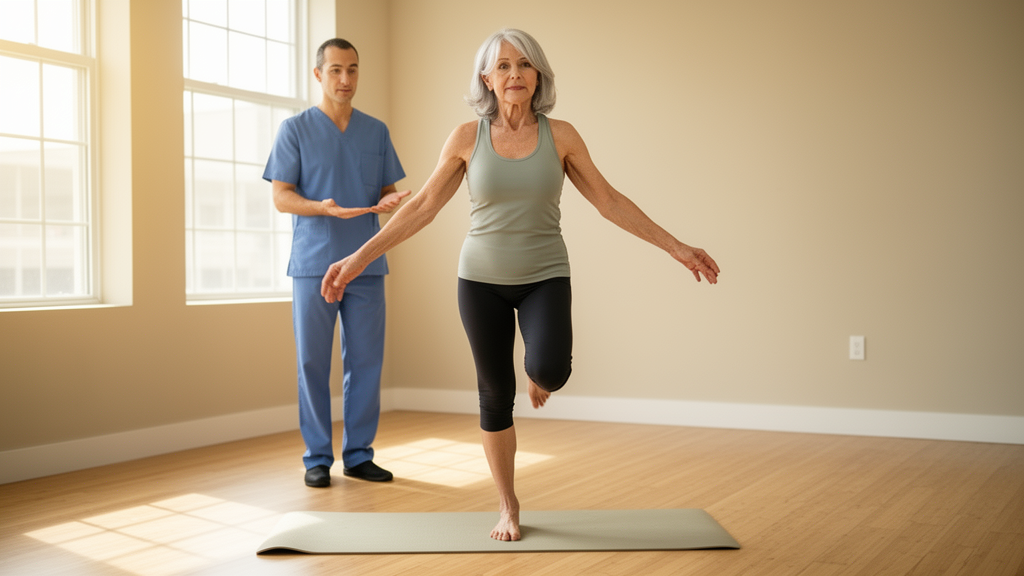
An eight-week vestibular rehabilitation training program improved balance performance and changed how older women rely on their sensory systems for postural control, according to a randomized controlled trial published in the European Review of Aging and Physical Activity.
The trial enrolled 29 older women, who were randomly assigned either to a vestibular rehabilitation training group of 15 participants or to a control group of 14. The intervention consisted of supervised vestibular exercises performed three times per week for eight weeks. Balance was assessed with a force plate, and the relative contribution of the visual, vestibular, and proprioceptive systems was estimated across eight sensory conditions using a least squares approach. Measurements were taken before and after the intervention period.
The results showed a significant Group × Time interaction for balance index (p = 0.01), indicating improved balance performance in the vestibular training group compared with controls. A significant Group × Time × Sensory System interaction was also observed (p = 0.049). Within the training group, vestibular dependence significantly decreased (p = 0.015), while proprioceptive dependence significantly increased (p = 0.009). At the post-test, sensory dependence became more evenly distributed across the three sensory systems, and the training group also showed lower visual dependence (p = 0.018) and greater proprioceptive dependence (p < 0.001) than the control group.
According to the authors, these findings suggest that an eight-week vestibular training program promotes adaptive sensory reweighting in older women by reducing vestibular dependence, enhancing proprioceptive contribution, and achieving a more balanced sensory organization. The study’s background notes that age-related alterations in sensory integration impair postural control and increase fall risk in older adults, and that vestibular rehabilitation training has been proposed as an effective intervention to improve balance, although its effects on the relative contribution of sensory systems had remained unclear.
The trial was retrospectively registered in the Iranian Registry of Clinical Trials on May 19, 2026 (registration number IRCT20251115068000N1). The published version is an early-release, peer-reviewed accepted manuscript that is citable and carries a permanent DOI, subject to further edits before the final Version of Record. The reported findings apply to the population studied—older women in this randomized trial—and the conclusion that vestibular rehabilitation may support postural control and reduce fall risk in older adults is presented by the authors as a direction supported by these results, with the trial’s scope limited to its 29 participants and eight-week intervention.
Subject of Research: Effects of an eight-week vestibular rehabilitation training program on balance and sensory reweighting in older women
Article Title: Effects of vestibular training on balance performance and sensory reweighting in older women: a randomized controlled trial
Article References: Dehghan Niri, E., Haj lotfalian, M., & Heydari, F. (2026). Effects of vestibular training on balance performance and sensory reweighting in older women: a randomized controlled trial. European Review of Aging and Physical Activity. https://doi.org/10.1186/s11556-026-00438-6
Image Credits: AI Generated
DOI: 10.1186/s11556-026-00438-6
Keywords: vestibular rehabilitation, balance, sensory reweighting, older women, postural control, randomized controlled trial, proprioception, fall risk, force plate, aging, Effects, vestibular
News Source: Beatrice Stafford. (October 28, 2026). Eight weeks of vestibular training improves balance and sensory reweighting in older women. Scienmag.