Arsenic in contaminated paddy soils is one of the quieter threats to global food security. The metalloid, classified as a Group 1 human carcinogen by the International Agency for Research on Cancer, enters the food chain chiefly through rice, a staple for more than half of the world’s population. In flooded paddies, shifting redox conditions convert arsenic between its more mobile, more toxic arsenite form and arsenate, repeatedly raising the risk that the element accumulates in grain. A new open-access study published in Biochar on 9 July 2026 reports that a chitosan-functionalized biochar can substantially reduce arsenic’s availability in soil and its uptake by rice plants, while also examining how six months of natural aging changes the material’s performance.
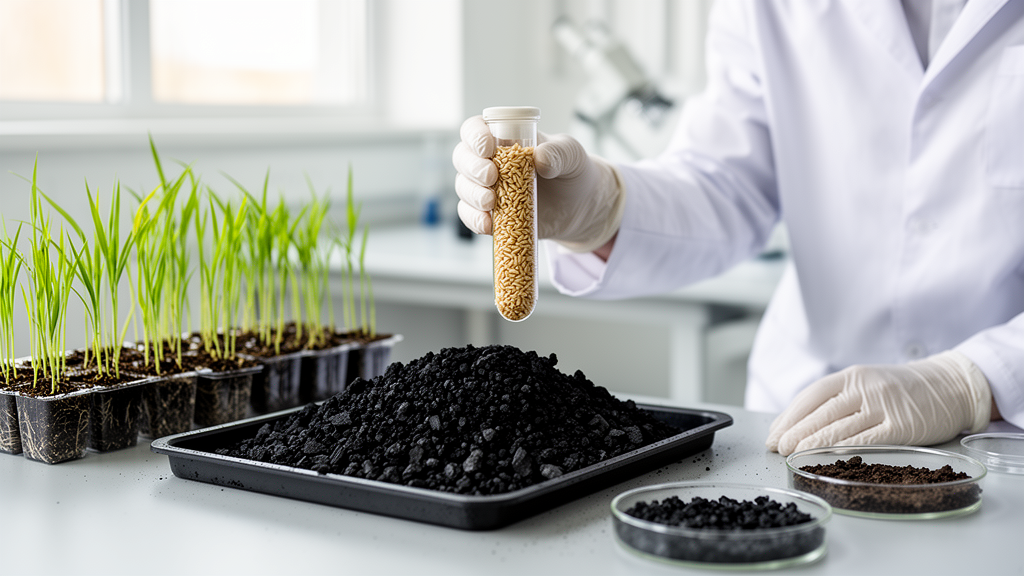
The research team, led by Meng Li and Jianhong Li with senior author Hailong Wang, prepared four amendments from the same pristine biochar, which was pyrolyzed from branches of Ficus microcarpa at 650 degrees Celsius for two hours. One sample was left unmodified (BC), one was coated with chitosan, a natural polysaccharide rich in amino and hydroxyl groups (CBC), and both versions were then buried in permeable nylon mesh bags at 20 centimeters depth in an open field at Foshan University in subtropical southern China. After six months of field exposure from January to July 2022, the aged counterparts (NBC and NCBC) were recovered. This design allowed the researchers to test, within a single experiment, both the chemical effect of chitosan loading and the environmental effect of natural aging, which involves freeze-thaw cycles, wet-dry alternation, photochemical oxidation, and microbial activity.
The pot experiment itself took place in a greenhouse in Foshan City, using 3 kilograms of contaminated soil with a total arsenic content of 397 milligrams per kilogram mixed with 60 grams of each biochar, a moderate 2 percent application rate within the commonly reported 1 to 5 percent range. Five treatments, including an unamended control, were each replicated three times, and rice was grown for 130 days under continuously flooded conditions until physiological maturity. Fourier transform infrared spectroscopy confirmed that chitosan loading introduced nitrogen-containing amide and glycosidic bond signals, while aging added carbonyl and hydroxyl features, collectively increasing oxygen- and nitrogen-containing functional groups on the biochar surfaces.
The headline result concerns arsenic mobility. Fresh chitosan-functionalized biochar reduced soil bioavailable arsenic, extracted with ammonium dihydrogen phosphate, by 21.1 percent relative to the control, and lowered dissolved arsenic in surface water to 9.43 micrograms per liter. Unmodified biochar did the opposite: BC and NBC raised surface water arsenic to 23.47 and 22.07 micrograms per liter respectively, and increased soil bioavailable arsenic by 36.2 and 16.3 percent. Sequential extraction explained the divergence. The CBC treatment shifted arsenic from labile pools into stable ones, cutting the mobile non-specifically and specifically adsorbed fractions by 28.7 percent and the amorphous iron-manganese oxide fraction by 23.7 percent, while increasing the residual fraction by 20.1 percent. The unmodified biochars instead increased the specifically adsorbed fraction, likely because biochar raised soil pH, strengthening electrostatic repulsion of arsenic oxyanions from iron and aluminum hydroxides.
Those soil changes translated into plant uptake patterns. Both CBC and NCBC significantly reduced arsenic concentrations in rice roots, by 48.1 and 37.1 percent respectively. In grains, all four biochar treatments reduced arsenic concentrations by 32.8 to 46.0 percent relative to the control, although the differences among the biochar treatments themselves were not statistically significant. Notably, the authors caution that the grain reduction under plain biochar likely reflects impaired root uptake under stress rather than genuine immobilization, since BC reduced root fresh weight by 35.4 percent and grain yield by 25.7 percent. Subcellular fractionation added mechanistic depth: CBC increased absolute arsenic in root cell walls by 50.6 percent, raising the cell wall’s share from 75 to 94 percent, while arsenic in the soluble fraction and organelles fell by 68.8 and 67.8 percent. In leaves, cell wall arsenic rose 35.6 percent, its contribution climbing from 29 to 49 percent. Sequestering the metalloid in the apoplast, away from chloroplasts and mitochondria, plausibly protects photosynthesis and respiration from interference.
Synchrotron-based micro-X-ray fluorescence mapping at the Beijing Synchrotron Radiation Facility provided spatial evidence for an iron-mediated pathway. Arsenic and iron showed strong co-localization on biochar particles and rice husk surfaces, and correlation analysis of the aged chitosan-functionalized biochar yielded a strong positive arsenic-iron relationship with an R-squared of 0.836. Compared with fresh biochar, the aged functionalized material displayed denser arsenic signals overlapping iron hotspots, suggesting aging favored iron-associated sequestration. Spatial associations with phosphorus and calcium were minimal, indicating calcium-phosphate co-precipitation played a negligible role. The authors are careful to note the technique’s limits: micro-XRF reveals elemental co-localization but cannot distinguish specific iron mineral phases or arsenic speciation, so synchrotron-based XANES and EXAFS will be needed to confirm the proposed iron-arsenic coordination mechanisms.
The plant physiology data painted a picture of relieved stress. Both functionalized biochars cut root hydrogen peroxide accumulation by roughly 76 to 79 percent, and reduced the stress metabolites glutathione by 28.1 and 66.0 percent and proline by 61.0 and 39.4 percent. The authors interpret the lower glutathione and proline cautiously: reduced detoxification demand as arsenic was immobilized externally is one explanation, but downregulated biosynthesis, altered metabolic allocation, or dilution by faster growth could also contribute, and targeted metabolomics would be needed to resolve the mechanism. Meanwhile, root levels of low-molecular-weight organic acids rose, with CBC increasing oxalic acid by 36.3 percent and citric acid by 38.8 percent, compounds that can promote iron-associated arsenic retention in the rhizosphere.
Growth and yield responded accordingly. CBC and NCBC increased panicle number by 26.3 and 15.8 percent, and CBC raised root fresh weight by 15.8 percent and grain yield by 27.3 percent relative to the control. Root morphology measurements showed expanded total root length, surface area, diameter, and tip number under the functionalized treatments. The authors attribute the gains to a combination of reduced arsenic toxicity and direct nutrition, since chitosan-functionalized biochars carry higher nitrogen content that may itself have promoted growth. Soil enzyme activities shifted selectively as well: CBC increased urease activity by 68.3 percent and acid phosphatase by 38.2 percent, catalase was unchanged, and the functionalized biochars suppressed sucrase activity, with the largest reduction, 21 percent, under NCBC, possibly because the material’s high surface affinity immobilizes extracellular enzymes and substrates.
An exploratory partial least squares path model linked the variables into a tentative causal chain. Soil arsenic was strongly and positively associated with root arsenic accumulation (path coefficient 0.710), root arsenic with grain arsenic (0.423), and grain arsenic negatively with grain biomass (minus 0.452). Root arsenic was negatively associated with root morphological development (minus 0.468), while root morphology was strongly positively associated with grain biomass (0.897), implying that arsenic-induced root impairment may be one pathway connecting soil contamination to yield loss. The authors stress, however, that with only three replicates per treatment these coefficients are exploratory and require validation with larger sample sizes.
Aging told a nuanced story. While it enriched oxygen-containing groups and reopened pore structure, raising the specific surface area of plain biochar from 12.5 to 21.3 square meters per gram, it attenuated the fresh material’s arsenic immobilization efficiency in soil, apparently by transforming or deactivating key chemical binding sites such as protonated amine groups. Yet the aged functionalized biochar retained significant capacity to promote root growth, modulate phytohormone-related stress responses, and control arsenic uptake, and it showed the strongest iron-arsenic co-localization. The team concludes that chitosan-functionalized biochar is a promising candidate for mitigating arsenic contamination in paddy systems, but is explicit that the findings come from a controlled pot experiment with three replicates per treatment and should be read as exploratory and treatment-specific. Future work, they write, should include large-scale multi-season field trials with lower application rates of roughly 0.2 to 1 percent to establish long-term stability, cost-effectiveness, and agronomic feasibility under real-world conditions.
Subject of Research: Effects of fresh and naturally aged chitosan-functionalized biochar on arsenic immobilization, uptake, and rice growth in contaminated paddy soil
Article Title: Chitosan-functionalized biochar modulates arsenic speciation, distribution, and stress tolerance during rice growth in contaminated paddy systems: role of natural aging
Article References: Li, M., Li, J., Xiong, H., Li, J., Zhang, X., Gustave, W., Xu, W., He, L., Yang, X., Shan, S., Chen, H., Yang, X., & Wang, H. (2026). Chitosan-functionalized biochar modulates arsenic speciation, distribution, and stress tolerance during rice growth in contaminated paddy systems: role of natural aging. Biochar, 8(1), Article 128. https://doi.org/10.1007/s42773-026-00644-6
Image Credits: AI Generated
DOI: 10.1007/s42773-026-00644-6
Keywords: arsenic, biochar, chitosan, rice, paddy soil, natural aging, soil remediation, heavy metalloid, iron plaque, grain contamination, phytotoxicity, greenhouse experiment
News Source: Alan Morgan. (October 29, 2026). Chitosan-Modified Biochar Cuts Arsenic in Rice, Aging Trial Shows. Scienmag.