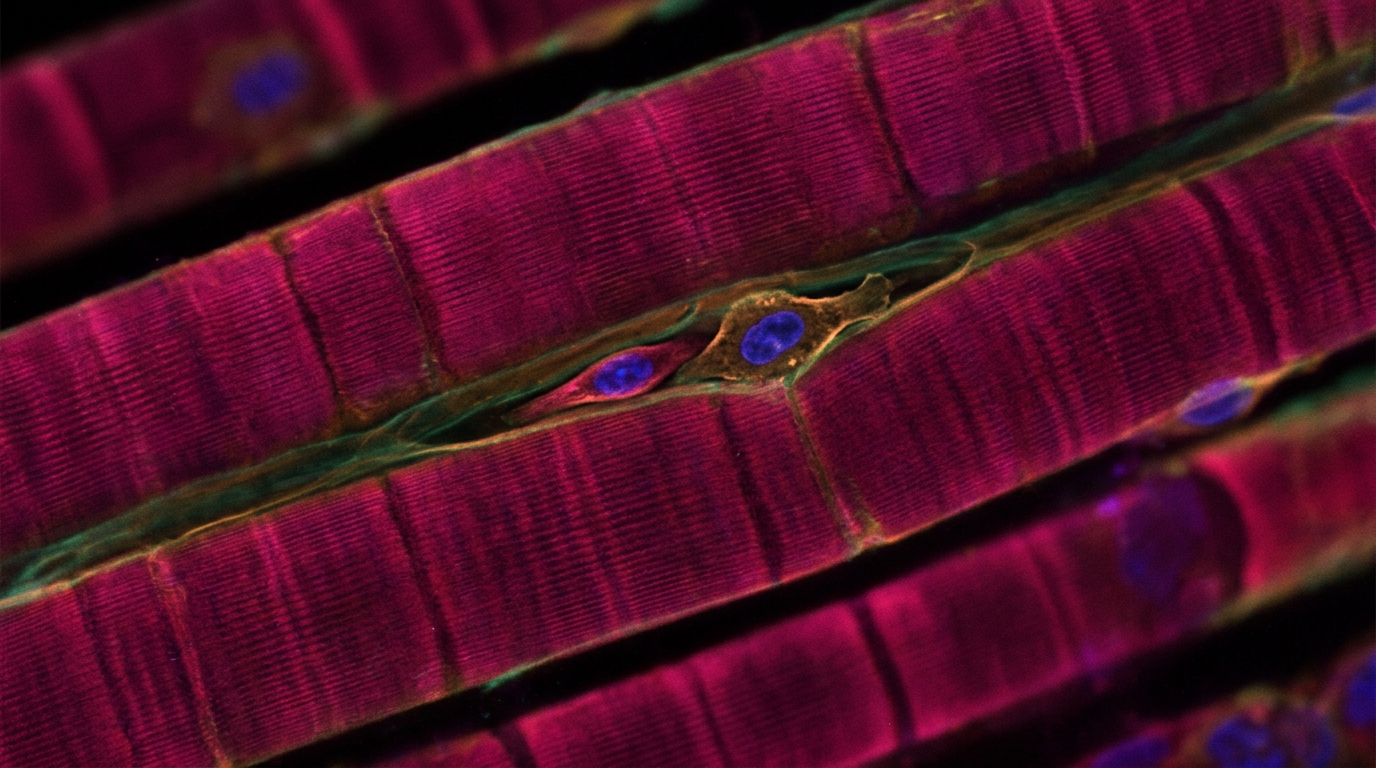
A single surface protein called CD90 splits the pool of muscle stem cells into two functionally different states, according to a study published in EMBO Reports. In both mouse and human muscle, roughly half of the quiescent satellite cells carry CD90 on their surface, and those CD90-positive cells exit dormancy faster than their CD90-negative counterparts.
Satellite cells, the muscle-specific stem cells marked by the transcription factor Pax7, normally sit in a poised, quiescent state and spring into action after damage, proliferating, differentiating and self-renewing to rebuild the tissue. Researchers have long known that this pool is molecularly heterogeneous, but only a handful of markers have been tied to actual functional differences. The new work adds CD90, a GPI-anchored protein also known as Thy-1, to that short list. Using flow cytometry on muscle digests from uninjured mice, the team found that CD90 expression divided the satellite cell compartment into two fractions of roughly equal size. The pattern held in reporter mice in which Pax7 or Myf5 drives a YFP label in satellite cells, and it was confirmed with an independent mass cytometry dataset from publicly available data.
Because the enzymatic digestion used to isolate stem cells can itself perturb quiescence, the researchers took precautions to show that the split exists in the intact tissue. They fixed muscle in situ before dissociation, a protocol that captures cells in their native resting state, and again found about half the satellite cells positive for CD90. Staining of gastrocnemius cryosections and of single fibers isolated from the soleus muscle confirmed the presence of both fractions in place. Quantitative PCR showed that the two fractions differ in CD90 transcript levels, pointing to transcriptional control of the split, and the team reported that CD90 expression does not simply overlap with previously described markers of satellite cell heterogeneity.
The functional divergence emerged in three experimental settings. First, when freshly sorted CD90-positive and CD90-negative cells were cultured briefly before their first division, the CD90-positive cells showed larger cell size, more MyoD protein and higher activity of the Rosa26 reporter, all readouts of activation, and they entered the cell cycle sooner. Second, in a needle-injury model of mouse hindlimb muscle, CD90-positive cells again grew larger and more active at the earliest time points and incorporated more EdU, a marker of DNA synthesis, at 1.5 and 2.75 days after injury. Third, in the GAlert paradigm, in which a distal injury places satellite cells into a partially activated, alert state, both fractions became alerted but the CD90-positive cells made the transition faster, as shown by cell size, phosphorylated S6, YFP intensity and mitochondrial content.
During regeneration the balance shifts and then resets. The CD90-positive fraction predominated in the early phase of repair, and by seven days after injury these cells showed higher levels of the differentiation marker Myogenin than their CD90-negative neighbors. Lineage experiments in culture suggested that CD90-positive cells can give rise to CD90-negative progeny, whereas the reverse was not observed, hinting that the CD90-positive state may sit upstream in the lineage hierarchy. After repeated injury-regeneration cycles the proportions of the two fractions returned to their starting values, indicating that the system is robust enough to restore its own balance.
The human side of the story mirrors the mouse. Flow cytometry on human muscle biopsies identified a CD90-positive fraction comprising roughly half of the satellite cells, and reanalysis of published single-cell RNA sequencing data found CD90-enriched clusters that still expressed myogenic markers. Ex vivo, human CD90-positive cells incorporated more EdU, confirming their faster activation. In an in vivo injury paradigm based on electrically stimulated eccentric contractions, human CD90-positive cells again showed greater activation, measured by cell size and the activation marker CD82, and their proportion rose significantly after injury, consistent with increased proliferation.
CD90 is not merely a passive label. When the researchers silenced CD90 with interfering RNA in freshly isolated cells, activation and proliferation dropped in the CD90-positive fraction, while the CD90-negative fraction was unaffected. Conversely, forcing CD90 expression in quiescent C2C12 reserve cells enhanced MYOD expression and EdU incorporation upon stimulation. The team then traced a metabolic link: both murine and human CD90-positive satellite cells carried more of the active, phosphorylated form of AMPK, a master regulator of mitochondrial biogenesis and a known modulator of stem cell activation. Silencing CD90 lowered active AMPK in CD90-positive cells, and inducing CD90 in C2C12 reserve cells raised it. Administering the AMPK activator AICAR in vivo accelerated cell-cycle entry after injury in both fractions, reaching statistical significance in the CD90-positive fraction. In a separate cohort of people who underwent low-load blood flow-restricted resistance exercise, a protocol that boosts mitochondrial function, the number of CD90-positive satellite cells increased without a change in the CD90-negative pool.
Activation needs a brake, and the study identifies one in the extracellular matrix. Single-cell RNA sequencing datasets showed that CD90-positive satellite cells are enriched for genes encoding extracellular matrix components, with Collagen VI among the most differentially expressed. Quantitative PCR confirmed higher Col6 transcript levels in quiescent CD90-positive cells, and immunostaining revealed more Collagen VI protein in the niche surrounding them. When sorted cells were plated on Collagen VI-coated dishes instead of Collagen IV, MyoD levels and EdU incorporation fell, an effect that was statistically significant in the CD90-positive fraction. The receptor for this signal appears to be the Calcitonin receptor, CALCR, which was more abundant in CD90-positive cells at both protein and transcript levels. An enzyme-linked immunosorbent assay showed that Collagen VI binds CALCR specifically, while Collagen IV and Collagen I bound poorly, and the quiescence-promoting effects of Collagen VI resembled those of Collagen V, which was previously shown to bind CALCR. Downstream, exposure to Collagen VI reduced nuclear YAP, a hallmark of active CALCR signaling, and a PKA inhibitor released CD90-positive cells from this restraint, supporting a Collagen VI-CALCR-PKA axis that holds the fast-activating fraction in check.
Genetic removal of Collagen VI in Col6a1-deficient mice confirmed the brake in vivo. Satellite cells in these animals showed signs of activation, and the response was strongest in the CD90-positive fraction, which displayed a significant increase in cell size. Marked cells progressed toward terminal differentiation, with EdU-labeled nuclei appearing in newly formed embryonic myosin-positive fibers and in differentiating MyoD- and Myogenin-positive cells. The same mice showed a perturbed balance between the two fractions, with significantly fewer CD90-positive cells than CD90-negative ones. A similar imbalance appeared in mdx mice, a model of Duchenne muscular dystrophy, where the CD90-positive fraction was specifically lost, a loss that worsened with age and was most dramatic in the diaphragm, the muscle with the most severe dystrophic pathology.
To test whether the CD90-positive fraction matters for repair, the researchers depleted CD90-positive cells in vivo with antibodies before and after injury. The depletion strategy does not uniquely target satellite cells, a limitation the authors acknowledge, but flow cytometry confirmed effective loss of CD90-positive satellite cells, and regenerating muscles showed smaller newly formed fibers at 4.5 days after injury without a significant change in the interstitial fraction of the tissue. They note that Collagen VI is also produced by other muscle-resident and non-muscle cells, so the phenotype cannot be attributed exclusively to stem-cell-derived Collagen VI, and they call for future studies to clarify the molecular link between CD90 and AMPK and the regenerative potential of the dormant CD90-negative fraction.
Subject of Research: Functional heterogeneity of muscle satellite cells defined by CD90 expression, linking activation kinetics, AMPK signaling and Collagen VI-CALCR quiescence control in mouse and human muscle
Article Title: CD90 delineates distinct muscle stem cell states of quiescence and activation
Article References: Kheir, E., Libergoli, M., Savino, S. D., Metti, S., Jensen, J. B., Wang, J., Jessen, N., Florio, F., Murganti, F., Marramiero, L., Belicchi, M., Villa, C., Vissing, K., Verma, M., Giordani, L., Bonaldo, P., Torrente, Y., Farup, J., & Biressi, S. (2026). CD90 delineates distinct muscle stem cell states of quiescence and activation. EMBO Reports. https://doi.org/10.1038/s44319-026-00980-5
Image Credits: AI Generated
DOI: 10.1038/s44319-026-00980-5
Keywords: muscle stem cells, satellite cells, CD90, quiescence, activation, AMPK, Collagen VI, Calcitonin receptor, muscle regeneration, muscular dystrophy, GAlert state, extracellular matrix
News Source: Drew Townsend. (November 6, 2026). CD90 Splits Muscle Stem Cells Into Fast-Activating and Dormant States. Scienmag.