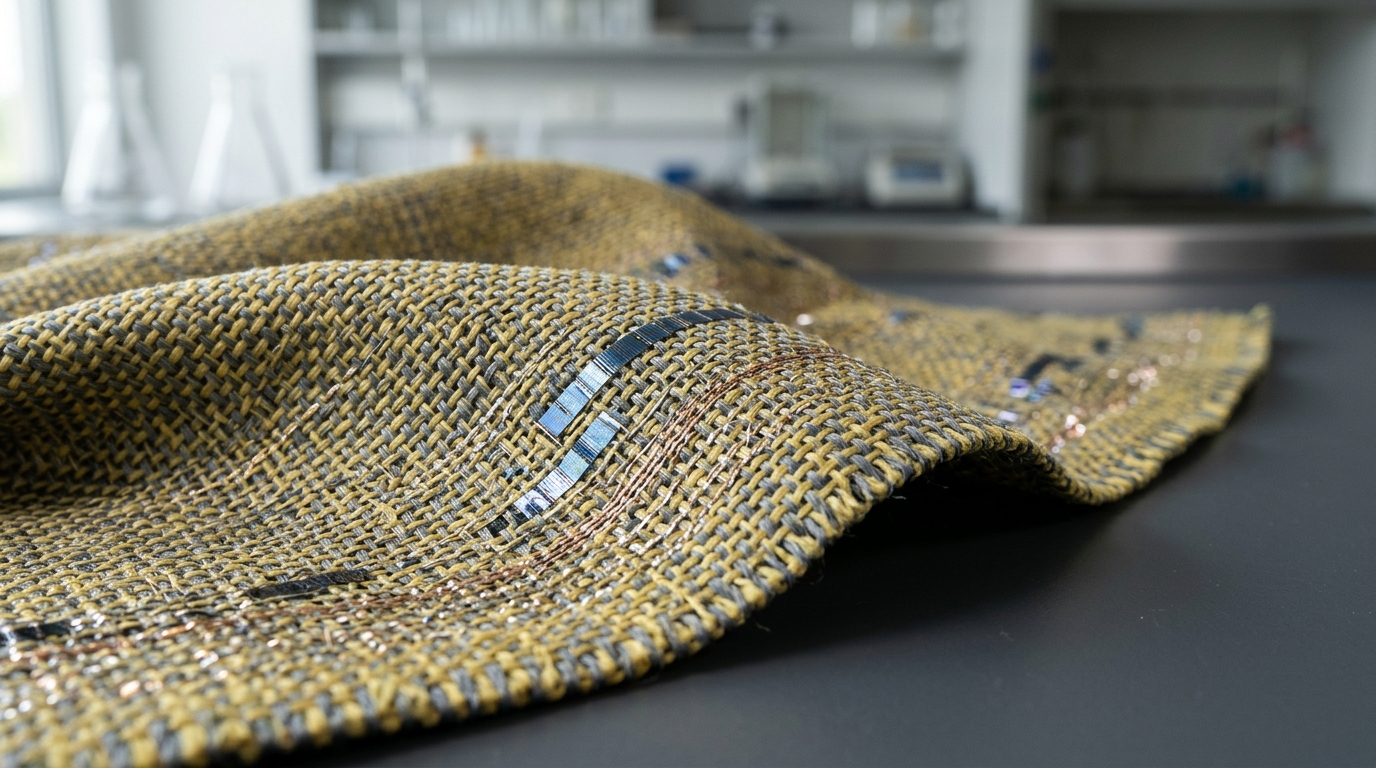
Researchers have woven solar energy storage and self-powered motion sensing into a single piece of fabric. A team reporting in Advanced Composites and Hybrid Materials describes a woven Kevlar textile coated with molecular solar thermal storage capsules and grown with semiconductor nanoflakes, producing a material that can soak up sunlight, hold that energy as a stable molecular state, release it as heat on demand, and simultaneously generate enough electrical power to detect human movement without any external battery.
In this work the switching molecule is azopyridine, encapsulated into nanocapsules and spin-coated onto fibers that had first been grown with zinc-molybdenum-selenide nanoflakes.
Structural and spectroscopic analyses confirmed that the nanoflakes grew conformally on the fibers and that the microcapsules retained their integrity through repeated photocharging and discharging cycles, a durability point that matters for any wearable intended to survive daily use. The reversible photoswitching itself was substantial: the team measured 98.8 percent conversion under 365-nanometer ultraviolet light and 97.8 percent back-conversion under 520-nanometer visible light, meaning the fabric can be cycled between its energy-storing and energy-releasing states with very little loss in either direction.
The performance numbers for storage are equally specific. The composite textile achieved an energy density of 457 joules per gram and a storage lifetime of 98 hours, with a maximum heat-release temperature of 56.4 degrees Celsius. Compared with bare woven Kevlar fabric, the finished composite showed a 77.1 percent increase in tensile strength, so the added functional layers did not weaken the textile but reinforced it.
One of the more striking features is that the fabric reports its own state visually. The color of the textile evolves in step with the stored thermal energy, so a wearer or observer can tell at a glance how much energy the material is holding without any electronics or readout display.
The second half of the functionality comes from the triboelectric nanogenerator, or TENG, built into the same textile. The Zn-Mo-Se-MOST textile delivered a power density of 1.7 milliwatts per square centimeter, which the authors describe as high output for this class of device. That output was sufficient to drive stable, self-powered detection of human motion and tactile gestures, meaning the fabric senses movement using only the electricity it generates from that same movement.
Combining these functions in one platform addresses a gap the authors identify in prior work. Earlier smart textiles incorporating molecular solar thermal storage had been limited to microencapsulated azo-switches used for thermoregulation alone, and integrated energy harvesting combined with self-powered sensing had barely been explored. By layering the MOST capsules onto nanoflake-grown fibers, the team achieved what they call system-level integration of multifunctional capabilities, rather than a single-purpose coating.
The practical implications span both energy and sensing.
Still, the combination of mechanical robustness, reversible switching with high conversion percentages, a 98-hour storage lifetime, and a heat-release temperature suited to human contact marks a concrete step toward wearable platforms that harvest, store, and spend solar energy while simultaneously powering their own sensing, all within the weave of a single fabric.
Subject of Research: A multifunctional woven Kevlar textile composite that integrates molecular solar thermal energy storage with triboelectric nanogenerator-based self-powered motion sensing.
Article Title: Photo-switchable molecular solar thermal fabric composite for solar energy storage and self-powered motion sensing
Article References: Hazarika, A., Deka, B. K., Lee, D., Han, J., Hwang, Y. J., Mun, C. H., & Park, H. W. (2026). Photo-switchable molecular solar thermal fabric composite for solar energy storage and self-powered motion sensing. Advanced Composites and Hybrid Materials. https://doi.org/10.1007/s42114-026-02170-2
Image Credits: AI Generated
DOI: 10.1007/s42114-026-02170-2
Keywords: molecular solar thermal, smart textiles, Kevlar fabric, triboelectric nanogenerator, solar energy storage, azopyridine, wearable sensors, Zn-Mo-Se nanoflakes, thermoregulation, self-powered sensing, energy density, photo-switching
News Source: Faith Mcneil. (November 6, 2026). Kevlar textile stores solar energy and powers motion sensing in one fabric. Scienmag.