• HOME
  • NEWS
  • EXPLORE
    • CAREER
      • Companies
      • Jobs
    • EVENTS
    • iGEM
      • News
      • Team
    • PHOTOS
    • VIDEO
    • WIKI
  • BLOG
  • COMMUNITY
    • FACEBOOK
    • INSTAGRAM
    • TWITTER
Friday, November 6, 2026
BIOENGINEER.ORG
No Result
View All Result
  • Login
  • HOME
  • NEWS
  • EXPLORE
    • CAREER
      • Companies
      • Jobs
        • Lecturer
        • PhD Studentship
        • Postdoc
        • Research Assistant
    • EVENTS
    • iGEM
      • News
      • Team
    • PHOTOS
    • VIDEO
    • WIKI
  • BLOG
  • COMMUNITY
    • FACEBOOK
    • INSTAGRAM
    • TWITTER
No Result
View All Result
Bioengineer.org
No Result
View All Result
Home NEWS Science News Technology

Physics-Informed Graph Network Improves Fatigue Life Prediction for Robotic Arms

by
November 6, 2026
in Technology
Reading Time: 2 mins read
0
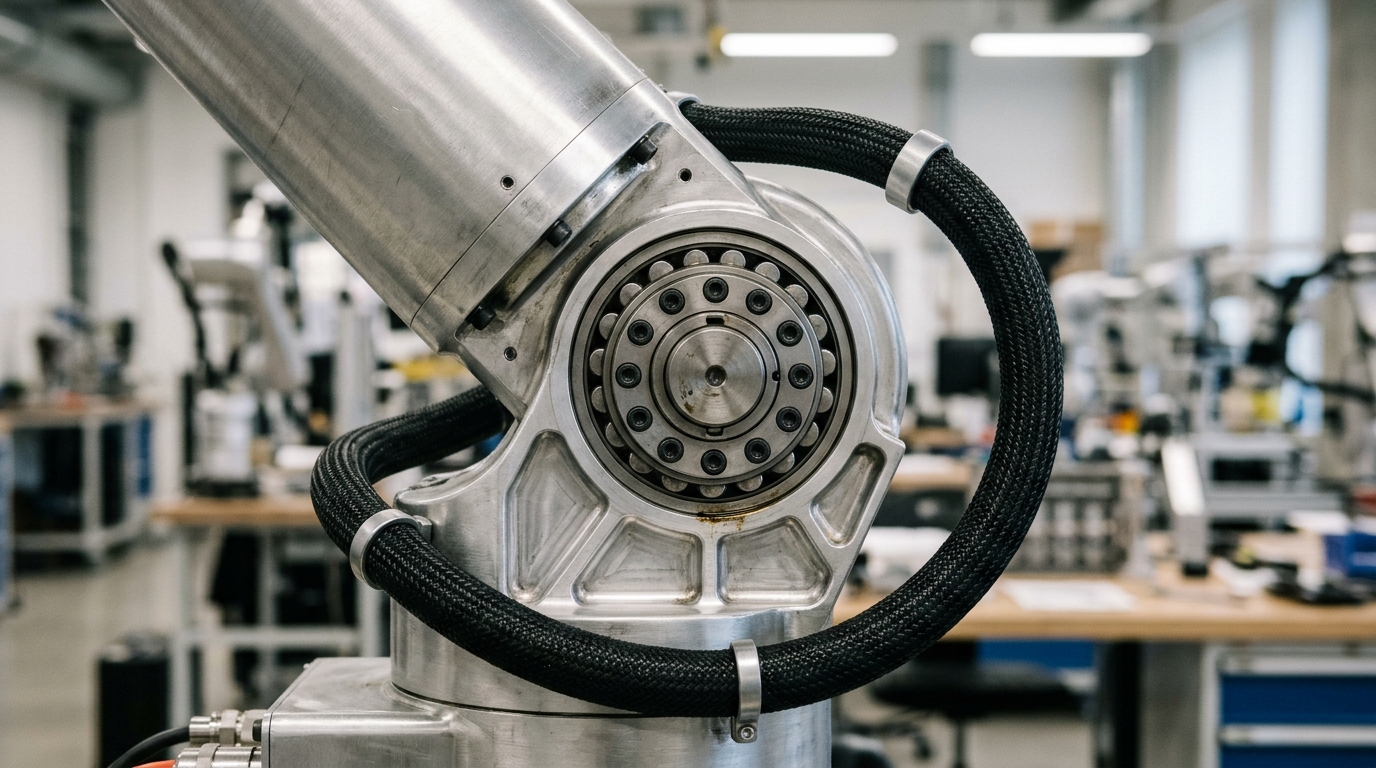
Physics-Informed Graph Network Improves Fatigue Life Prediction for Robotic Arms

Physics-Informed Graph Network Improves Fatigue Life Prediction for Robotic Arms

Share on FacebookShare on TwitterShare on LinkedinShare on RedditShare on Telegram

A physics-informed Graph Attention Network model achieved an overall average prediction accuracy of 92.48% for the fatigue life of industrial robotic arms evaluated on a mixed full-condition test set. Across specific operational subsets, the proposed model attained prediction accuracies of 96% to 97% under low-load conditions, 94% to 97% under medium-load conditions, and 93% to 95% under heavy-load conditions. In comparative evaluations, benchmark comparison models reached 91% to 94% accuracy under low-load conditions but decreased to between 88% and 92% under heavy-load conditions.

The research addresses operational settings where industrial robotic arms experience changing load conditions over extended time periods, leading to joint fatigue accumulation that can trigger sudden operational failures. To overcome limitations in conventional life-prediction methods that struggle to integrate spatial topology, temporal degradation patterns, and physical mechanics, the architecture maps robotic arm joints into a topology-mechanics graph. Spatiotemporal features are extracted through dynamic graph attention and temporal units, while a joint loss function incorporates physics regularization.

The framework directly embeds the Miner damage criterion alongside a stiffness-degradation model to achieve end-to-end fatigue-life prediction under variable-load scenarios. Conducted by researcher Jia Guo at Sias University, the investigation demonstrated improved accuracy and robustness under varying load conditions. The author noted that the approach provides technical support for predictive maintenance and health management of industrial robotic arms.

Subject of Research: Fatigue life prediction in industrial robotic arms using physics-informed neural networks

Article Title: Fatigue life prediction of variable-load industrial robotic arms based on physics-informed graph neural networks

Article References: Guo, J. (2026). Fatigue life prediction of variable-load industrial robotic arms based on physics-informed graph neural networks. Frontiers in Mechanical Engineering, 12, Article 2006613. https://doi.org/10.3389/fmech.2026.2006613

Image Credits: AI Generated

DOI: 10.3389/fmech.2026.2006613

Keywords: Robotic arms, Fatigue life prediction, Graph neural networks, Physics-informed machine learning, Miner damage criterion, Predictive maintenance, Multi-body simulation, Structural mechanics, Fatigue, life, prediction, variable-load

News Source: Katie Riggs. (November 6, 2026). Physics-Informed Graph Network Improves Fatigue Life Prediction for Robotic Arms. Scienmag.


Tags: fatiguefatigue life predictiongraph neural networksLifeMiner damage criterionmulti-body simulationPhysics-Informed Machine LearningpredictionPredictive MaintenanceRobotic armsstructural mechanicsvariable-load
Share12Tweet7Share2ShareShareShare1

Related Posts

Dual Constrained Neural Network Accelerates Robot Path Planning on Grid Maps

Dual Constrained Neural Network Accelerates Robot Path Planning on Grid Maps

November 6, 2026
Machine Learning Classifies Urban Heat Patterns Directly from Radiant Temperature Data

Machine Learning Classifies Urban Heat Patterns Directly from Radiant Temperature Data

November 6, 2026

Study Evaluates Artificial Intelligence Integration in Sustainable Apparel Design and Production

November 6, 2026

Magnolia Bark Compounds Evaluated for Antioxidant Activity and Apoptosis Protein Interactions

November 6, 2026

POPULAR NEWS

  • Green Incentives Cannot Bridge Profitability Gap in European Kelp Cultivation

    Green Incentives Cannot Bridge Profitability Gap in European Kelp Cultivation

    29 shares
    Share 12 Tweet 7
  • Rethinking Continuous Endpoints in Clinical Decision Analysis Through Decision Curves

    29 shares
    Share 12 Tweet 7
  • Physics-Informed Graph Network Improves Fatigue Life Prediction for Robotic Arms

    29 shares
    Share 12 Tweet 7
  • Researchers Propose Dynamical Systems Framework for Complex Emotional Needs

    29 shares
    Share 12 Tweet 7

About

We bring you the latest biotechnology news from best research centers and universities around the world. Check our website.

Follow us

Recent News

Crotonylation Boost Keeps Aging Stem Cells Fighting Gut Inflammation

Lightweight Edge Computing Model Dynamically Segments Citrus Flowers and Developing Fruitlets

Dual Constrained Neural Network Accelerates Robot Path Planning on Grid Maps

Subscribe to Blog via Email

Enter your email address to subscribe to this blog and receive notifications of new posts by email.

Join 86 other subscribers
  • Contact Us

Bioengineer.org © Copyright 2023 All Rights Reserved.

Welcome Back!

Login to your account below

Forgotten Password?

Retrieve your password

Please enter your username or email address to reset your password.

Log In
No Result
View All Result
  • Homepages
    • Home Page 1
    • Home Page 2
  • News
  • National
  • Business
  • Health
  • Lifestyle
  • Science

Bioengineer.org © Copyright 2023 All Rights Reserved.