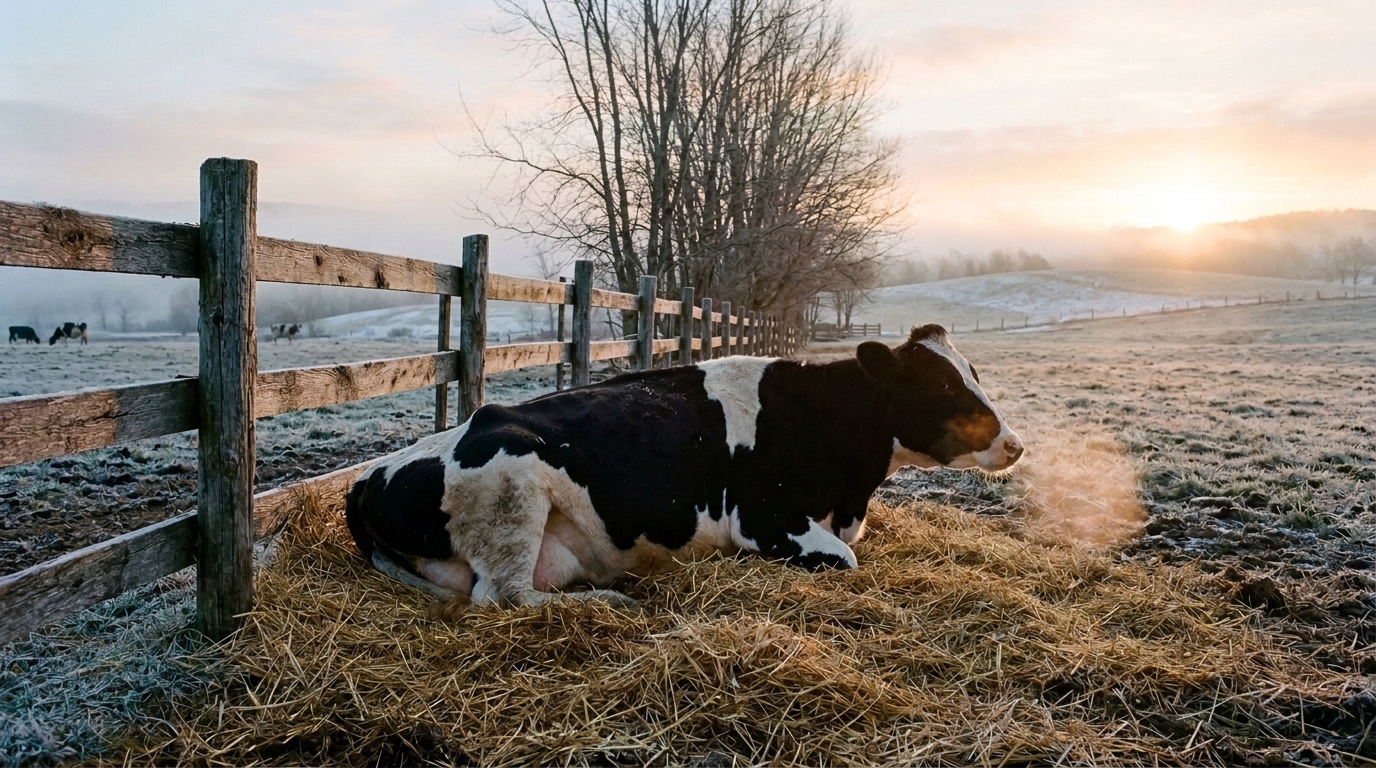
Dairy cows kept outdoors in winter do not simply drop their calves wherever they happen to be standing. When given a choice among a natural shelter with bushes and trees, small artificial shelters, and a large open paddock, the animals split their calving sites across all three options, and the choice appeared to depend on the cow herself and on the weather. That is the central finding of a new observational study of prepartum dairy cattle managed on pasture during the cold season, a period when little is known about how cows select calving locations in outdoor systems.
The research team enrolled 48 pregnant dairy cows, 17 of them first-time mothers and 31 multiparous animals, in an 8,450 square meter paddock. The paddock offered three distinct potential calving areas. The natural shelter covered 440 square meters and consisted of bushes and trees with straw bedding on the ground. The artificial shelter option comprised three structures, each 18 square meters, with three walls and a straw bed. The remaining 7,956 square meters formed the open paddock. Continuous video monitoring recorded where 36 cows actually gave birth, providing the calving location data for the analysis.
The distribution of calving sites was far from uniform. Of the 36 recorded calvings, 38.9 percent occurred in the natural shelter, 16.7 percent in the artificial shelters, and 44.4 percent in the open paddock. In other words, more than half of the cows chose one of the sheltered areas, while a substantial share still calved in the open. The researchers then used multinomial logistic regression to identify factors associated with the odds of calving in each area relative to the open paddock.
Parity emerged as a significant factor. A higher lactation number was associated with lower odds of calving in the natural shelter compared with the open paddock, with an odds ratio of 0.587 and a 95 percent confidence interval of 0.365 to 0.943, reaching statistical significance at p = 0.028.
Weather also left its mark on the data. Cumulative rainfall increased the odds of calving in the artificial shelters, with an odds ratio of 1.195 and a 95 percent confidence interval of 0.980 to 1.456, a tendency that approached but did not reach conventional significance at p = 0.078. In addition, a higher calf-to-dam weight ratio tended to be related to greater odds of calving in the natural shelter, with an odds ratio of 3.047 and a 95 percent confidence interval of 0.000 to 9.288, at p = 0.050. The authors interpret these patterns as evidence that the selection of sheltered areas was associated with both individual characteristics of the cow-calf pair and the prevailing winter weather conditions.
Beyond the birth site itself, the study examined how cows spent the final 24 hours before calving. Prepartum exploratory behavior was assessed using 10-minute instantaneous scan sampling from video recordings for 23 of the cows. The descriptive analysis showed that cows that ultimately calved in the artificial shelters spent approximately one third of the 24-hour prepartum period in that area, averaging 6.33 plus or minus 4.02 hours per day. Cows that calved in the natural shelter spent a similar share of time there, averaging 7.82 plus or minus 3.68 hours per day.
The timing of these visits was equally telling. The researchers observed that visits to the calving areas appeared to concentrate during the hours closest to parturition, meaning that as birth approached, the use of sheltered areas increased.
The broader context for this work is the growing interest in pasture-based dairy systems, which may facilitate the expression of natural calving behavior by allowing cows to move away from the group. Before calving, dairy cows may seek a secluded area, and access to varied terrain could support that motivation.
The study’s conclusions are framed carefully. The authors state that their results indicate dairy cows allocated outdoors during winter select both sheltered and open areas to calve, and that the selection of sheltered areas was associated with individual factors and winter weather conditions. The descriptive behavioral data suggest that as parturition approached, the use of sheltered areas increased. Because the behavioral findings rest on scan sampling of a subset of animals and the regression results include some estimates with wide confidence intervals, the patterns should be read as associations observed in this particular herd and setting rather than as universal rules.
The work adds to a small but growing body of evidence on how outdoor winter management interacts with the natural calving behavior of dairy cattle, a topic the authors flag as central to welfare in pasture-based systems.
Subject of Research: Calving area selection and prepartum exploratory behavior of dairy cows managed outdoors in winter with access to natural and artificial shelters.
Article Title: Calving area selection and prepartum behavior of dairy cows managed outdoors with access to artificial and natural shelters during winter
Article References: Pavez-Muñoz, E., Romero-Aguilera, P., & Sepúlveda-Varas, P. (2026). Calving area selection and prepartum behavior of dairy cows managed outdoors with access to artificial and natural shelters during winter. Frontiers in Animal Science, 7, Article 1977351. https://doi.org/10.3389/fanim.2026.1977351
Image Credits: AI Generated
DOI: 10.3389/fanim.2026.1977351
Keywords: dairy cows, calving behavior, parturition, pasture-based systems, secluded areas, animal welfare, natural shelter, artificial shelter, winter paddock, prepartum behavior, multinomial logistic regression, Calving
News Source: Drew Townsend. (November 6, 2026). Dairy cows choose where to calve in winter paddocks, study finds. Scienmag.