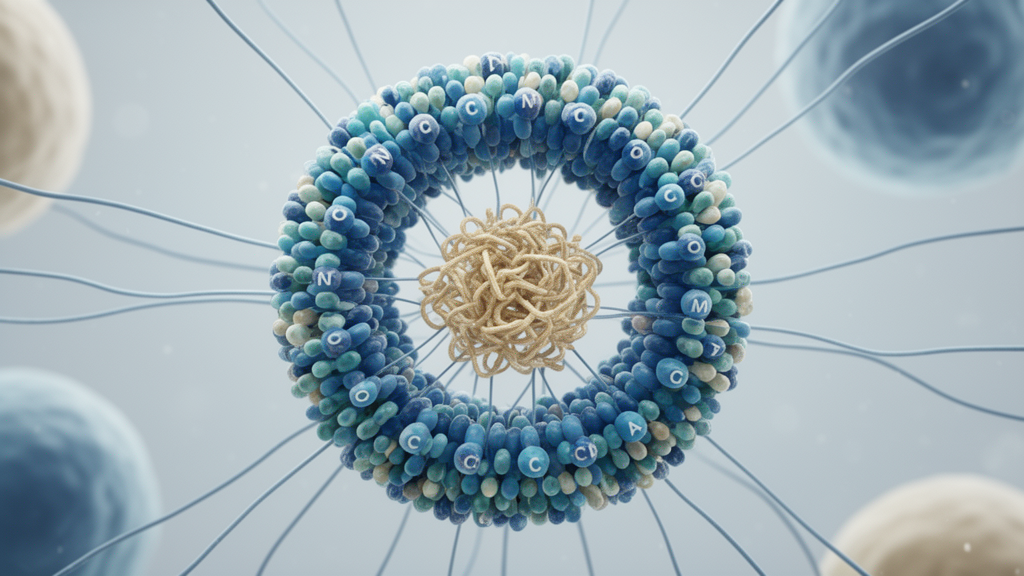
Researchers at the University of Osaka and their collaborators have identified a previously unresolved architecture for the constitutive centromere-associated network, or CCAN: in chicken DT40 cells, the protein complex assembles into a hollow, spherical shell within the cell nucleus. The structure was most pronounced during interphase, before cell division, when each chromosome’s kinetochore contains multiple CCAN units. Supercomputer simulations predicted that the protein CENP-C forms the shell’s central core by clustering around DNA, while CENP-T and CENP-N occupy its surface. Expansion microscopy and other high-resolution imaging methods revealed a shell-like arrangement consistent with those predictions. The experimental study, published in Science Advances as “CCAN forms the spherical shell-like structure in interphase kinetochores,” examined how individual molecular components combine to build a chromosome-associated structure large enough to coordinate cell division.
CCAN forms the foundation of the kinetochore, the larger protein assembly that connects a chromosome to the machinery pulling chromosomes toward opposite poles during division. Earlier work had detailed the structure of a single CCAN unit, but each kinetochore contains dozens of these units, leaving their collective organization inside cells uncertain. The new study combines molecular simulations with cellular imaging to address that scale between individual proteins and whole chromosomes. In the model, DNA-bound CENP-C molecules cluster near the center of the assembly. Their interactions arrange the remaining CCAN proteins into an orderly outer layer, producing a shell rather than an irregular collection of separate complexes. The imaging results support this model: the CCAN signal appeared as a shell-like structure in chicken cells, with CENP-C at the core and CENP-T and CENP-N positioned toward the exterior.
The researchers also tested whether this arrangement is necessary for chromosome inheritance. When CENP-C was removed or prevented from binding to DNA, the shell failed to form properly, and the affected cells showed defective chromosome segregation. These results support the conclusion that the ordered shell-like organization of CCAN is important for faithful chromosome separation, linking the architecture observed before division to its cellular function. The findings concern molecular organization and chromosome behavior in the experimentally studied cells; the release does not establish that altered CCAN structure causes chromosome-number errors in people or that targeting it would prevent cancer or improve an existing treatment. Instead, the work provides a mechanistic description of how one essential component of the kinetochore is assembled and identifies CENP-C as indispensable for building the observed structure.
The study also demonstrates how computational modeling and high-resolution microscopy can work together to visualize supramolecular assemblies. Expansion microscopy physically enlarges cell samples so that structures too small to resolve clearly by conventional methods can be inspected, while the simulations generate a testable prediction about how the proteins might be arranged. The predicted CENP-C core and surrounding shell were then observed in cells, strengthening the interpretation of both approaches. Because errors in chromosome segregation can give daughter cells abnormal chromosome numbers—a common feature of many cancers—the researchers say that understanding kinetochore construction may offer insight into how such errors arise. That broader clinical relevance remains prospective, however; the current evidence comes from simulation, molecular imaging and experimental manipulation in cells rather than patient data or clinical outcomes.
Subject of Research: Molecular organization of the CCAN kinetochore complex before cell division
Article Title: Shell game: Chromosome anchors become spherical before cell division
Article References: Shell game: Chromosome anchors become spherical before cell division. Original publication (Bibliographic details unavailable.)
Image Credits: AI Generated
DOI: Not provided
Keywords: CCAN, CENP-C, kinetochore, centromere, chromosome segregation, cell division, protein architecture, expansion microscopy, supercomputer simulation, chicken DT40 cells, Shell, game
News Source: Bethany Barker. (October 26, 2026). CCAN protein complex forms spherical shell before cell division. Scienmag.