Bio-based plastics made by bacterial fermentation could become cheaper and more versatile if inexpensive mineral fillers are blended into them without ruining their rubber-like character. A new open-access study in Discover Polymers reports one of the first systematic tests of that idea for a sulfur-vulcanized polyhydroxyalkanoate, a class of microbially produced polymers whose unsaturated side chains can be crosslinked much like natural rubber. The researchers found that the dose of calcium carbonate, a cheap and widely available inorganic powder, changed the material’s mechanical profile in distinct ways: a small dose slightly strengthened and toughened the vulcanized film, while a large dose maximized how far it could stretch and how stiff it was at the start of deformation.
The polymer at the center of the work is poly(3-hydroxybutyrate-co-3-hydroxy-5-hexenoate), abbreviated P(3HB-co-3H5HE). Polyhydroxyalkanoates, or PHAs, are synthesized by microorganisms from carbon sources, and their monomer composition and side-chain structure strongly influence crystallinity and, with it, mechanical behavior, spanning materials from rigid, brittle thermoplastics to soft, flexible ones. The 3HB homopolymer is typically highly crystalline, rigid and brittle, whereas 3HB-based copolymers are softer and more flexible because crystallinity is reduced. The copolymer used here carried 47 mol% 3H5HE units, which contain unsaturated side chains that serve as reactive sites for sulfur crosslinks and simultaneously suppress crystallinity, yielding a flexible material with high elongation that is well suited to vulcanization.
To make the material, the team used recombinant Escherichia coli LS5218 harboring a plasmid for PHA production. Cells were grown in shake flasks at 30 degrees Celsius for 72 hours in a modified M9 medium supplemented with glucose, sodium 5-hexenoate and IPTG. The fermentation yielded P(3HB-co-47 mol% 3H5HE) at a PHA concentration of 0.45 g/L, corresponding to 21.2 wt% PHA content in the dried cells. The polymer was extracted from freeze-dried cells with chloroform, filtered, concentrated and precipitated in methanol to obtain purified material for compounding.
Vulcanization followed a solvent-free sulfur cure system containing zinc oxide, stearic acid, the accelerator 2-mercaptobenzothiazole and sulfur. Roughly 100 mg of copolymer per batch was masticated for one minute at 50 degrees Celsius, then the additives were stirred in sequentially, with calcium carbonate added before sulfur, over a total mixing time of ten minutes. The compound was hot-pressed into sheets at 75 degrees Celsius, rolled repeatedly, stabilized for two days, and finally compression-molded into films at 155 degrees Celsius for a two-minute cure time chosen in preliminary screening experiments and kept constant across all formulations so that filler effects could be compared directly. Four filler levels were tested: 0, 10, 30 and 50 parts per hundred resin, abbreviated phr.
Mechanical testing on dumbbell-shaped specimens with a Shimadzu universal testing machine showed that sulfur vulcanization itself was transformative. Compared with the unvulcanized copolymer film used as a reference, the vulcanized samples substantially increased tensile strength, elongation at break, Young’s modulus and toughness, and all of them stretched to roughly 800 to 1000% before breaking, confirming highly extensible, rubber-like behavior. Adding 10 phr of calcium carbonate pushed tensile strength from 6.3 to 7.1 MPa and elongation at break from 813 to 839%, and this sample also posted the highest toughness at 33 MJ/m3, a balance the authors attribute to likely good dispersion of filler particles and efficient stress transfer from polymer chains to filler during deformation.
Higher loadings told a more complicated story. At 30 phr, both tensile strength and elongation at break fell, a pattern linked to the reduced fraction of polymer available to bear tensile stress, restricted chain mobility and possible particle agglomeration that concentrates stress and promotes crack initiation. At 50 phr, tensile strength stayed low but elongation at break rose to 1019%, the highest of the series, which the authors connect to changes in deformation behavior around or between filler-rich regions and at filler-matrix interfaces. Young’s modulus increased with calcium carbonate addition across the board, consistent with rigid inorganic particles raising resistance to initial elastic deformation. Notably, no significant variation in crosslink density was observed between filled and unfilled samples, so the mechanical trends could not be clearly correlated with crosslink density.
Swelling experiments in chloroform added a subtler layer of interpretation. All samples showed high gel fractions of about 92 to 93%, confirming that sulfur vulcanization formed insoluble three-dimensional networks regardless of filler content, with no significant gel-fraction differences among formulations. The unfilled sample swelled the most, at 655%, while 10 phr calcium carbonate cut the swelling ratio to 267%; at 30 and 50 phr the ratio rose again to 413% and 453%, respectively. The authors suggest that reduced swelling may reflect non-swelling inorganic particles, a reduced polymer fraction, physical confinement, restricted solvent diffusion and polymer-filler interactions, while higher loadings may change filler distribution and aggregation. They are careful to note a limitation: because calcium carbonate and zinc oxide are insoluble in chloroform and remain in the dried residues, and no correction for their mass was applied, the swelling results cannot demonstrate changes in the chemical crosslink density of the vulcanized PHA.
Elemental analysis and thermogravimetric analysis corroborated the filler’s presence and its thermal neutrality. As calcium carbonate content increased, carbon and hydrogen contents decreased and ash content climbed progressively from 3.6% in the unfilled vulcanizate to 19.8% at 50 phr, although the authors caution that the high-temperature analysis, at 950 degrees Celsius, may decompose calcium carbonate into calcium oxide and carbon dioxide, so the values should be interpreted with care. A small amount of nitrogen was detected, attributable to the MBT accelerator. In TGA, the temperature of 5% weight loss was essentially unchanged, 250 degrees Celsius for the unfilled and 10 phr samples and 247 degrees Celsius at 30 and 50 phr, a difference of only about 3 degrees that may fall within experimental variability, so no definitive conclusion about the onset of thermal degradation can be drawn from it alone. The maximum degradation temperature shifted slightly downward with increasing filler content, and residual mass rose systematically with filler loading, since calcium carbonate remains stable up to about 600 to 800 degrees Celsius and contributes directly to residue.
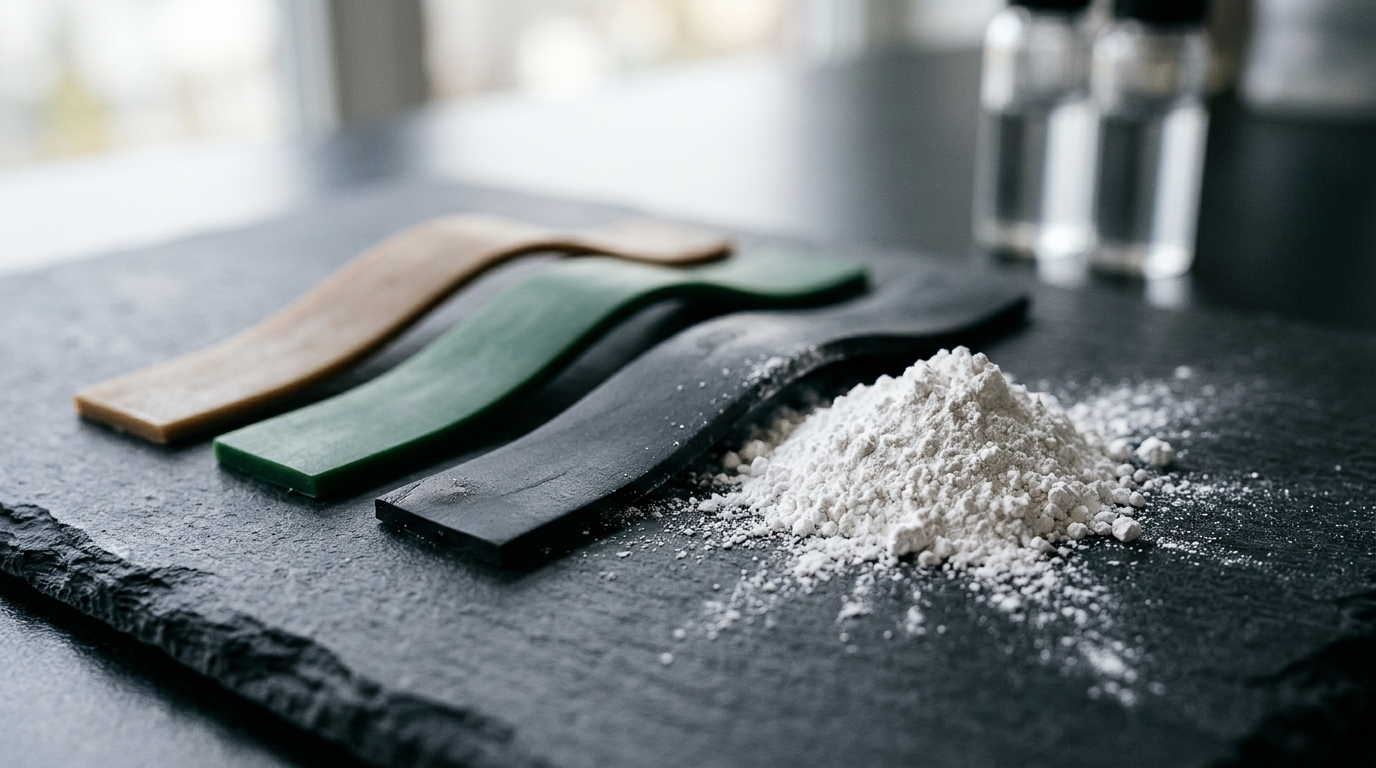
Microscopy revealed why the mechanical trends make sense. Scanning electron microscopy at 100-fold magnification showed a smooth, homogeneous surface for the unfilled vulcanizate, while adding calcium carbonate increased surface roughness and particle clustering. The 10 phr sample showed relatively well-distributed particles in the observed region, the 30 phr sample showed small dispersed particles with no obvious agglomeration at that loading, and the 50 phr sample displayed clear agglomeration, indicating that the dispersion limit of calcium carbonate in the polymer matrix had been exceeded. Interestingly, the macroscopic films looked progressively more uniform and visually smoother as filler was added, with a whitish, opaque appearance imparted by the inherently white calcium carbonate, but the authors stress that this visual smoothness does not necessarily indicate lower surface roughness at the microscopic scale.
The practical upshot is a recipe for tuning rather than a single best formulation. Because calcium carbonate is a non-reinforcing filler for this PHA, its effect on tensile strength is slight, but the loading level steers the material between toughness at 10 phr, reduced strength at 30 phr, and maximum extensibility and stiffness at 50 phr, all while cutting the amount of expensive resin needed in the formulation. The study also fills a gap: previous work had examined sulfur vulcanization of unsaturated PHAs and filler incorporation into non-vulcanized PHA composites, but the authors report that no prior studies had addressed filler effects in sulfur-vulcanized PHA systems. For anyone trying to turn bacterial plastics into affordable rubber-like goods, the message is that the filler’s dose, dispersion and interaction with the crosslinked network must be balanced carefully, since the same mineral that reinforces at low loading can agglomerate, concentrate stress and reshape deformation behavior at high loading.
Subject of Research: Effects of calcium carbonate filler loading on sulfur-vulcanized polyhydroxyalkanoate composites
Article Title: Characterization of vulcanized polyhydroxyalkanoate composites filled with calcium carbonate
Article References: Khamjapo, P., Miyahara, Y., & Tsuge, T. (2026). Characterization of vulcanized polyhydroxyalkanoate composites filled with calcium carbonate. Discover Polymers, 3(1), Article 33. https://doi.org/10.1007/s44347-026-00075-3
Image Credits: AI Generated
DOI: 10.1007/s44347-026-00075-3
Keywords: polyhydroxyalkanoates, calcium carbonate, sulfur vulcanization, P(3HB-co-3H5HE), mechanical properties, swelling ratio, thermogravimetric analysis, filler loading, bio-based plastics, recombinant Escherichia coli, tensile strength, rubber-like materials
News Source: Bethany Barker. (November 5, 2026). Calcium carbonate fine-tunes vulcanized bio-based rubber-like plastic. Scienmag.