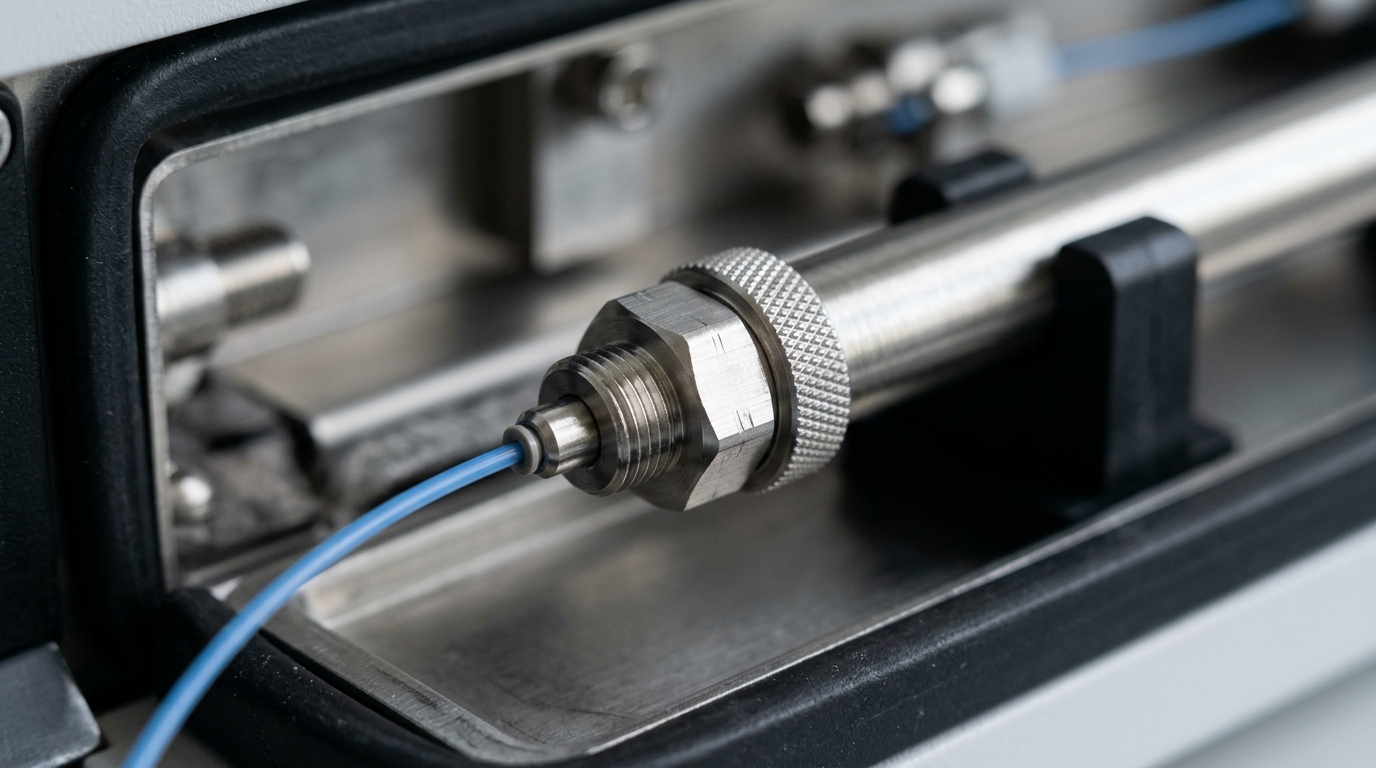
Chemists have developed and validated a reverse-phase high-performance liquid chromatography method that measures the antidiabetic drugs glimepiride and linagliptin simultaneously in synthetic mixtures, using Analytical Quality by Design and a Central Composite Design rather than trial-and-error optimization. The open access research was published in BMC Chemistry on 4 November 2026.
Separation was achieved on a Shim-pack C18 column measuring 250 mm by 4.6 mm with 5 µm particles, using a mobile phase of acetonitrile and water in a 70:30 ratio by volume, pumped at 1.0 mL per minute, with detection at 254 nm. These conditions allow a single chromatographic run to quantify both compounds instead of requiring two separate assays.
The optimization treated mobile phase composition, flow rate and detection wavelength as three factors, each examined at three levels, within a Central Composite Design. This design-of-experiments framework varies factors deliberately and in combination, so the data capture not only each factor’s main effect but also the interaction effects between factors on the responses of interest. The monitored responses included retention time, peak area and resolution.
Because the relationship between chromatographic factors and responses is rarely linear, the team fitted a quadratic model. Analysis of variance showed the model to be significant, with p values below 0.05, and the coefficient of determination exceeded 0.99, confirming model fit and predictive capability. Response surface analysis and a desirability function were then used to establish the optimized conditions, identifying the set of settings that best balanced all responses at once.
Validation followed ICH Q2(R2) guidelines. Linearity was demonstrated with correlation coefficients above 0.999. Sensitivity was high: the limit of detection was 0.0875 µg/mL for one analyte and 0.0821 µg/mL for the other, while the limits of quantification were 0.2651 µg/mL and 0.2487 µg/mL respectively. Accuracy, assessed by recovery, fell between 98.51% and 99.94%, and precision was tight, with relative standard deviations below 2%. These figures indicate that the method measures both compounds reproducibly and without meaningful bias at the concentrations tested.
Robustness was examined by deliberately introducing small variations into the chromatographic conditions. The optimized method held its performance against these deliberate changes, which the authors cite as confirmation that the procedure is suitable for routine pharmaceutical quality control.
The study’s scope deserves precise framing. The validation was performed on synthetic mixtures of the two drugs, not on commercial tablets or biological matrices, so the reported accuracy and precision describe performance in that controlled matrix. The design phase, however, is what gives the method its claimed resilience: by quantifying factor interactions and mapping the response surfaces before validation, the developers could select conditions whose robustness was tested explicitly rather than assumed. The quadratic model’s high R² value supports the reliability of that mapping within the studied factor ranges.
Methodologically, the paper illustrates why Analytical Quality by Design has become a preferred paradigm for chromatographic method development. Traditional one-factor-at-a-time optimization misses interactions and offers little assurance about the edges of the operating window. A three-factor, three-level Central Composite Design supports quadratic terms, letting ANOVA judge which factors and interactions are statistically significant. Combined with desirability-based optimization, the approach yields a method whose critical variables, acceptable ranges and performance limits are documented together, an arrangement that aligns with regulatory expectations for analytical lifecycle management.
For pharmaceutical analysts, the practical takeaway is a validated, statistically grounded RP-HPLC procedure: a C18 column, a 70:30 acetonitrile-water mobile phase, 1.0 mL/min flow, 254 nm detection, sub-µg/mL detection limits for both drugs, recoveries near 99% and precision within 2% RSD, all established through a design space that anticipates small operational drift.
Subject of Research: Development and ICH Q2(R2) validation of an AQbD-optimized RP-HPLC method for simultaneous estimation of glimepiride and linagliptin in synthetic mixtures
Article Title: AQbD-assisted central composite design optimization of an RP-HPLC method for simultaneous estimation of glimepiride and linagliptin in a synthetic mixture
Article References: Mehta, H., & Bhai, P. A. S. (2026). AQbD-assisted central composite design optimization of an RP-HPLC method for simultaneous estimation of glimepiride and linagliptin in a synthetic mixture. BMC Chemistry. https://doi.org/10.1186/s13065-026-01953-4
Image Credits: AI Generated
DOI: 10.1186/s13065-026-01953-4
Keywords: RP-HPLC, Analytical Quality by Design, Central Composite Design, glimepiride, linagliptin, method validation, ICH Q2(R2), pharmaceutical analysis, chromatography optimization, quality control, design of experiments, synthetic mixture
News Source: Bethany Barker. (November 5, 2026). Design of experiments fine-tunes a dual-drug HPLC assay for glimepiride and linagliptin. Scienmag.