Researchers from the international KM3NeT collaboration analysed 5,828 atmospheric neutrino candidate events recorded by KM3NeT/ORCA, a detector positioned roughly 2,450 metres below the waves about 40 kilometres off the coast of Toulon, France. Their goal was to probe Lorentz invariance, the fundamental principle that the laws of physics are the same everywhere in the Universe and for every observer, a principle that lies at the heart of Einstein’s theory of relativity. The team found no evidence that this principle is broken, but the analysis allowed them to set new experimental limits on how large any such violation could be, including the first direct constraints on certain possible differences in the behaviour of muon and tau neutrinos. The results are published in the Journal of Cosmology and Astroparticle Physics.
Why would physicists question so foundational an assumption? The answer lies in one of the deepest unsolved problems in science: the search for a theory of quantum gravity that can reconcile general relativity, our best description of gravity and spacetime, with quantum physics, our best description of matter and forces at the smallest scales. Some theoretical approaches suggest that spacetime, which we normally treat as a smooth continuum, might actually be built from extremely small, discrete units. If that were true, the consequences could be profound, potentially including violations of Lorentz invariance. “We still don’t know whether our spacetime is continuous or might be discrete,” explains Alba Domi, a researcher at the Erlangen Centre for Astroparticle Physics at Friedrich-Alexander-Universität Erlangen-Nürnberg and one of the study’s two corresponding authors. “Looking for violations of Lorentz invariance is one way to investigate this possibility.”
Neutrinos turn out to be exceptionally promising probes for signs of such new physics. These tiny particles rarely interact with matter, which allows them to travel enormous distances, even straight through the Earth, essentially unimpeded. They also possess a remarkable property: they can change from one type, or flavour, to another as they travel, a phenomenon known as neutrino oscillation. The probabilities of these transformations can be predicted with great precision by the standard theory. If the observed behaviour deviates from those predictions, it could be a signature of new physics, potentially including a violation of Lorentz invariance.
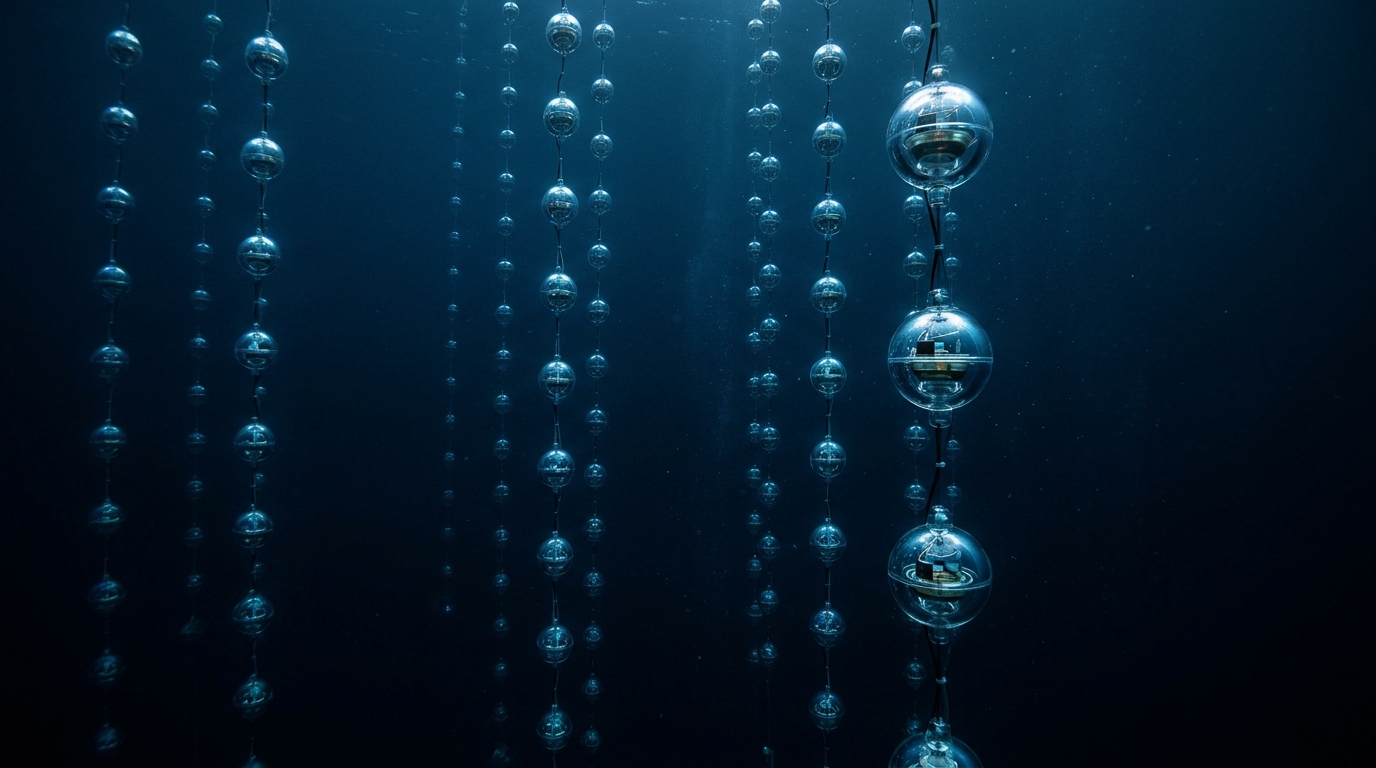
To hunt for such deviations, the researchers analysed 1.4 years of data collected with the first six detection units of KM3NeT/ORCA, comparing the observed neutrino energies and arrival directions with theoretical predictions. ORCA, whose name stands for Oscillation Research with Cosmics in the Abyss, is designed to study neutrinos produced in the Earth’s atmosphere, focusing on how they oscillate between different flavours. The detector works by deploying networks of highly sensitive light sensors deep underwater to catch the faint flashes of light produced when neutrinos interact with matter.
The outcome was a null result with real scientific weight. The researchers found no evidence of Lorentz invariance violation. However, this does not mean that such violations are impossible; rather, the results establish new limits on how large certain effects could be without contradicting the observations. Despite being obtained with an early, partial configuration of the detector, the results are competitive with those of long-running experiments such as IceCube and Super-Kamiokande, observatories that have accumulated data over many years.
Perhaps the most notable achievement of the analysis is a genuine first. For the first time, the team established direct limits on certain possible effects of Lorentz invariance violation involving two neutrino flavours, muon and tau, and the way neutrinos oscillate between them.
These results are particularly striking considering the state of the instrument when the data were collected. At the time, ORCA was still in an early stage of construction, operating with just six detection units, and the detector is still being expanded towards its full planned configuration. “These results show the potential of KM3NeT/ORCA to test fundamental principles of physics, even with a relatively small detector,” says Lukas Hennig, a PhD student at ECAP and the study’s other corresponding author.
The collaboration is not stopping with atmospheric neutrinos. In the future, the researchers hope to extend their investigations to KM3NeT/ARCA, the collaboration’s second underwater telescope, which focuses on much higher-energy neutrinos arriving from distant astrophysical sources. Such neutrinos could be especially promising for these searches, because some possible effects of Lorentz invariance violation become more pronounced over very long distances and at higher energies. “ARCA could be particularly well suited to this kind of research, but we don’t yet have enough astrophysical neutrino events to perform such an analysis,” explains Domi.
The KM3NeT infrastructure itself is an international research facility under construction in the Mediterranean Sea, consisting of the two complementary underwater neutrino telescopes ORCA and ARCA. ORCA sits about 40 kilometres off the coast of Toulon, France, at a depth of approximately 2,450 metres, while ARCA is located off the coast of Sicily, near Portopalo di Capo Passero, at a depth of approximately 3,500 metres. ORCA is optimised for atmospheric neutrinos and oscillation studies, whereas ARCA targets the most energetic neutrinos from the cosmos, helping scientists investigate some of the most energetic phenomena in the Universe.
The growing importance of high-energy neutrino research was recently recognised with the 2026 Nobel Prize in Physics, awarded to Francis Halzen for his pioneering contributions to the IceCube Neutrino Observatory and the discovery of high-energy neutrinos from space. The analysis itself was carried out as part of Domi’s Marie Skłodowska-Curie Postdoctoral Fellowship, known as QGRANT, funded by the European Union’s Horizon Europe programme. For now, the message from the abyss is one of confirmation through constraint: Einstein’s principle of Lorentz invariance has survived another rigorous trial, and the apparatus that tested it is only just beginning to grow.
Subject of Research: Testing Lorentz invariance, a foundation of Einstein's relativity, using atmospheric neutrinos detected by the KM3NeT/ORCA underwater telescope
Article Title: Testing Einstein's laws from the bottom of the Mediterranean Sea
Article References: Testing Einstein's laws from the bottom of the Mediterranean Sea. Original publication (Bibliographic details unavailable.)
Image Credits: AI Generated
DOI: Not provided
Keywords: Lorentz invariance, KM3NeT, ORCA, neutrino oscillation, quantum gravity, atmospheric neutrinos, Einstein relativity, particle physics, neutrino telescope, Mediterranean Sea, muon neutrino, tau neutrino
News Source: Grant Pearson. (November 6, 2026). Underwater Neutrino Telescope Puts Einstein’s Relativity to a New Test. Scienmag.