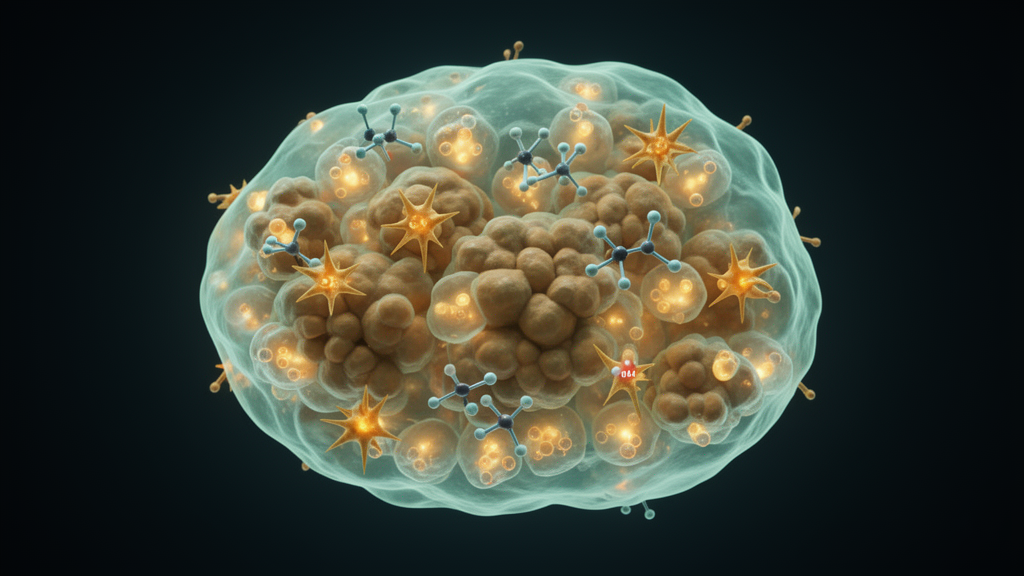
Pancreatic cancer is notoriously difficult to treat, and part of the reason lies not in the cancer cells themselves but in the tissue that surrounds them. Tumors are embedded in a complex microenvironment of supporting cells, blood vessels, and immune cells, and in pancreatic cancer this surrounding tissue can make up as much as 90 percent of the tumor mass. At the heart of this environment are cancer-associated fibroblasts (CAFs), altered connective tissue cells that wrap around the tumor. Rather than restraining the cancer, these fibroblasts actively promote its growth and spread: they build a scar-like tissue structure around the tumor and suppress the body’s own immune response. This immunosuppressive shield is one reason why immunotherapies that work well in many other cancers often fail in pancreatic cancer.
Researchers at the Karlsruhe Institute of Technology (KIT), together with colleagues from TRON at the University Medical Center of Johannes Gutenberg University Mainz and the University of Freiburg, have now identified a molecular switch that appears to reprogram these tumor-promoting cells. In a study published in Cell Death & Disease, the team focused on CD44, a molecule present on the surface of cancer-associated fibroblasts. Their experiments showed that CD44 intensifies key signaling pathways that keep the fibroblasts in their activated, tumor-supporting state.
To test what happens when this switch is turned off, the researchers inactivated CD44 both in a mouse model of pancreatic cancer and in human cells in the laboratory. The effect on the fibroblasts was striking. The cells produced less extracellular matrix, the fibrous scaffolding that forms the tumor’s protective scar-like shell. They released fewer cytokines, the signaling molecules that help orchestrate immunosuppression. And they lost their ability to suppress the immune system. With the fibroblasts no longer holding immune cells at bay, the immune cells could attack the tumor cells more effectively, and tumor size decreased significantly in the mouse model.
“This changed the fibroblasts dramatically. They produced less extracellular matrix, released fewer cytokines, and lost their ability to suppress the immune system. As a result, immune cells could attack the tumor cells more successfully, which significantly decreased the tumor size in a mouse model,” said Professor Véronique Orian-Rousseau, head of the Cancer Cell Plasticity, Tumor Microenvironment and Metastasis research group at KIT’s Institute of Biological and Chemical Systems – Functional Molecular Systems.
The study, published under the title “Loss of CD44 re-educates pancreatic cancer-associated fibroblasts modulating their fibrotic and immunosuppressive functions,” points to an approach that differs from strategies that aim to eliminate these cells. Instead of destroying cancer-associated fibroblasts, the researchers demonstrated that the cells can be changed in a targeted way. Inactivated fibroblasts did not simply disappear; they shifted their behavior, becoming less fibrotic and less immunosuppressive. “The fact that we can change fibroblasts in a targeted manner by inactivating CD44 instead of destroying them opens up new prospects for more effective and less disruptive cancer treatments,” Orian-Rousseau explained.
The findings also build on a therapeutic line of research already pursued at KIT. Earlier work had shown that blocking certain CD44 variants on the cancer cells themselves can slow the progression of pancreatic cancer. Based on that insight, the researchers developed a peptide directed against CD44v6, a specific variant of the molecule, which has already been tested in a clinical study. The new results now suggest that targeting CD44 in the supporting tissue of tumors, rather than only on the cancer cells, could also be therapeutically promising, potentially addressing the microenvironment that shields the tumor from immune attack.
The significance of the work lies in how it reframes the role of the tumor microenvironment in pancreatic cancer. Because fibroblasts can constitute the majority of the tumor mass and actively suppress immune responses, they have long been viewed as a formidable barrier to treatment. The KIT-led study provides direct experimental evidence, in mouse models and human cells, that removing a single surface molecule from these cells can convert them from tumor allies into a less hostile population, allowing immune cells to act against the tumor.
Important caveats remain. The tumor-shrinking effect was demonstrated in a mouse model, and the experiments on human cells were carried out in the laboratory, so the findings cannot yet be translated directly into patient benefits. The researchers themselves emphasize that considerable further research will be needed before blocking CD44 in the tumor microenvironment can be developed into a clinical application. Even so, the study adds a concrete molecular target to the search for therapies against one of medicine’s most stubborn cancers, showing that the tumor’s surroundings may be as actionable as the tumor cells themselves.
Subject of Research: Reprogramming cancer-associated fibroblasts by inactivating CD44 in pancreatic cancer
Article Title: Pancreatic cancer: Researchers reprogram the tumor microenvironment
Article References: Pancreatic cancer: Researchers reprogram the tumor microenvironment. Original publication (Bibliographic details unavailable.)
Image Credits: AI Generated
DOI: Not provided
Keywords: pancreatic cancer, tumor microenvironment, cancer-associated fibroblasts, CD44, CD44v6, immunosuppression, extracellular matrix, cytokines, mouse model, Karlsruhe Institute of Technology, Cell Death & Disease, fibroblast reprogramming
News Source: Nathaniel Bowman. (October 23, 2026). Blocking CD44 Reprograms Support Cells in Pancreatic Tumors. Scienmag.