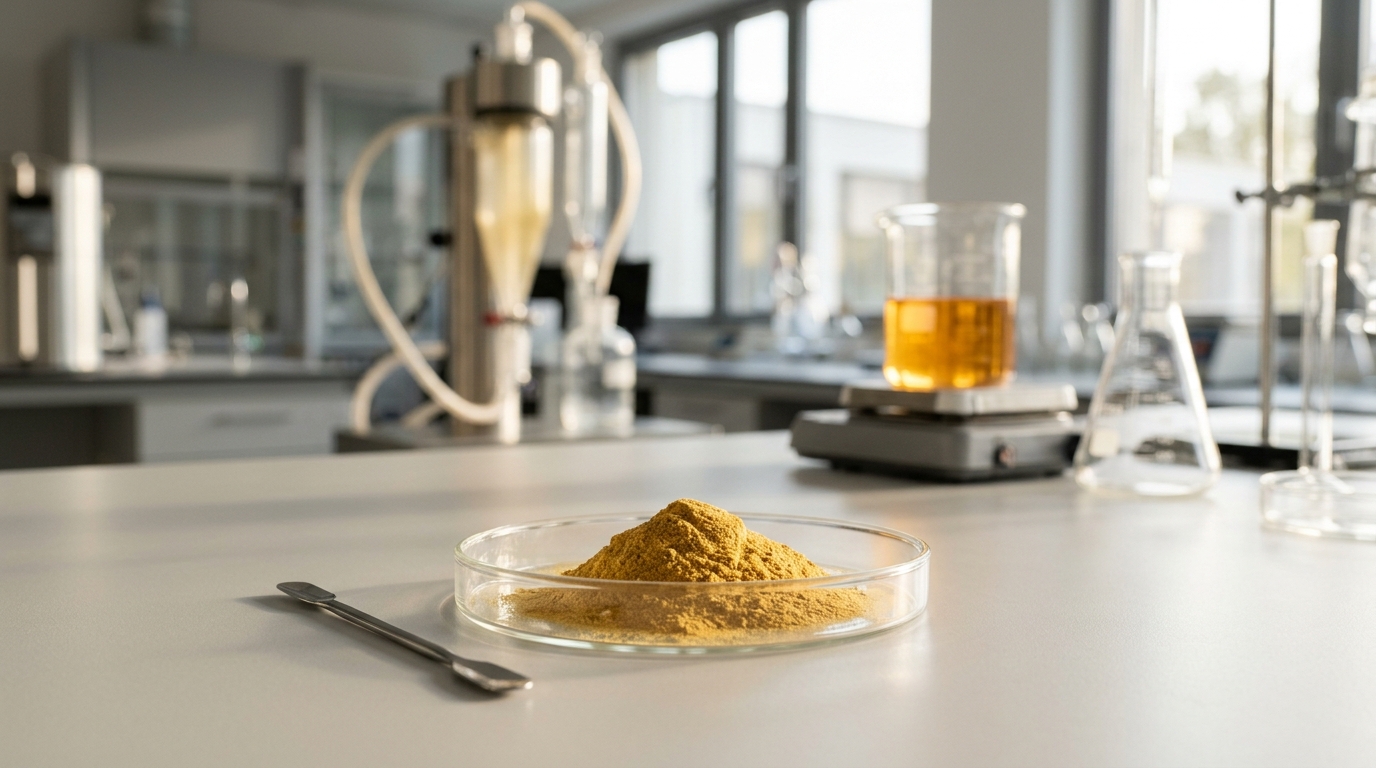
Curculigo orchioides Gaertn. extract is rich in phenolic compounds with antioxidant activity, yet these molecules degrade easily during processing and storage. The study evaluated whether maltodextrin, gum arabic, and inulin, used alone or in combination, could serve as carrier materials for the spray-dried extract, and the 90-day storage data showed the best performance for a three-part blend of maltodextrin, gum arabic, and inulin in equal proportions.
The researchers evaluated maltodextrin, gum arabic, and inulin as carrier systems for the spray-dried extract. Powder yield across the formulations ranged from 70.9% to 78.5%, while encapsulation efficiency ranged from 71.3% to 82.3%. These figures show that the spray-drying process achieved powder yields of 70.9% to 78.5% and encapsulation efficiencies of 71.3% to 82.3% across the tested carriers, with differences between carriers emerging in the stability and release data.
Formulations containing gum arabic and inulin showed lower water activity and lower hygroscopicity than maltodextrin alone.
The carrier blend also preserved more of the antioxidant chemistry. Total phenolic content in the gum arabic and inulin formulations reached 15.25 to 30.66 mg GAE per gram of powder, and DPPH inhibition, a standard measure of radical-scavenging capacity, ranged from 71.4% to 84.5%. The abstract reports that formulations containing gum arabic and inulin had higher total phenolic content and greater DPPH inhibition than maltodextrin alone.
Structural analysis supported these observations. Fourier-transform infrared spectroscopy confirmed that the major chemical functionalities of the extract were preserved through the drying process, and X-ray diffraction showed that the dried powders were predominantly amorphous.
Release behavior depended strongly on pH. Phenolic release from the powders was slower at pH 1.2 than at pH 6.8. This pH-dependent pattern suggests the carrier matrix may allow controlled release of the phenolic compounds.
The most decisive test came from storage. Over 90 days, the researchers tracked how much of the original phenolic content each formulation retained and how quickly the compounds degraded. The maltodextrin–gum arabic–inulin formulation at a 1:1:1 ratio showed the highest phenolic retention and the lowest degradation rate of all the systems tested. Among the systems tested, the three-carrier blend showed the highest phenolic retention and the lowest degradation rate over the 90-day storage period.
The authors conclude that combining carriers may improve both the storage stability and the controlled release of phenolic compounds, opening a path toward functional food applications. Because the study measured encapsulation efficiency, release profiles, and degradation kinetics under defined conditions rather than testing a finished product in consumers, the findings are best read as a formulation-level result. Even so, the data indicate that combining maltodextrin, gum arabic, and inulin in a 1:1:1 ratio may improve the storage stability and controlled release of phenolic compounds for functional food applications.
Subject of Research: Carrier systems for spray-dried Curculigo orchioides extract and their effect on phenolic encapsulation, release, and storage stability
Article Title: Effect of carrier system on encapsulation efficiency, release behavior, and stability of spray-dried Curculigo orchioides extract
Article References: Phan, V. M., & Tran, C. H. (2026). Effect of carrier system on encapsulation efficiency, release behavior, and stability of spray-dried Curculigo orchioides extract. Food Science and Biotechnology. https://doi.org/10.1007/s10068-026-02367-7
Image Credits: AI Generated
DOI: 10.1007/s10068-026-02367-7
Keywords: Curculigo orchioides, spray drying, encapsulation efficiency, maltodextrin, gum arabic, inulin, phenolic compounds, antioxidant activity, controlled release, storage stability, functional foods, DPPH inhibition
News Source: Gregory Coleman. (November 5, 2026). Blended carriers boost phenolic retention in spray-dried Curculigo orchioides extract. Scienmag.