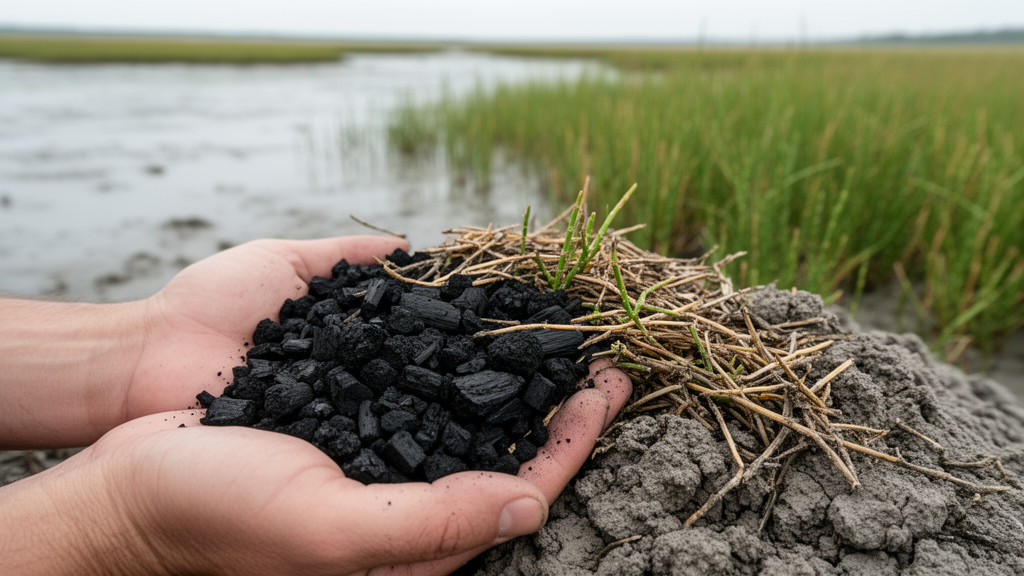
Coastal salt-affected soils cover vast stretches of the planet’s low-lying margins, and in places like the Yellow River Delta of northern China, decades of salinization have been accompanied by declining soil carbon stocks. A new open-access study published in the journal Biochar reports the results of a 370-day laboratory experiment asking whether corn straw biochar, applied together with the litter of a native halophyte, can push two chemically distinct pools of soil organic carbon—plant-derived lignin phenols and microbial necromass carbon—into a more persistent state. The answer, according to the researchers led by Xianxiang Luo and Hao Zheng, is that the combination outperformed either amendment alone, producing synergistic gains in recalcitrant organic carbon fractions under both dry and flooded moisture regimes.
The experiment was built on soil collected from the top 20 centimeters of a coastal salt-affected site near Xianhe Town in Dongying, China. The team placed 1000 grams of prepared soil into plastic microcosms and tested four treatments under two moisture levels, 75 percent and 125 percent of maximum water-holding capacity, representing non-flooded and flooded conditions. The treatments were unamended control soil, soil mixed with corn straw biochar produced by slow pyrolysis at 450 degrees Celsius, soil receiving dried Suaeda salsa litter enclosed in nylon litter bags, and soil receiving both biochar and litter. The biochar was mixed in at 3 percent by dry weight, a rate chosen on the basis of earlier incubation studies in the same region, while the litter dose of 2 grams per microcosm corresponded to roughly 312.5 grams per square meter, within the natural range of Suaeda salsa litter input in these soils.
Suaeda salsa is a pioneer halophyte of the Yellow River Delta, and its decomposing litter creates what soil scientists call the detritusphere—the narrow zone of mineral soil surrounding plant residues where decomposition, microbial growth, and carbon stabilization proceed most intensely. The researchers incubated their microcosms for 370 days, retrieved litter bags at intervals to track mass loss, and at the end of the experiment sampled the detritusphere soil attached to and surrounding the bags. They quantified lignin phenols using alkaline cupric oxide oxidation, estimated microbial necromass carbon from amino sugar biomarkers, and measured soil organic carbon and recalcitrant organic carbon by dichromate oxidation and difference. Bacterial 16S rRNA gene and fungal ITS sequencing revealed how the microbial community shifted under each treatment.
The headline result concerns synergy. Compared with litter alone, the combined biochar-plus-litter treatment significantly increased lignin phenols by 22.43 to 41.15 percent, bacterial necromass carbon by 165.21 to 233.48 percent, and total microbial necromass carbon by 25.09 to 53.82 percent under both moisture conditions. Three-way analysis of variance confirmed a significant biochar-by-litter interaction for bacterial necromass carbon, soil organic carbon, and recalcitrant organic carbon. The increments in soil organic carbon and recalcitrant organic carbon in the combined treatment exceeded the sums of the increments from biochar alone and litter alone, by 23.33 percent and 40.12 percent respectively, a statistical signature the authors interpret as genuine synergism rather than simple additivity.
Not every effect was positive in isolation. Biochar added without litter actually decreased lignin phenol content by 12.18 to 12.87 percent, even as it enhanced microbial necromass carbon accumulation by 15.36 to 42.22 percent. Litter input on its own raised lignin phenols by 32.80 to 33.36 percent and microbial necromass carbon by 0.78 to 14.36 percent. The study also found that biochar and litter inputs, rather than the moisture regime, were the stronger drivers of lignin phenol and necromass carbon accumulation, although moisture shaped some early-stage responses. These nuances matter because they show that biochar’s influence on soil carbon is not uniform: it depends on what else is present in the soil and on which carbon fraction is being measured.
The fate of the litter itself tells part of the story. Cumulative litter mass loss over the 370 days ranged from 51.68 to 77.27 percent, and loss was consistently higher in the combined treatment than with litter alone, with a final increase of 16.39 percent. Fourier transform infrared spectra of the residual litter showed a preferential loss of labile esterified components and a relative enrichment of aromatic structures, including bands associated with lignin skeletal vibrations. Acid-to-aldehyde ratios of vanillyl and syringyl phenols, established indicators of lignin oxidation, were elevated in the combined treatment. Together, these signals suggest that biochar accelerated the decomposition of labile litter constituents while promoting the oxidation and release of lignin-derived aromatic fragments into the surrounding soil, where they contributed to the measured lignin phenol pool.
The microbial data point to a complementary, bacterial-driven route to stable carbon. In the combined treatment, the amino sugar muramic acid, a bacterial biomarker, rose by 216.56 to 283.68 percent relative to the individual amendments and the control, and bacterial necromass carbon in the combined treatment exceeded the control by 283.58 percent. The ratio of bacterial to fungal necromass carbon climbed sharply, and the increase in bacterial necromass carbon under the combined treatment surpassed the sum of the separate biochar and litter effects. Sequencing showed enrichment of decomposition-associated fungal taxa such as Preussia and Talaromyces, and of bacterial genera including Thiobacillus and Thioalkalispira that were associated with bacterial necromass accumulation. The authors propose that pulses of labile substrate from decomposing litter preferentially stimulated fast-growing bacteria, whose turnover generates necromass that can be stabilized in soil.
Physicochemical changes in the soil likely underpinned these biological shifts. The combined treatment reduced the exchangeable sodium percentage, improved mean weight diameter of water-stable aggregates, and raised cation exchange capacity, available phosphorus, and the carbon-to-phosphorus and nitrogen-to-phosphorus ratios. Biochar addition did increase soil electrical conductivity, probably through the release of soluble mineral ions, a short-term salinity risk the authors acknowledge. But the broader pattern—lower sodicity, better aggregation, and improved nutrient availability—appears to have eased the salinity and alkalinity stress that constrains microbial activity in these soils, shifting microbial energy allocation toward growth and turnover. Mineral-associated organic carbon fractions tied to reducible iron phases and organo-mineral complexes also increased significantly and correlated positively with soil organic carbon, lignin phenols, and necromass carbon, consistent with mineral surfaces helping to retain both plant- and microbial-derived carbon against further degradation.
What does this mean for carbon sequestration in coastal saline landscapes? The study measured contents of specific organic carbon fractions in a controlled microcosm, not field-scale carbon stocks, and the authors are explicit about the limits. Litter bags can alter moisture retention, gas exchange, and substrate access, so absolute decomposition rates may not mirror undisturbed field soils, even though the relative treatment differences were consistent across both moisture regimes and all sampling times. Natural coastal wetlands are additionally shaped by tidal flooding, root activity, seasonal temperature swings, and long-term redox fluctuations that a pot experiment cannot reproduce. The authors call for field trials and in situ decomposition experiments, ideally with stable isotope labeling, to verify how plant- and microbial-derived carbon partitions into stable soil organic carbon pools over longer timescales.
Even with those caveats, the findings sharpen an important conceptual point. Biochar’s contribution to durable soil carbon may depend less on its own recalcitrant carbon than on how it reshapes the processing and protection of carbon from other sources. In this experiment, biochar accelerated litter turnover, fostered microbial communities that convert plant carbon into bacterial necromass, and created physical and mineralogical conditions—pore entrapment, surface adsorption, aggregate occlusion, and organo-mineral association—that favor the retention of lignin-derived residues and microbial remains. For the degraded saline soils of deltas like the Yellow River’s, where halophyte litter is abundant and biochar application is increasingly discussed as a nature-based remediation option, the study offers a mechanistic roadmap for how the two inputs might act together to build carbon that resists decomposition.
Subject of Research: Biochar and halophyte litter effects on organic carbon fractions in coastal salt-affected soil
Article Title: Biochar and halophyte litter synergistically enhance recalcitrant organic carbon fractions in coastal salt-affected soil via lignin phenols and microbial necromass carbon
Article References: Luo, X., Liang, Z., Liu, L., Chen, K., Zhao, L., Liu, Q., Wang, Z., Cao, Y., Li, F., & Zheng, H. (2026). Biochar and halophyte litter synergistically enhance recalcitrant organic carbon fractions in coastal salt-affected soil via lignin phenols and microbial necromass carbon. Biochar, 8(1), Article 146. https://doi.org/10.1007/s42773-026-00660-6
Image Credits: AI Generated
DOI: 10.1007/s42773-026-00660-6
Keywords: biochar, soil organic carbon, microbial necromass, lignin phenols, salt-affected soil, Yellow River Delta, Suaeda salsa, carbon sequestration, detritusphere, microcosm experiment, soil remediation, recalcitrant organic carbon
News Source: Alan Morgan. (October 30, 2026). Biochar and halophyte litter lock carbon into salty coastal soils. Scienmag.