


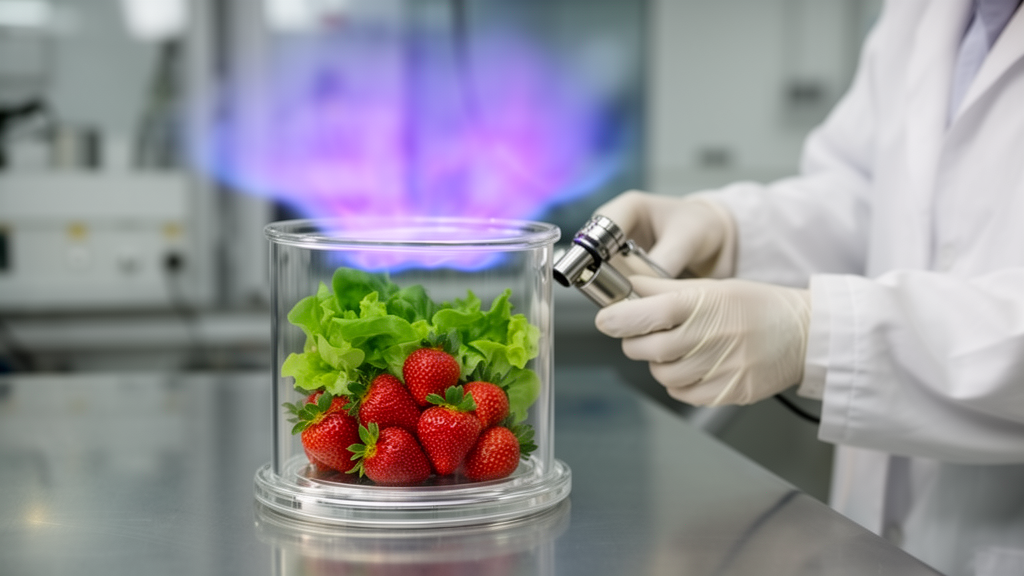
Cold plasma, an ionized gas that operates at temperatures below 60 degrees Celsius, is emerging as a non-thermal way to process food while leaving its nutritional value intact. A new review of recent research concludes that the technology can either enhance or degrade the health-promoting compounds in foods such as fruits, vegetables, cereals, and juices, depending on how it is applied. The balance between these two outcomes hinges on plasma power, exposure time, gas composition, and the structure of the food matrix itself.
The review, published in Food, Nutrition and Health, examined how cold plasma affects polyphenols, carotenoids, vitamins, and natural pigments. Cold plasma is generated by partially ionizing a gas through an electric discharge, producing a mixture of reactive oxygen species such as ozone and hydroxyl radicals alongside reactive nitrogen species including nitric oxide and nitrogen dioxide. Because electrons are far lighter than ions, they gain high energy while the bulk gas stays near room temperature, allowing treatment of heat-sensitive products without the thermal damage that conventional processing causes.
These reactive species act on food through two competing pathways. On one side, they can etch plant cell walls, rupture vacuolar membranes and chromoplasts, and depolymerize large molecules, releasing bound compounds and making them easier to extract and digest. On the other, the same oxidants can cleave aromatic rings, oxidize conjugated double bonds, and destroy sensitive molecules outright. The review frames this as a treatment-severity spectrum rather than a binary effect: low-to-moderate exposure tends to favor release and protection, while exceeding a matrix-specific threshold drives net oxidation and loss.
Polyphenols illustrate the pattern clearly. Atmospheric cold plasma raised total polyphenol content in chia seeds to 64.98 milligrams of gallic acid equivalents per gram under high-voltage conditions, while açaí pulp showed increases of up to 38.8 percent at specific frequencies. Cold plasma treatment of Xinong Black Spike whole wheat flour broke down phenolic macromolecules and increased caffeic and p-coumaric acids, enhancing antioxidant and anticancer activity. In banana slices, total phenolic content rose progressively with treatment time, from 26.85 milligrams per 100 grams fresh weight at 35 seconds to 46.71 milligrams per 100 grams after 155 seconds of exposure.
Not all phenolic responses are positive. Several studies reported reductions in total phenolic content after cold plasma treatment, and the review attributes these inconsistencies to differences in plasma power, duration, gas type, and food structure. Solid matrices such as cereal grains and seeds often gain extractability through cell wall disruption, whereas liquid matrices appear more vulnerable to reactive-species-driven degradation. At the molecular level, the degree of hydroxylation, polymerization, and conjugation within a phenolic’s aromatic ring determines whether plasma promotes depolymerization into smaller antioxidant fragments or oxidative cleavage of the structure itself.
Carotenoids, the lipophilic pigments behind yellow, orange, and red hues, are especially prone to oxidation because of their long conjugated double-bond systems. Dielectric barrier discharge at 70 kilovolts for 4 minutes increased total carotenoids in carrot juice, likely by degrading pectin and crystalline complexes that normally lock the pigments away. Fresh-cut mangoes treated at 75 kilovolts for 3 minutes retained carotenoids better than untreated controls during storage, and avocado pulp showed marked carotenoid increases after short 10-minute treatments at low gas flow rates of 10 milliliters per minute. Yet in tucumã subjected to pre-treatment drying, plasma reduced carotenoid levels, and tomato studies documented losses from oxidative free radicals. Carrot juice experiments showed carotenoid losses of 12 to 28 percent depending on voltage, with the greatest degradation at intermediate levels, while thermal treatment kept levels near baseline.
Vitamin C responded within a narrow treatment window. In cashew apple juice, atmospheric cold plasma raised vitamin C content from 637.97 milligrams per liter in controls to 825.74 milligrams per liter at 700 hertz, an effect attributed to activation of dehydroascorbate reductase, an enzyme that converts dehydroascorbic acid back into ascorbic acid. The same high-frequency treatment lifted vitamin C bioaccessibility from 67.56 percent to 78.25 percent. In carrot juice treated at 8 kilovolts, ascorbic acid levels stayed comparable to untreated controls at roughly 3.8 milligrams per 100 milliliters and outperformed thermally processed samples. More intense or prolonged treatments, however, promote irreversible oxidative loss of the vitamin.
Natural pigments split along chemical lines. Anthocyanins, water-soluble flavonoid pigments, gained from moderate plasma: jet plasma at 4 watts and 2.5 kilovolts for 3 to 7 minutes increased total anthocyanins in pomegranate juice by 21 to 35 percent, and dielectric barrier discharge at 12 kilovolts and 5 kilohertz for up to 90 seconds raised anthocyanin levels in blueberries by roughly 45 percent. But camu-camu juice treated at 24 kilovolts and 960 hertz for 15 minutes suffered substantial anthocyanin losses, showing how quickly enhancement flips to degradation once severity rises. Chlorophyll behaved differently depending on gas: air-based surface micro-discharge plasma at 10 to 15 milliwatts per square centimeter for 5 minutes drove chlorophyll a in Spirulina powder down from 3126 micrograms per gram to between 1142 and 1381 micrograms per gram, while nitrogen plasma caused far less degradation. Nitrogen-based micro dielectric barrier discharge raised total chlorophyll in ginseng seedlings by 62 percent, and argon plasma at 3500 volts for 30 seconds increased chlorophyll in fenugreek seeds by 49 percent.
Betalains, the red-purple and yellow-orange pigments in beetroot, appear more fragile still. Atmospheric cold plasma reduced total betalain content in beetroot juice, an effect linked to plasma-induced pH shifts and localized temperature rises, and the betalamic acid backbone’s susceptibility to oxidation may limit high-intensity plasma for betalain-rich foods. The review notes that increases in measured concentration should not automatically be read as new compound formation; many apparent gains reflect improved extractability, moisture-related concentration effects, or release from disrupted compartments, whereas true biosynthetic increases occur mainly in living tissues during post-treatment storage.
Translating these laboratory findings into industrial practice remains difficult. The review identifies gaps in process standardization, scalability, and regulatory acceptance, noting that applications such as fresh-cut mango, carrot juice, and berry juices have rarely progressed beyond pilot-scale validation. Challenges in reactor design, energy efficiency, and uniform treatment of heterogeneous food surfaces persist, and long-term safety questions around allergenicity, toxicity, and genotoxic by-products lack data. Future work, the authors argue, should quantify matrix-specific severity thresholds, establish predictive relationships between reactive species profiles and compound stability, and deploy real-time monitoring, artificial intelligence, and multi-omics approaches to keep treatments inside the window where plasma preserves rather than destroys the compounds that make food nutritious.
Subject of Research: Effects of cold plasma treatment on food bioactive compounds including polyphenols, carotenoids, vitamins, and natural pigments
Article Title: Effects of cold plasma treatment on food bioactive compounds
Article References: Cebeci, B., & Kamiloglu, S. (2026). Effects of cold plasma treatment on food bioactive compounds. Food, Nutrition and Health, 3(1), Article 24. https://doi.org/10.1007/s44403-026-00069-w
Image Credits: AI Generated
DOI: 10.1007/s44403-026-00069-w
Keywords: cold plasma, food processing, polyphenols, carotenoids, vitamin C, anthocyanins, chlorophyll, betalains, bioaccessibility, antioxidant activity, non-thermal technology, food bioactive compounds
News Source: Alan Morgan. (October 30, 2026). Cold plasma can boost or destroy the nutrients in your food. Scienmag.



