• HOME
  • NEWS
  • EXPLORE
    • CAREER
      • Companies
      • Jobs
    • EVENTS
    • iGEM
      • News
      • Team
    • PHOTOS
    • VIDEO
    • WIKI
  • BLOG
  • COMMUNITY
    • FACEBOOK
    • INSTAGRAM
    • TWITTER
Sunday, August 16, 2026
BIOENGINEER.ORG
No Result
View All Result
  • Login
  • HOME
  • NEWS
  • EXPLORE
    • CAREER
      • Companies
      • Jobs
        • Lecturer
        • PhD Studentship
        • Postdoc
        • Research Assistant
    • EVENTS
    • iGEM
      • News
      • Team
    • PHOTOS
    • VIDEO
    • WIKI
  • BLOG
  • COMMUNITY
    • FACEBOOK
    • INSTAGRAM
    • TWITTER
  • HOME
  • NEWS
  • EXPLORE
    • CAREER
      • Companies
      • Jobs
        • Lecturer
        • PhD Studentship
        • Postdoc
        • Research Assistant
    • EVENTS
    • iGEM
      • News
      • Team
    • PHOTOS
    • VIDEO
    • WIKI
  • BLOG
  • COMMUNITY
    • FACEBOOK
    • INSTAGRAM
    • TWITTER
No Result
View All Result
Bioengineer.org
No Result
View All Result
Home NEWS Science News Biology

Bacteria-killing gel heals itself while healing you

Bioengineer by Bioengineer
July 25, 2019
in Biology
Reading Time: 2 mins read
0
IMAGE
Share on FacebookShare on TwitterShare on LinkedinShare on RedditShare on Telegram

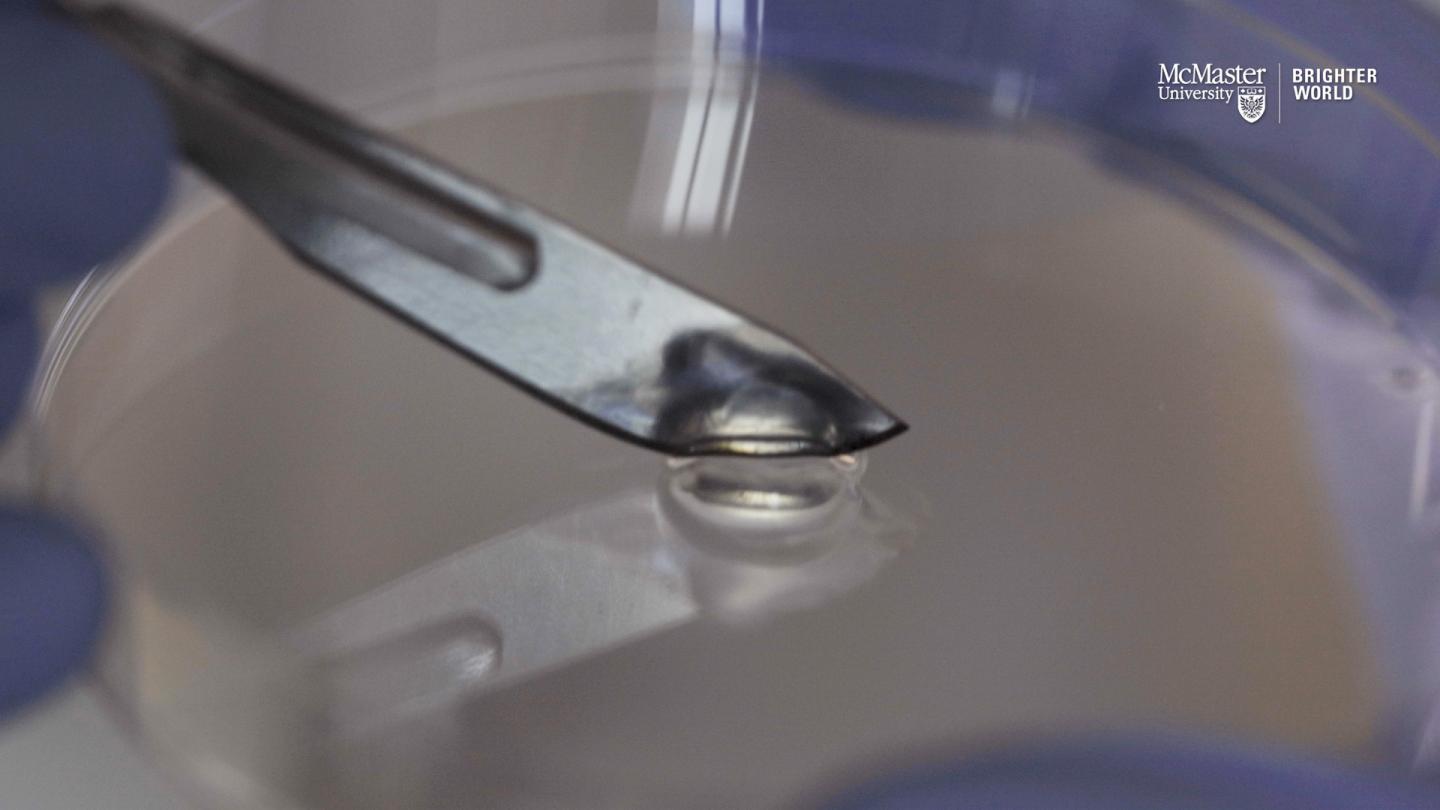
McMaster researchers aggregate trillions of phages into new form
IMAGE

Credit: JD Howell, McMaster University

HAMILTON, ON July 25, 2019 – McMaster researchers have developed a novel new gel made entirely from bacteria-killing viruses.

The anti-bacterial gel, which can be targeted to attack specific forms of bacteria, holds promise for numerous beneficial applications in medicine and environmental protection.

Among many possibilities, it could be used as an antibacterial coating for implants and artificial joints, as a sterile growth scaffold for human tissue, or in environmental cleanup operations, says chemical engineer Zeinab Hosseini-Doust.

Her lab, which specializes in developing engineering solutions for infectious disease, grew, extracted and packed together so many of the viruses – called bacteriophages, or simply phages – that they assembled themselves spontaneously into liquid crystals and, with the help of a chemical binder, formed into a gelatin-like substance that can heal itself when cut.

Yellow in colour and resembling Jell-O, a single millilitre of the antibacterial gel contains 300 trillion phages, which are the most numerous organisms on Earth, outnumbering all other organisms combined, including bacteria.

“Phages are all around us, including inside our bodies,” explains Hosseini-Doust. “Phages are bacteria’s natural predators. Wherever there are bacteria, there are phages. What is unique here is the concentration we were able to achieve in the lab, to create a solid material.”

The field of phage research is growing rapidly, especially as the threat of antimicrobial resistance grows.

“We need new ways to kill bacteria, and bacteriophages are one of the promising alternatives,” says Lei Tan, a PhD student in Hosseini-Doust’s lab and a co-author on the paper describing the research, published today in the journal Chemistry of Materials. “Phages can kill bacteria that are resistant to antibiotics.”

Hosseini-Doust says the DNA of phages can readily be modified to target specific cells, including cancer cells. Through a Nobel Prize-winning technology called phage display, it’s even possible to find phages that target plastics or environmental pollutants.

Being able to shape phages into solid form opens new vistas of possibility, just as their utility in fighting diseases is being realized, she says.

###

Media Contact
Wade Hemsworth
[email protected]

Tags: BiotechnologyChemistry/Physics/Materials SciencesIndustrial Engineering/ChemistryInfectious/Emerging DiseasesMedicine/HealthNanotechnology/MicromachinesVirology
Share12Tweet8Share2ShareShareShare2

Related Posts

Strubbelig–NHL3 Receptor Complex Helps Arabidopsis Respond to Cellulose Deficiency

Strubbelig–NHL3 Receptor Complex Helps Arabidopsis Respond to Cellulose Deficiency

August 15, 2026
Bombyx mori Satellitome Analysis Reveals Evolutionary Stability, Dispersed Chromosomal Organization, Transposon Origins

Bombyx mori Satellitome Analysis Reveals Evolutionary Stability, Dispersed Chromosomal Organization, Transposon Origins

August 15, 2026

Synthetic pyrenoid reconstruction reveals EPYC1-driven carbon concentration mechanisms and evolution

August 15, 2026

Endophytic Flavobacterium boosts root hairs and drought tolerance through ERF–CEP5 signaling

August 15, 2026
Please login to join discussion

POPULAR NEWS

  • KAIST develops semiconductor neuron that harnesses noise to selectively process signals

    29 shares
    Share 12 Tweet 7
  • Imagining natural and extra robotic thumbs together strengthens kinesthetic sensorimotor networks

    29 shares
    Share 12 Tweet 7
  • PARP1 Drives Neuropathic Pain Through GPX4-Dependent Ferroptosis in Injured Mice’s Sensory Neurons

    29 shares
    Share 12 Tweet 7
  • Strubbelig–NHL3 Receptor Complex Helps Arabidopsis Respond to Cellulose Deficiency

    29 shares
    Share 12 Tweet 7

About

We bring you the latest biotechnology news from best research centers and universities around the world. Check our website.

Follow us

Recent News

KAIST develops semiconductor neuron that harnesses noise to selectively process signals

Imagining natural and extra robotic thumbs together strengthens kinesthetic sensorimotor networks

PARP1 Drives Neuropathic Pain Through GPX4-Dependent Ferroptosis in Injured Mice’s Sensory Neurons

Subscribe to Blog via Email

Success! An email was just sent to confirm your subscription. Please find the email now and click 'Confirm' to start subscribing.

Join 85 other subscribers
  • Contact Us

Bioengineer.org © Copyright 2023 All Rights Reserved.

Welcome Back!

Login to your account below

Forgotten Password?

Retrieve your password

Please enter your username or email address to reset your password.

Log In
No Result
View All Result
  • Homepages
    • Home Page 1
    • Home Page 2
  • News
  • National
  • Business
  • Health
  • Lifestyle
  • Science

Bioengineer.org © Copyright 2023 All Rights Reserved.