A novel numerical simulation framework that couples static equilibrium initialization with an implicit-dynamic solver operated under quasi-static conditions has demonstrated high precision in predicting structural stability and ground movement for underground transportation infrastructure. Developed to overcome numerical convergence breakdowns in data-constrained geotechnical projects, the computational workflow was evaluated against real-world excavation data from a major highway tunnel excavated through soft sedimentary strata. Finite element simulations tracking three-dimensional stress redistribution around the advancing subterranean opening reproduced field-measured crown displacements with a relative agreement ranging from 85.36 percent to 98.6 percent across physical monitoring stations. Beyond kinematic deformation estimates, the modeling strategy introduced a localized strain-energy evaluation protocol at the tunnel roof, comparing mechanical energy released by the surrounding geological formation directly against the cumulative work capacity of installed structural supports. The resulting computational data confirmed that the deployed support system remained well within its structural energy absorption limits throughout progressive excavation phases, highlighting the viability of multi-solver sequencing for infrastructure engineering.
Assessing underground structural stability represents an enduring engineering challenge, particularly when subterranean passageways must be advanced through heterogeneous geological units displaying variable strength, nonlinear deformation characteristics, and complex energy-dissipation behaviors. Conventional geomechanical analyses in civil engineering traditionally rely on purely static or standard quasi-static solution routines to estimate post-excavation equilibrium configurations and stress redistributions. While static formulations provide valuable approximations of long-term equilibrium, they frequently encounter severe numerical instability, convergence failure, or mathematical divergence when addressing extensive post-yield plastic deformation within yielding rock masses. Furthermore, conventional static algorithms cannot adequately capture transient mechanical phenomena, including rapid localized energy release, progressive yield propagation, and temporary dynamic equilibrium adjustments that inevitably govern the onset of structural collapse. Although advanced three-dimensional finite-element codes are increasingly applied to transportation infrastructure, calibrating sophisticated constitutive algorithms remains difficult in practical engineering settings where budgets, time constraints, or regional infrastructure limitations preclude exhaustive laboratory testing programs, necessitating robust numerical frameworks that function reliably with conventional geomechanical parameters.
To validate the multi-solver computational strategy under realistic field conditions, researchers applied the framework to the Texanna twin-tunnel project, a critical infrastructure component of Algeria’s national East-West Freeway network that spans more than 1,200 kilometers. Situated along a dedicated 110-kilometer highway alignment connecting the province of Texanna within the Wilaya of Jijel to the El Eulma highway segment, the twin-tube structure features two parallel bores, each measuring approximately two kilometers in length. The adjacent subterranean bores are separated by a pillar width of 13 meters, with each individual tube excavated to an internal excavation radius of 7.5 meters under an approximate overburden burial depth of 130 meters beneath the ground surface. Geologically, the investigated sections correspond to chainages extending from PK 26+230 to PK 26+550 in the left tube and PK 2+191.682 to PK 2+490.970 in the right tube, intersecting an Albo-Aptian flysch sequence characterized by alternating thin- to medium-bedded mudstone strata and medium- to thick-bedded sandstone layers exhibiting moderate structural stiffness.
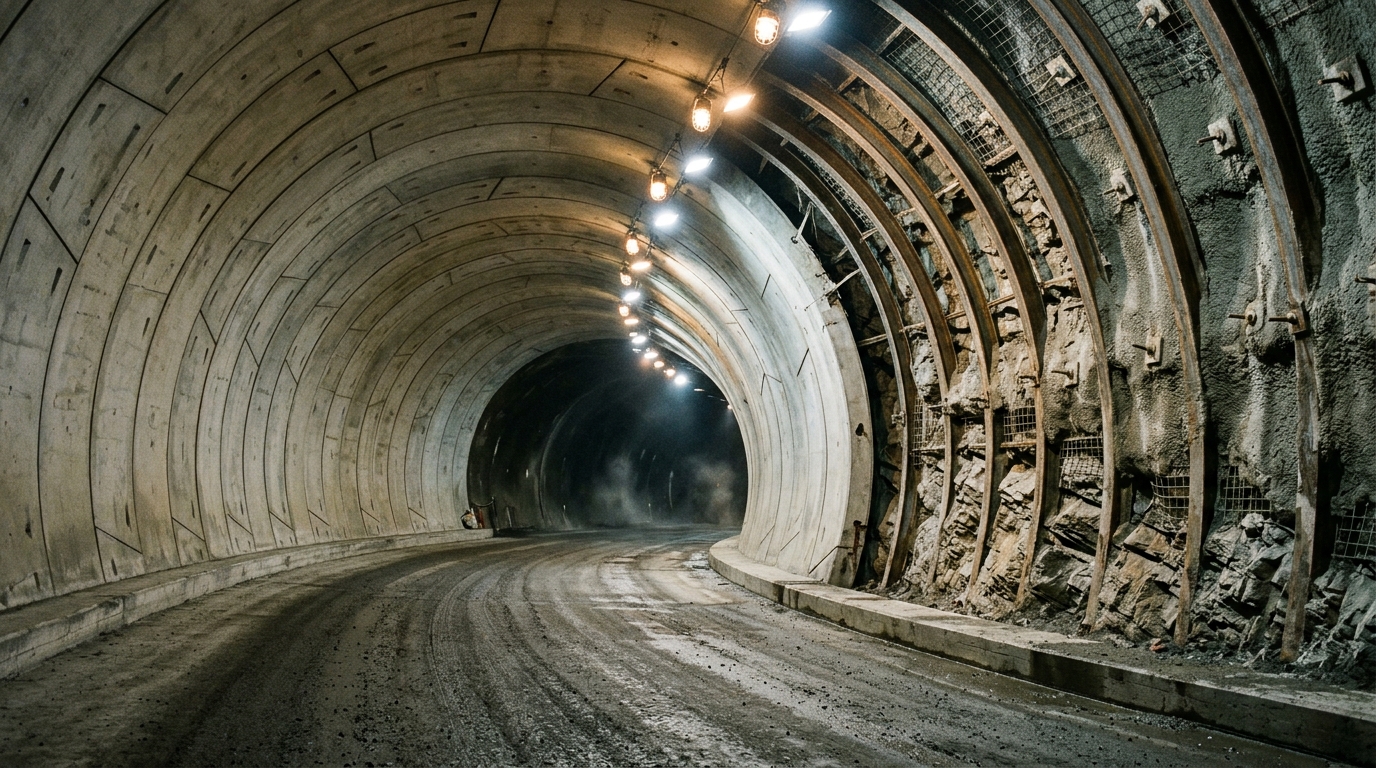
Stabilizing the excavated opening through the sedimentary sequence required a robust composite support system capable of arresting progressive ground movement while accommodating substantial excavation-induced deadweight. The primary structural stabilization installed along the freeway alignment consists of heavy HEB-180 structural steel arch profiles integrated with a continuous 0.25-meter-thick lining of cast C30 shotcrete, reinforced with supplementary rock bolts placed in accordance with local geological variations. Prior to numerical analysis, the interaction between the surrounding ground and structural lining was characterized using an analytical ground reaction formulation based on the Hoek and Brown failure criterion, which specifically accounts for overburden deadweight acting directly upon the tunnel crown. Analytical calculations established ground reaction pressures of 3.86 megapascals at the tunnel roof crown, 3.51 megapascals along the lateral sidewalls, and 3.178 megapascals across the tunnel invert floor. Against these ground loads, the installed primary support system provides a rated structural support resistance of 1.202 megapascals while permitting an allowable radial deformation threshold of 0.05727 meters before reaching structural capacity.
The three-dimensional numerical simulation was established within the Abaqus finite element analysis environment, constructing a representative continuum domain spanning 200 meters in total longitudinal length, 200 meters in vertical depth, and 20 meters in horizontal extrusion along the tunnel axis. Discretization was performed utilizing a free meshing scheme governed by the medial axis algorithm, generating a baseline mesh comprising 5,156 solid continuum elements. The structural lining was discretized as plate elements, with the 20-meter extrusion length divided into four sequential construction stages per tube to replicate staged excavation and installation cycles. The surrounding soft rock mass was assigned an elastoplastic constitutive relationship adhering to the isotropic Mohr-Coulomb failure criterion, reflecting an estimated rock mass elastic modulus of approximately 8 gigapascals. Researchers justified the continuum finite element formulation over discrete element methods because geological mapping demonstrated an absence of persistent joint sets or dominant intersecting discontinuity planes that would dictate discrete block detachment mechanisms at the engineering scale of the excavation.
The central procedural feature of the modeling workflow involves a structured sequential transition between distinct numerical solvers to preserve solution stability across elastoplastic yielding regimes. The simulation initiates with a geostatic step that establishes initial stress equilibrium under in-situ gravitational loading and horizontal earth pressures at rest prior to excavation, thereby preventing spurious artificial stress imbalances from corrupting subsequent steps. Once static equilibrium is achieved, excavation stages are simulated through an implicit-dynamic solver executed under carefully controlled quasi-static loading rates. Although implicit-dynamic algorithms inherently incorporate inertial equations of motion, loading velocities were regulated to ensure that inertial energy contributions remained negligible compared to internal strain energy accumulations. This hybrid approach effectively eliminates the severe mathematical convergence stalls that frequently paralyze standard static solvers during plastic shear localization, allowing smooth numerical resolution of transient stress redistribution and yielding mechanisms without introducing distorted dynamic wave propagation effects into the structural response.
Full three-dimensional simulation outputs demonstrated strong numerical consistency between the distinct solver formulations while closely matching field displacement observations recorded during actual tunnel construction. The implicit-dynamic solver calculated a maximum vertical displacement of 4.183 centimeters at the tunnel crown, whereas the purely geostatic calculation predicted a maximum vertical displacement of 4.536 centimeters. When compared with physical field displacement monitoring conducted across three discrete roof crown monitoring stations, the numerical predictions aligned within an overall relative error band of 2 to 12 percent, reflecting high correlation indices of 87.23 percent and 98.6 percent for the respective solver steps. At the first monitoring location, field instruments recorded vertical crown displacements of 4.9 centimeters and 4.1 centimeters across measurement intervals, while the second monitoring station registered corresponding deformations of 4.6 centimeters and 4.0 centimeters. Minor asymmetrical displacement discrepancies between geometrically symmetric left and right tunnel tubes were attributed to progressive stress redistribution induced by sequential excavation stages rather than computational error.
To rigorously verify numerical stability and eliminate artificial mesh dependencies, the authors conducted comprehensive spatial discretization checks alongside targeted parametric sensitivity evaluations. Reducing total mesh density by approximately 1,000 elements down to a coarser mesh of 4,156 elements yielded computed vertical displacements of 4.032 centimeters and 4.18 centimeters across solvers, representing a marginal 2.5 percent variation in key outputs and confirming robust mesh convergence. In parallel, because comprehensive laboratory testing data were unavailable, a sensitivity analysis evaluated model response to a uniform 15 percent reduction in principal geomechanical parameters, specifically Young’s modulus, cohesive strength, and internal friction angle. The parametric perturbation revealed that Young’s modulus exerted the primary governing control over global displacement magnitudes, whereas cohesion and friction angle predominantly influenced the spatial extent of plastic yielding and local energy redistribution. Crucially, across all parameter reductions, the simulation maintained continuous mathematical stability without altering fundamental deformation mechanisms or degrading solver consistency.
A critical innovation within the study was the implementation of a localized nodal strain-energy evaluation extracted from Node 535, situated directly at the center of the tunnel roof crown where overburden deadweight generates maximum vertical stress concentrations. The total structural work capacity of the installed composite lining was calculated from the nominal support pressure of 1.21 megapascals, the allowable displacement limit of 0.05727 meters, and the contact lining area of 0.0687 square meters, yielding a total energy absorption capacity of 1,002,016.6 joules. Extraction of the vertical nodal strain energy component revealed discrete transient energy peaks of approximately -31,000 joules and -42,000 joules, matched by positive Cartesian peaks slightly exceeding 20,000 joules and 21,000 joules. These localized energy fluctuations remained orders of magnitude below the structural lining’s rated capacity of over one million joules. The progressive attenuation and subsequent decay of transient energy oscillations over simulation increments confirmed that mechanical stabilization was successfully achieved through controlled structural yielding of the support.
The research demonstrates that an alternating multi-solver finite element workflow provides a reproducible, practical methodology for evaluating tunnel stability when civil engineering projects operate under data-limited geotechnical conditions. By bridging the operational gap between idealized numerical requirements and practical engineering data constraints, the framework enables reliable structural assessment without demanding uncalibrated constitutive complexities. Nevertheless, the investigators highlighted essential methodological boundaries, noting that their continuum Mohr-Coulomb model assumed isotropic material properties because available geological survey data could not support anisotropic calibration. While large-scale joint systems were absent in the investigated flysch formation, localized bedding-plane orientations between alternating sandstone and mudstone strata could induce secondary stress concentrations or minor kinematic shearing under differing geological alignments. Consequently, the authors caution that the workflow is intended for engineering design verification and preliminary screening rather than serving as an outright substitute for comprehensive site geomechanical investigations, recommending that future extensions incorporate transversely isotropic or strain-softening formulations as specialized laboratory testing data become accessible.
Subject of Research: Three-dimensional finite element modeling of tunnel stability and rock-support interaction
Article Title: Multi solver FEA 3D modelling approach for tunnel stability assessment
Article References: Allouache, A. N., & Lahmer, A. (2026). Multi solver FEA 3D modelling approach for tunnel stability assessment. International Journal of Geo-Engineering, 17(1), Article 21. https://doi.org/10.1186/s40703-026-00281-9
Image Credits: AI Generated
DOI: 10.1186/s40703-026-00281-9
Keywords: finite element analysis, tunnel stability, rock-support interaction, implicit-dynamic solver, geostatic initialization, strain energy, Texanna twin-tunnel, Mohr-Coulomb model, transportation geotechnics, underground engineering, mesh sensitivity, in-situ monitoring, shotcrete lining, steel arches, post-yield convergence, soft rock geomechanics
News Source: Denise Maddox. (November 20, 2026). Multi-Solver Finite Element Framework Accurately Predicts Freeway Tunnel Stability. Scienmag.