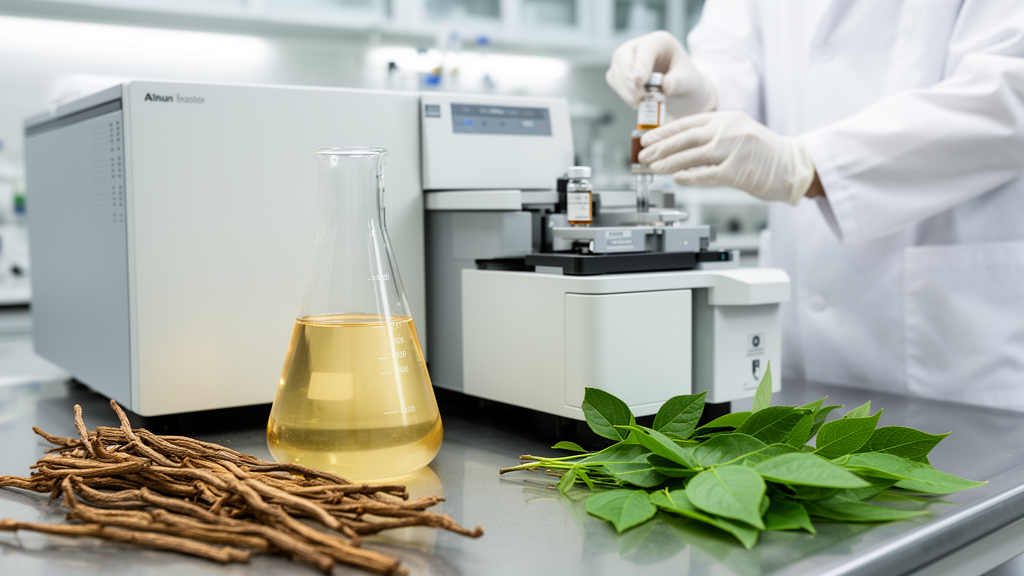
Guduchi Arka, a classical Ayurvedic hydro-distillate prepared from the stem of Tinospora cordifolia (Willd.) Miers, has been examined in a new open-access study combining pharmacopoeial quality testing, gas chromatography–mass spectrometry (GC–MS) profiling and computational network pharmacology. The work, published in Bioresources and Bioprocessing, reports that the distilled formulation met Ayurvedic Pharmacopoeia of India (API) safety parameters across batches made from raw material collected at three geographically distinct Indian sites, and that its volatile chemical profile was remarkably consistent regardless of where the crude drug originated. The authors also used in-silico tools to predict which molecular targets the formulation’s constituents might engage in connection with fever and cold-like illness.
It is important to state clearly what the study did and did not do. All therapeutic claims in the paper rest on laboratory quality analysis and computer modelling, including database-driven target prediction and molecular docking. No clinical trial, animal experiment or cell-based efficacy test was performed. The docking scores and the 248 overlapping gene targets reported are computational predictions of possible interactions, not demonstrated biological effects in patients. The findings therefore provide a standardisation framework and a set of testable hypotheses, not evidence that Guduchi Arka treats fever or the common cold.
The raw material came from Jhansi in Uttar Pradesh, Bengaluru in Karnataka and Itanagar in Arunachal Pradesh, locations chosen to represent central, southern and north-eastern India and a range of climates and altitudes. Dravyaguna and pharmacognosy experts at the Central Ayurveda Research Institute in Jhansi authenticated the samples. Macroscopic assessment found the three batches highly similar in appearance, all with brown colour, bitter taste and a coarse, fibre-like texture when powdered. Powder microscopy revealed cork cells in surface view, parenchymatous cells containing starch grains, lignified stone cells, bordered pitted vessels and lignified crystal fibres, characteristics the authors report as compliant with the API monograph for Guduchi, Part I, Volume I, number 27.
Physicochemical testing of the raw drug followed API guidelines and covered pH, loss on drying, ash values, and water- and alcohol-soluble extractive values. The paper reports moisture content of 5.56 to 5.66 percent, a pH of 6.61 to 6.81, water-soluble extractives of 19.19 to 19.25 percent and alcohol-soluble extractives of 7.06 to 7.09 percent. High-performance thin-layer chromatography (HPTLC) of methanolic extracts, developed in a toluene, ethyl acetate and formic acid solvent system and visualised under ultraviolet light, produced highly comparable Rf values across the three batches, which the authors interpret as a consistent non-volatile and semi-volatile phytochemical baseline in the starting material.
The arka itself was prepared by a standardised hydro-distillation method. In each batch, 2.5 kilograms of cleaned, washed and dried Guduchi powder were soaked overnight in 25 litres of water in a stainless-steel heating tank connected to a distillation assembly with a double-surface condenser. After boiling commenced, the temperature was held between 60 and 70 degrees Celsius, while chilled water circulating through the condenser was maintained at 5 to 18 degrees Celsius, plus or minus 2 degrees, by a refrigerated recirculating unit with a digital PID controller. Roughly 5 litres of distillate were collected, and the process was stopped when vapours appeared in the glass receiver. The finished arka was packed in pharmaceutical-grade airtight containers protected from light and moisture.
Quality control of the distillate showed a pH of 6.15 to 6.95, a specific gravity near 1.00 and an essential oil content of approximately 0.236 percent. On the safety side, the authors report that no pathogenic organisms were detected, that heavy metals, pesticide residues and aflatoxins were undetectable, and that total microbial counts, yeasts and moulds remained below API limits. Because the hydro-distillate is rich in volatile and semi-volatile compounds that can evaporate during standard HPTLC plate processing, the team did not apply HPTLC to the arka and instead turned to GC–MS for its chemical fingerprint.
The GC–MS/MS analysis used an Agilent 8890 system coupled to a 7000D triple quadrupole detector with two HP-5MS UI columns, helium carrier gas, an injection volume of 1 microlitre at a 5:1 split ratio, and an oven programme rising from 60 to 280 degrees Celsius and then to 310 degrees Celsius. Mass spectra of major peaks were matched against the NIST library. Across all three batches the arka contained a consistent array of compounds, including 1-eicosanol, alpha-campholenal, o-toluric acid, anethole, estragole, embelin, nicolaioidesin A, (-)-globulol, paliclavine and chamazulene. The authors argue that this consistency, despite the geographic diversity of the raw drug, suggests the distillation process acts as a kind of standardising step for volatile constituents, though this observation covers three batches and would need wider replication.
For the network pharmacology component, the ten phytoconstituents with percentage peak areas above one percent were screened. SwissTargetPrediction yielded 360 putative human targets after removing duplicates, while GeneCards searches for fever and cold-related terms returned 4,785 disease-associated targets. The intersection contained 248 shared targets. Mapping these in the STRING database at a high-confidence interaction threshold above 0.7 produced 1,090 edges with an enrichment p-value below 1.0e-16, and Cytoscape 3.10.2 was used to build a compound–target network. Gene Ontology and KEGG enrichment analyses, run at a false discovery rate of 0.05, highlighted biological processes and pathways the authors link to immune-inflammatory signalling, with the major KEGG pathways including cancer, metabolic, lipid and atherosclerosis pathways, a reminder that computational enrichment reflects statistical association rather than confirmed therapeutic relevance.
Three hub genes emerged from the protein–protein interaction network on the basis of interaction edge counts: HSP90AA1, EGFR and HSP90AB1. The top phytoconstituents by number of connections to common targets were nicolaiodesin A, with 77 edges, and embelin, with 39. Molecular docking with PyRx and the AutoDock Vina algorithm, using crystal structures of the three proteins from the Protein Data Bank, gave favourable predicted binding energies, with nicolaiodesin A docking to EGFR at a score of minus 7.2 kilocalories per mole and embelin docking to HSP90AA1 at minus 6.6 kilocalories per mole. The authors note that detailed mapping of specific amino acid interactions was outside the scope of this initial predictive screening, so the docking results should be read as corroboration of the network predictions rather than as proof of binding in living systems.
Taken together, the study delivers a documented set of quality parameters for Guduchi Arka, from raw-drug authentication through distillation conditions to finished-product physicochemical and microbial specifications, and proposes a plausible multi-component, multi-target model centred on chaperone and growth-factor signalling proteins. Within Ayurvedic practice, Guduchi is traditionally regarded as a rejuvenating plant, and arka preparations are described as liquid dosage forms with high bioavailability, though those traditional characterisations are not themselves validated by this work. What the paper establishes is analytical: the hydro-distillation process, as performed here, yielded a safe-by-pharmacopoeial-criteria product with a reproducible volatile profile across three source regions. What it proposes is mechanistic and entirely computational. The authors themselves frame the outcome as a scientific basis for future research, and the natural next steps would be experimental validation of the predicted compound–protein interactions in biological systems, followed by properly controlled studies before any conclusions about clinical effectiveness in fever or respiratory infection could be drawn.
Subject of Research: Quality control, GC–MS chemical profiling and in-silico network pharmacology of the Ayurvedic hydro-distillate Guduchi Arka prepared from Tinospora cordifolia
Article Title: Physicochemical evaluation, GC–MS-based phytoconstituent analysis and network pharmacology study of Guduchi Arka: an ayurvedic hydro-distillate
Article References: Sharma, D., Dane, G., Tandon, S., Jagtap, C., Kumar, V., Mondal, S., Thakur, A., Charde, V., Rawat, H., Nahar, R., Lale, S. K., Sharma, B. S., Khanduri, S., Maheshwar, T., Srikanth, N., & Acharya, R. (2026). Physicochemical evaluation, GC–MS-based phytoconstituent analysis and network pharmacology study of Guduchi Arka: an ayurvedic hydro-distillate. Bioresources and Bioprocessing, 13(1), Article 146. https://doi.org/10.1186/s40643-026-01127-z
Image Credits: AI Generated
DOI: 10.1186/s40643-026-01127-z
Keywords: Guduchi Arka, Tinospora cordifolia, Ayurveda, hydro-distillation, GC–MS, network pharmacology, molecular docking, HPTLC, phytochemistry, quality control, HSP90AA1, EGFR
News Source: Louis Brooks. (October 29, 2026). Ayurvedic Hydro-Distillate Guduchi Arka Profiled by GC–MS and Network Pharmacology. Scienmag.