When global temperatures spiked about 56 million years ago, three lineages of early hoofed mammals in Wyoming’s Bighorn Basin kept eating much the same things, according to a new dental microwear study. Researchers analyzed microscopic wear patterns on fossil molars of the archaic ungulates Copecion and Ectocion and the early perissodactyl Sifrhippus, spanning the late Paleocene, the Paleocene–Eocene Thermal Maximum (PETM), and the early Eocene. Across most measures of dental microwear, the lineages showed no significant change through the hyperthermal, and the wear textures of all three taxa most closely resembled those of modern frugivores and browsers rather than grazers.
The PETM was triggered by a massive release of isotopically light carbon, driving average global surface temperatures up by 5°C to 8°C over just a few thousand years. Warm conditions persisted through a roughly 100,000-year body of the event and a recovery interval of about 150,000 years. In western North America, where the record of the event is particularly complete, precipitation plummeted and aridification peaked during the latter half of the PETM, alongside more frequent extreme seasonal rainfall events. These conditions make the PETM a deep-time case study for how mammal communities respond to rapid warming.
The Bighorn Basin preserves a rich fossil record of mammals and plants from the late Paleocene Clarkforkian through the early Eocene Wasatchian land mammal ages, including a relatively complete stratigraphic column through the PETM. During the event, floral communities changed dramatically: mesophytic plants, particularly conifers, were locally and regionally extirpated, with floral turnover estimated at over 80 percent. Seasonally dry tropical conditions with open deciduous forests and savannas rich in ferns and Celtis trees took hold, and thermophilic, drought-tolerant tropical plants immigrated during the PETM body. Mammal communities changed too, through extinction, immigration, and phylogenetic dwarfing, with more than a dozen lineages losing as much as 80 percent of body mass before rebounding during recovery.
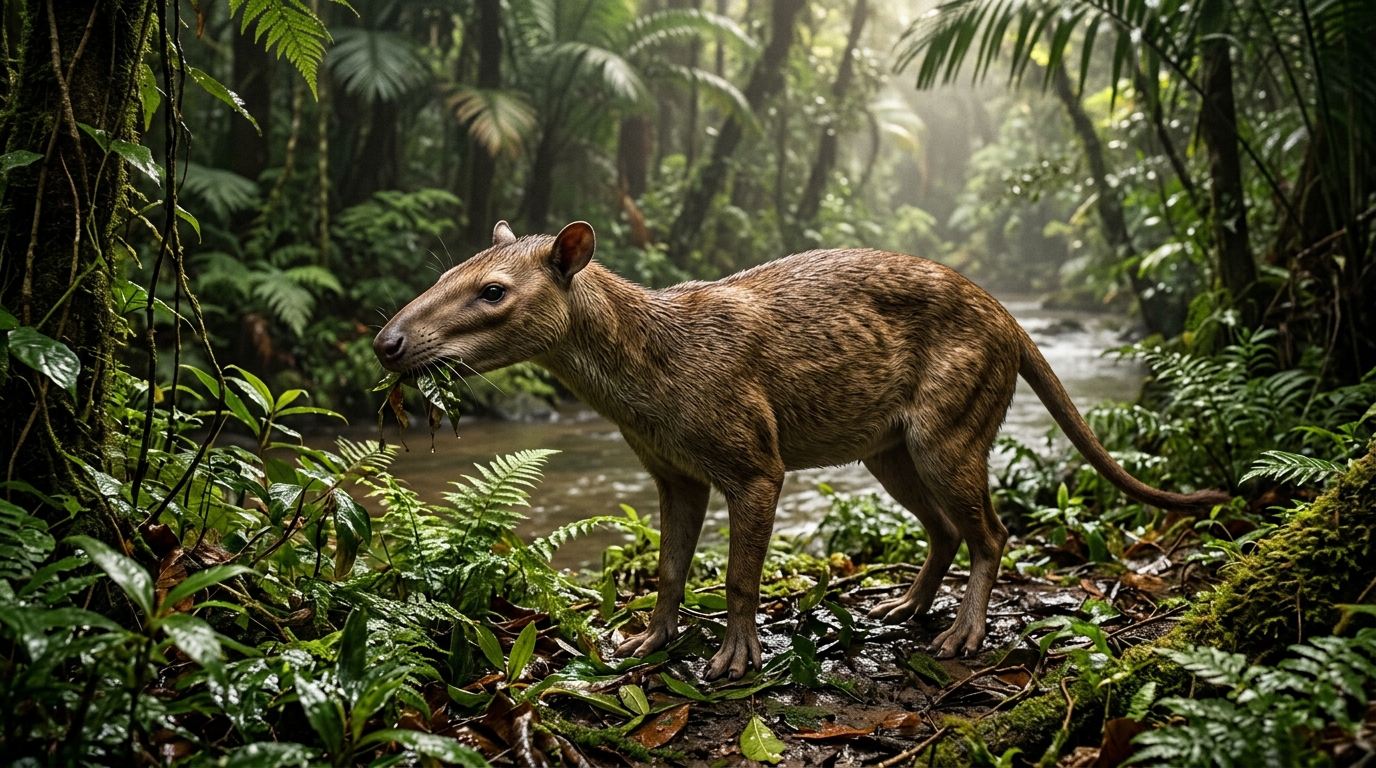
The phenacodontids Copecion and Ectocion persisted across the interval, with the Clarkforkian C. brachypternus and E. osbornianus replaced by the diminutive C. davisi and E. parvus during the PETM, and the larger species reappearing afterward. Sifrhippus, by contrast, appears abruptly in the basin during the PETM, likely immigrating from Eurasia across high-latitude dispersal routes opened by warming. Because all three lineages were relatively abundant despite substantial climatic and floral upheaval, the researchers used dental microwear texture analysis (DMTA) to ask how they partitioned resources and whether their diets shifted as the environment changed.
DMTA quantifies the three-dimensional texture of tooth wear surfaces using confocal profiling and scale-sensitive fractal analysis. The team sampled 106 specimens from museum collections, scanning wear facets on first and second molars and measuring five variables: complexity, anisotropy, scale of maximum complexity, textural fill volume, and heterogeneity of complexity. Complexity tends to be highest in frugivores and browsers eating hard or brittle foods, while anisotropy is highest in grazers processing tough grasses. Because dental microwear is overwritten after roughly two to three weeks through the last supper effect, the signals reflect diet shortly before death rather than a lifetime average.
To interpret the fossil signals, the researchers compared their data with a dataset of 585 specimens from 25 species of extant African bovids divided into six foraging guilds. All three ungulate lineages consistently differed from obligate and variable grazers across most variables while showing similarities with frugivores, browsers, and generalists. A quadratic discriminant analysis trained on the bovid data, which achieves 77.1 percent cross-validation accuracy, assigned the highest posterior probabilities to the frugivore guild for S. grangeri (70.3 percent), S. sandrae (62.4 percent), C. brachypternus from the Wasatchian (57.0 percent), and E. parvus (51.1 percent), though the authors stress these are measures of similarity to modern guilds rather than direct dietary classifications.
Within lineages, dental microwear remained remarkably stable. For Copecion, no significant differences were recovered across the studied interval, though a power analysis estimated that roughly 240 specimens would be needed to detect a moderate temporal shift, and the Clarkforkian sample of C. brachypternus included only four individuals. For Ectocion, the one significant change was in textural fill volume, which was lower in the Clarkforkian E. osbornianus than in both E. parvus from the PETM and E. osbornianus from the Wasatchian. For Sifrhippus, high-resolution stratigraphic sampling at the Cabin Forks locality revealed no significant trends across the PETM body and recovery, with only complexity approaching significance.
The increase in textural fill volume in Ectocion without a corresponding rise in complexity puzzled the authors, since the two measures are usually correlated. They propose several explanations, including lineage-specific shifts in resource use, selective consumption of plant tissues rich in phytoliths, or increased contact with exogenous grit as aridity raised dust loads in the basin. Experiments show that exogenous particles can generate and modify dental microwear and that grit and diet interact, but the independent effects of grit on DMTA variables remain incompletely resolved, so the authors cannot yet distinguish between these alternatives.
The study also found substantial dietary overlap among contemporaneous taxa. During the PETM, S. sandrae differed from the dwarfed phenacodontids mainly in having higher complexity and heterogeneity of complexity and lower scale of maximum complexity, suggesting the immigrant perissodactyl consumed a greater variety of wear-causing particles. After the PETM, only scale of maximum complexity distinguished the three lineages, being highest in E. osbornianus. The authors suggest this broad overlap is compatible with niche unsaturation in the basin, microhabitat partitioning, or neutral coexistence, but note that DMTA alone cannot identify which ecological process permitted coexistence.
Several caveats temper the findings. The comparative dataset derives from ruminant bovids rather than phylogenetically closer non-ruminant ungulates, and phenacodontids had more primitive, compression-dominated chewing that may introduce uncertainty. Many early ungulate specimens showed complexity values exceeding those of any modern bovid, comparable instead to the hard-object-feeding tufted capuchin, and the absence of hard-object-specialized bovids in the reference set may contribute to these outliers. Ferns and horsetails, prominent in Bighorn Basin floras, could plausibly produce microwear resembling that of grazers, but no experimental data link their consumption to specific textures. The authors also caution that the PETM should not be viewed as a direct analog for future climate change given today’s faster warming rates, and that the limited dietary responses observed here should not be read as evidence that modern ecosystems will remain similarly stable.
Subject of Research: Dental microwear analysis of Paleocene–Eocene ungulate diets across the PETM in the Bighorn Basin
Article Title: Shifting Dietary Ecologies of Early Ungulates Across the Paleocene–Eocene Thermal Maximum in the Bighorn Basin, Wyoming
Article References: Schwartz, A., DeSantis, L. R. G., & Scott, R. S. (2026). Shifting Dietary Ecologies of Early Ungulates Across the Paleocene–Eocene Thermal Maximum in the Bighorn Basin, Wyoming. Ecology and Evolution, 16(11), Article e74613. https://doi.org/10.1002/ece3.74613
Image Credits: AI Generated
DOI: 10.1002/ece3.74613
Keywords: PETM, Bighorn Basin, dental microwear, Copecion, Ectocion, Sifrhippus, Paleocene–Eocene Thermal Maximum, paleodiet, phylogenetic dwarfing, early ungulates, frugivory, climate change
News Source: Drew Townsend. (November 5, 2026). Ancient Wyoming Ungulates Kept Similar Diets Through Rapid PETM Warming. Scienmag.