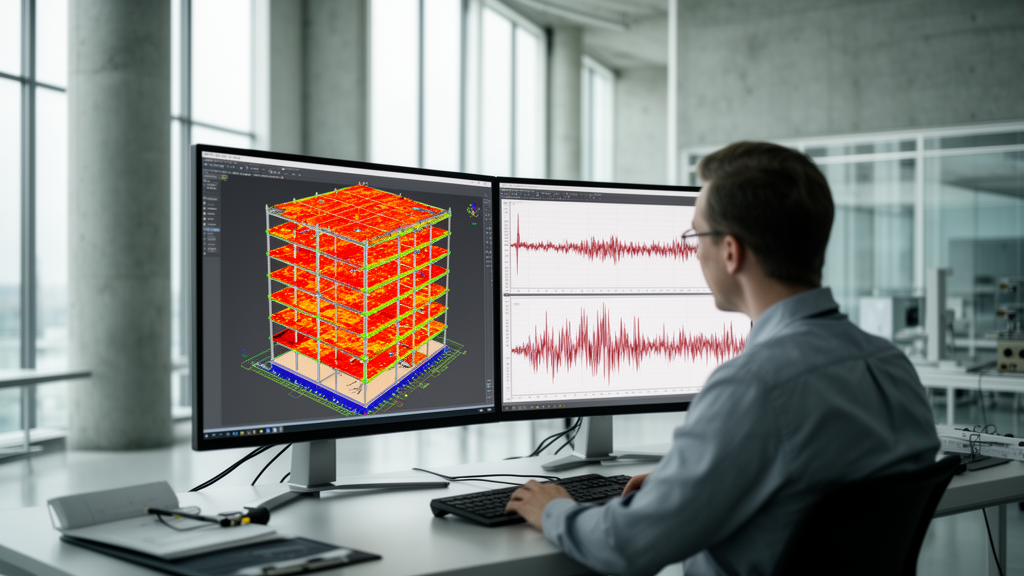
The model, described in the journal AI in Civil Engineering, predicts four key indicators of structural health: maximum displacement, maximum inter-storey drift, base shear, and maximum overturning moment. None of these quantities require sensors bolted to the building or inspectors climbing through damaged floors. Instead, the system draws entirely on earthquake ground motion data that are freely available online, offering a non-intrusive and low-cost route to rapid post-earthquake assessment.
The motivation is straightforward. After a significant earthquake, decisions about whether occupants can re-enter a building, whether rescue teams can work nearby, and where rehabilitation resources should flow first depend on a fast and reliable picture of structural integrity. Conventional approaches struggle to deliver that picture quickly. Visual inspection is slow and subjective, and full finite element modelling of an individual damaged structure is time-consuming and resource-intensive, making both impractical for large-scale deployment in the chaotic hours after a major event. The researchers, Rohit Patel and Aloke Kumar Datta, set out to bypass the need for physical measurements altogether by teaching a neural network to infer structural response directly from the characteristics of the shaking itself.
Their approach rests on a carefully constructed training dataset generated from validated finite element simulations. Six five-storey reinforced concrete buildings with shear walls placed at different locations were modelled in the finite element software ETABS, designed in accordance with IS 456:2000 and detailed to resist earthquake forces corresponding to seismic zone V under IS 1893 (Part 1):2016. Modal analysis of each building extracted its natural periods and frequencies, the dynamic fingerprints that determine how a structure responds to particular frequencies of ground shaking. The placement of the shear walls mattered: the study notes that peripheral shear wall arrangements provide superior resistance to lateral earthquake forces, a finding consistent with earlier work on shear wall configuration.
Ground motion records for the study came from the Pacific Earthquake Engineering Research Center (PEER) Ground Motion Database. In total, 90 real earthquake records were retrieved, processed in MATLAB and Microsoft Excel, and transformed from the time domain into the frequency domain using the Fast Fourier Transform. This step allowed the team to compare the dominant frequency content of each record with the natural frequencies of each building. Where a ground motion’s predominant frequency closely matched a structural natural frequency, a resonance-like condition arises, representing a critical scenario for structural safety. Records with significant spectral overlap with the buildings’ natural frequencies were selected, fifteen for each of the six models, so that the training data deliberately included the most dangerous excitation scenarios. The logic is that if a model performs well under resonant loading, it should also be adequate for less severe events.
Each selected record was then fed into a non-linear time-history analysis in ETABS, producing the four output parameters: maximum displacement, maximum inter-storey drift, base shear, and overturning moment. Together these quantities capture both the deformation behaviour of the structure and its overall stability under seismic loading, and they serve as essential indicators of building health in the immediate aftermath of an earthquake. The result was a paired dataset of ground motion characteristics and simulated structural responses on which the neural network could be trained.
The artificial neural network itself follows a conventional feedforward architecture with two hidden layers of ten neurons each, trained using the Levenberg–Marquardt optimisation algorithm, a method well suited to minimising error functions during network training. The 90 samples were randomly divided into 70 percent for training, 15 percent for testing, and 15 percent for validation. Performance was measured with the regression coefficient, which quantifies the correlation between predicted and actual values. The trained model achieved regression values of 96.517 percent for training, 99.548 percent for validation, and 99.589 percent for testing, with an overall regression value of 97.48 percent, indicating that the network generalised well to data it had never seen during training.
Validation went beyond simply re-testing the model on the same buildings. The trained network was first used to predict the structural response of one of the original building configurations under a new earthquake record, the Mammoth Lakes-09 event of 1980, with the predictions compared against reference values generated independently in ETABS. The team then went further, modelling an entirely new five-storey reinforced concrete building with a different layout, a square plan of 22.5 by 22.5 metres, M30 grade concrete, Fe 415 grade reinforcing steel, and 300-millimetre-thick shear walls at each corner. Under the Taiwan SMART1(5) record from 1981, the model’s predictions of displacement, drift, base shear, and overturning moment were again compared with full ETABS simulations, providing a test of whether the network had learned relationships that transfer between structures rather than memorising one configuration.
To demonstrate scalability, the researchers extended the framework to two taller, more realistic structures: a 15-storey building designed for seismic zone V and a 20-storey building designed for seismic zone IV, both compliant with Indian standard provisions but deliberately differing in material grades and cross-sectional dimensions. For these real-type buildings, 60 ground motions were retrieved from the PEER database, with 30 selected for each building on the basis of frequency matching. The ANN for this phase used six inputs, three ground motion parameters (peak ground acceleration, duration, and frequency) and three building geometric parameters (length, width, and height), and a single hidden layer of ten neurons. Trained on 60 samples with the same 70/15/15 split, the model reached regression values of 97.026 percent for training, 99.050 percent for validation, and 97.996 percent for testing, with an overall regression value of 97.528 percent. When tested on new ground motions, the Tottori, Japan earthquake of 2000 for the 15-storey building and the Anza (Horse Canyon)-01 record of 1980 for the 20-storey building, the predictions were compared against ETABS simulations to confirm accuracy.
The practical payoff is speed. The researchers report that the prediction time for all four health parameters is less than one minute, while the model maintains its overall regression value of 97.528 percent. Because the method requires no in-situ measurements of structural response, it can in principle deliver an assessment immediately after an earthquake, before inspection teams can reach the site. The authors emphasise that the approach facilitates rapid post-earthquake rehabilitation by removing the need for instrumented monitoring, and that the methodology could be extended to other building types, paving the way toward a generalised AI-driven structural health assessment system.
Important caveats remain. The model was trained and validated entirely on finite element simulations rather than measurements from real damaged buildings, so its performance on actual structures in real earthquakes has not yet been demonstrated in the field. The dataset, while spanning a wide range of ground motion frequencies matched to structural natural frequencies, is limited in scope, and the authors themselves identify substantial future work: enriching the dataset with records from more diverse seismic events, magnitudes, epicentral distances and soil conditions; incorporating additional inputs such as soil properties, construction materials and structural detailing; expanding the outputs to include damage indices and damage states; exploring more advanced architectures such as convolutional and recurrent networks; and adding uncertainty quantification so that predictions come with confidence intervals. Integrating such tools into decision-support systems with user-friendly interfaces, they argue, would ultimately allow structural engineers, building owners and emergency responders to act on the predictions during and after seismic events. For now, the study stands as a demonstration that a neural network trained on simulated responses can reproduce those responses rapidly and accurately for the building classes examined, a step toward faster and less intrusive seismic risk assessment for high-rise shear wall buildings.
Subject of Research: Artificial intelligence-based rapid post-earthquake structural health assessment of reinforced concrete shear wall buildings using ground motion data
Article Title: An artificial intelligence model for rapid health assessment of earthquake-affected shear wall buildings: a disaster mitigation study
Article References: Patel, R., & Datta, A. K. (2026). An artificial intelligence model for rapid health assessment of earthquake-affected shear wall buildings: a disaster mitigation study. AI in Civil Engineering, 5(1), Article 22. https://doi.org/10.1007/s43503-026-00105-w
Image Credits: AI Generated
DOI: 10.1007/s43503-026-00105-w
Keywords: artificial intelligence, neural network, earthquake engineering, structural health monitoring, shear wall buildings, seismic assessment, ground motion records, finite element analysis, ETABS, inter-storey drift, base shear, disaster mitigation
News Source: Violet Maxwell. (October 28, 2026). AI predicts earthquake damage in buildings in under a minute using only ground motion data. Scienmag.