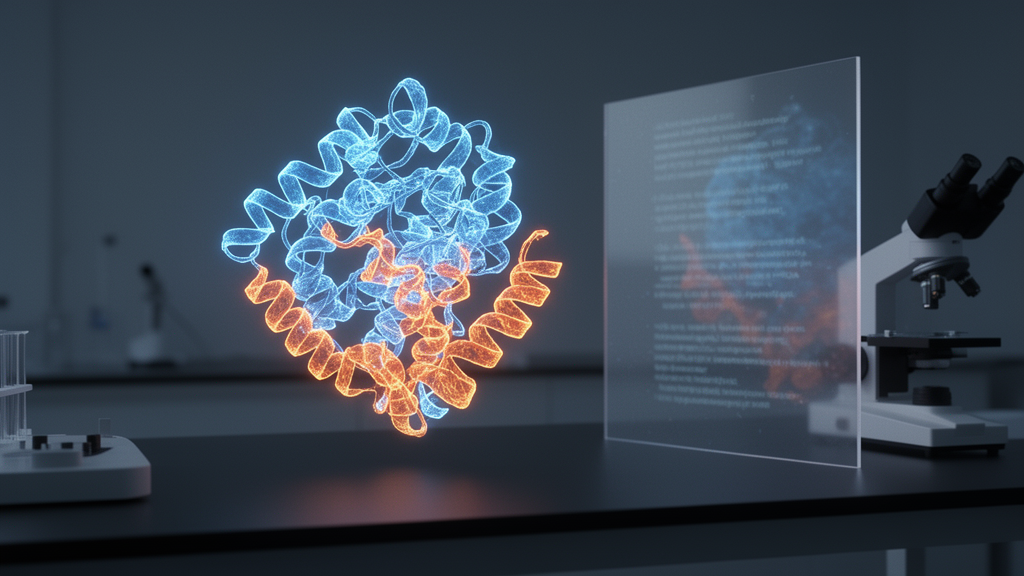
Scientists have unveiled a 16-billion-parameter artificial intelligence model that can design entirely new proteins from simple natural-language descriptions of the function they should perform, and the designs worked in the laboratory.
According to the researchers, existing protein-design models face a fundamental limitation: they typically require either natural proteins as starting points for optimization, or the manual reformulation of functional goals into geometric and sequence-level constraints to guide candidate generation. Pinal was built to bypass that bottleneck. It was trained on 1.7 billion synthetically annotated protein–text pairs, allowing it to link a statement of functional intent directly to protein sequence and structure.
In computational evaluations, the team reports that proteins generated by Pinal combined high predicted foldability with alignment to their functional descriptions and high sequence diversity. The authors note that this provides a basis for prioritizing which computationally generated candidates are worth testing experimentally, rather than committing laboratory resources to every design the model produces.
The real test came in the wet lab. The researchers applied Pinal to four distinct design tasks: a fluorescent protein, a polyethylene terephthalate (PET) hydrolase, an alcohol dehydrogenase and a metabolic H-protein. In each case, they experimentally observed the intended function, including catalytic activity for both of the designed enzymes.
One result stands out for its potential relevance to climate-related biotechnology. Without any iterative experimental optimization, a Pinal-designed H-protein increased product titre by 1.7-fold relative to the corresponding native Escherichia coli H-protein when incorporated into a multi-enzyme CO2 fixation pathway. The H-protein is a component of such synthetic pathways, and the comparison was made against the native bacterial version of the same protein within the same system.
The authors caution that the findings support natural language as a high-level interface for candidate generation in protein design, enabling programmable exploration with reduced reliance on manually specified structural or sequence constraints. In other words, the model’s value lies in opening a new, more accessible way to generate testable candidates, not in replacing experimental validation. Every design described in the paper still had to be synthesized and tested in the laboratory before its function could be confirmed.
The work sits within a broader push to make protein engineering more programmable. Designing bespoke proteins to perform specified molecular tasks is described by the researchers as a foundational goal of molecular engineering, with applications that could range from enzyme catalysis to metabolic pathway construction. The four validated functional classes in this study, spanning fluorescence, plastic-degrading hydrolase activity, alcohol dehydrogenase activity and a metabolic pathway component, illustrate the range of tasks the model was asked to attempt.
Because the published abstract is the extent of the publicly available content, with the full article behind a subscription paywall, important details such as the number of designs attempted per task, success rates, and the precise experimental assays used remain outside what can be reported here. The authors’ computational benchmarks, presented in figures covering scaling behaviour, design performance, the diversity of generated proteins and the translation of diverse functional prompts into candidates, are likewise summarized only at a high level in the available material.
What the available evidence does establish is a proof of concept: a single foundation model, trained on protein–text pairs rather than manually engineered constraints, produced candidate proteins that functioned as described across four different protein classes, and one of those designs outperformed its natural counterpart in a defined pathway context. The researchers frame this as a step toward treating natural language as an interface for programmable protein design, with the caveat that experimental testing remains the necessary arbiter of function.
Subject of Research: A foundation model that designs functional proteins from natural-language descriptions
Article Title: Programmable design of functional proteins from natural language
Article References: Dai, F., You, S., Zhu, Y., Gao, Y., Fu, L., Zhou, X., Su, J., Wang, C., Fan, Y., Tan, Q., Ma, X., Deng, X., Yu, L., Qian, H., He, Y., Ke, Y., Zhang, Z., Han, C., Chang, X., … Yuan, F. (2026). Programmable design of functional proteins from natural language. Nature. https://doi.org/10.1038/s41586-026-11205-z
Image Credits: AI Generated
DOI: 10.1038/s41586-026-11205-z
Keywords: protein design, artificial intelligence, foundation model, natural language, enzyme engineering, CO2 fixation, synthetic biology, Pinal, machine learning, biotechnology, Programmable, design
News Source: Blake Davidson. (October 27, 2026). AI model designs working proteins from plain-language descriptions. Scienmag.