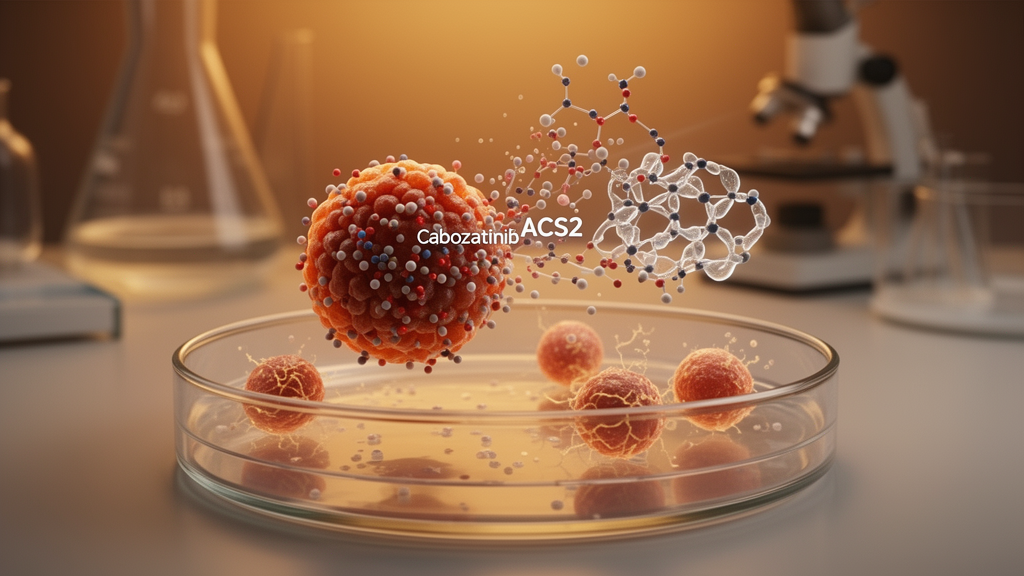
Cabozantinib increased autophagic flux in hepatocellular carcinoma cells, helping protect the cancer cells from the drug’s growth-inhibitory and pro-apoptotic effects, according to a laboratory study. Combining cabozantinib with either an inhibitor of ACSS2 or the autophagy inhibitor chloroquine enhanced antitumor activity in cell cultures and animal models. The findings identify a potential resistance mechanism and a candidate combination strategy, but they do not establish clinical benefit in people with hepatocellular carcinoma.
Researchers used RNA sequencing to analyze changes in gene expression after cabozantinib treatment in hepatocellular carcinoma cells. They also used a luciferase reporter assay to measure the transcriptional activity of transcription factor EB, or TFEB. Additional experiments examined the effects of cabozantinib alone or in combination with autophagy inhibitors, with findings assessed in vitro and in vivo. The study’s mechanistic and therapeutic experiments were conducted in preclinical models rather than in patients.
The mechanistic results indicated that cabozantinib increased the expression of acetyl-CoA synthetase 2, or ACSS2, and promoted its nuclear translocation. Nuclear ACSS2 was linked to activation of TFEB. TFEB then bound to promoter regions of lysosomal and autophagy-related genes, promoting lysosomal biogenesis and inducing autophagic flux. Thus, the experiments placed ACSS2 upstream of TFEB-dependent autophagy in the response of hepatocellular carcinoma cells to cabozantinib. The authors described this process as a protective response that counteracted the drug-induced inhibition of cell growth and apoptosis.
Impairing autophagy increased the cancer-cell killing associated with cabozantinib. Downregulating ACSS2 promoted cabozantinib-induced apoptosis, while treatment with an ACSS2 inhibitor enhanced the antitumor efficacy of cabozantinib in vitro and in vivo. Chloroquine produced a similar enhancement when used in combination with cabozantinib, supporting the conclusion that blocking autophagic flux can increase sensitivity to the treatment. These results were reported across both cell-based and animal experiments, although the supplied study abstract does not provide numerical response measures, statistical results, model details or other effect-size estimates.
The study proposes that cabozantinib can induce an ACSS2-TFEB-autophagy pathway that allows hepatocellular carcinoma cells to resist treatment, and that inhibiting ACSS2 or autophagy may counteract that response. The work offers a mechanistic basis for examining cabozantinib-based combinations in hepatocellular carcinoma. Its scope is preclinical: the reported evidence comes from cancer cells and animal models, not a clinical trial. Accordingly, the results show enhanced antitumor activity in experimental models and do not yet demonstrate that the combinations improve outcomes for patients with liver cancer.
Subject of Research: Preclinical enhancement of cabozantinib activity in hepatocellular carcinoma through ACSS2 and autophagy inhibition
Article Title: Inhibition of ACSS2 enhances cabozantinib sensitivity by blocking TFEB-induced autophagic flux in hepatocellular carcinoma
Article References: Feng, X., Lan, J., Du, J., Jiang, C., Qiu, G., Song, Y., Zhou, X., Zhang, Z., Xu, L., Hu, D., Liang, Y., Huang, J., Zeng, Y., & Yuan, K. (2026). Inhibition of ACSS2 enhances cabozantinib sensitivity by blocking TFEB-induced autophagic flux in hepatocellular carcinoma. British Journal of Cancer. https://doi.org/10.1038/s41416-026-03538-3
Image Credits: AI Generated
DOI: 10.1038/s41416-026-03538-3
Keywords: hepatocellular carcinoma, cabozantinib, ACSS2, TFEB, autophagic flux, drug resistance, chloroquine, lysosomal biogenesis, cancer cells, animal models, Inhibition, enhances
News Source: Nathaniel Bowman. (October 21, 2026). ACSS2 inhibition boosts cabozantinib activity in liver cancer models. Scienmag.