• HOME
  • NEWS
  • EXPLORE
    • CAREER
      • Companies
      • Jobs
    • EVENTS
    • iGEM
      • News
      • Team
    • PHOTOS
    • VIDEO
    • WIKI
  • BLOG
  • COMMUNITY
    • FACEBOOK
    • INSTAGRAM
    • TWITTER
Sunday, August 16, 2026
BIOENGINEER.ORG
No Result
View All Result
  • Login
  • HOME
  • NEWS
  • EXPLORE
    • CAREER
      • Companies
      • Jobs
        • Lecturer
        • PhD Studentship
        • Postdoc
        • Research Assistant
    • EVENTS
    • iGEM
      • News
      • Team
    • PHOTOS
    • VIDEO
    • WIKI
  • BLOG
  • COMMUNITY
    • FACEBOOK
    • INSTAGRAM
    • TWITTER
  • HOME
  • NEWS
  • EXPLORE
    • CAREER
      • Companies
      • Jobs
        • Lecturer
        • PhD Studentship
        • Postdoc
        • Research Assistant
    • EVENTS
    • iGEM
      • News
      • Team
    • PHOTOS
    • VIDEO
    • WIKI
  • BLOG
  • COMMUNITY
    • FACEBOOK
    • INSTAGRAM
    • TWITTER
No Result
View All Result
Bioengineer.org
No Result
View All Result
Home NEWS Science News Chemistry

A scanning transmission X-ray microscope for analysis of chemical states of lithium

Bioengineer by Bioengineer
January 14, 2021
in Chemistry
Reading Time: 2 mins read
0
IMAGE
Share on FacebookShare on TwitterShare on LinkedinShare on RedditShare on Telegram

IMAGE

Credit: NINS/IMS

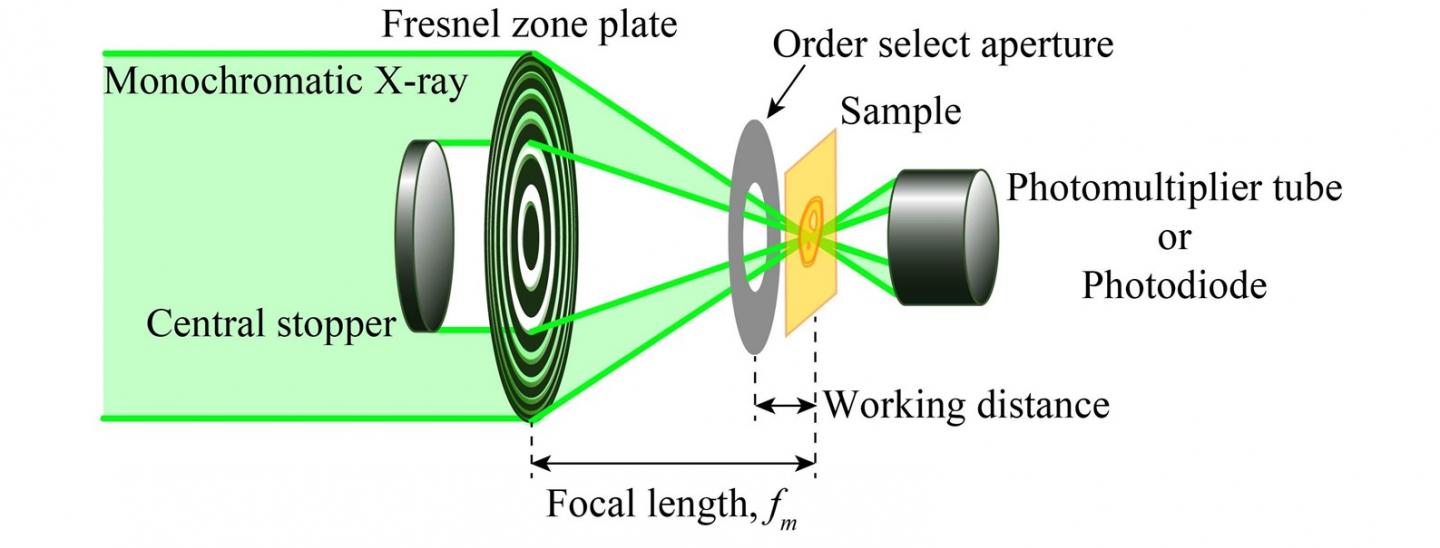
Lithium-ion batteries (LIB) are widely used for daily products in our life, such as hybrid cars, cell phone, etc. but their charge/discharge process is not fully understood yet. To understand the process, behaviors of lithium ion, distribution and chemical composition and state, should be revealed. A research group in Institute for Molecular Science noticed on a scanning transmission X-ray microscope (STXM, shown in Fig. 1) as a powerful technique to perform X-ray absorption spectroscopy (XAS) with high spatial resolution. By using absorption edge of a specific element, 2-dimensional chemical state of a sample can be obtained. To analyze lithium by the STXM, the Li K absorption edge (55 eV) in low energy region makes it difficult to measure the XAS due to lack of a proper optical element and tremendous higher-order harmonics from a monochromator which contaminate XAS. Therefore, a low-pass filtering zone plate (LPFZP), a focusing optical element of the STXM, was developed to overcome these issues. The LPFZP uses silicon of 200 nm thick as a substrate of the zone plate and the substrate works as a low-pass filter above 100 eV by using Si L2,3 edges. The hybrid optics of the LPFZP can suppress the higher-harmonics without installing an additional optical component into the STXM. As a result, the STXM with the LPFZP suppresses higher-order harmonics down to 0.1% of an original intensity and enables to measure XAS spectra of the Li K-edge. Then the spatial resolution was estimated as 72 nm.

A thin section sample of a test electrode of the LIB was analyzed. The sample is made of Li2CO3 by a focusing ion-beam process. The STXM image at 70 eV and the Li K-edge XAS spectra are shown in Fig. 2(a) and 2(b), respectively. The XAS spectra are successfully obtained from the regions indicated by circles in Fig. 2(a).

To understand the behavior of lithium in the LIB is necessary to improve its performance. Then, the STXM with the LPFZP will be helpful to analyze that with high spatial resolution.

###

Media Contact
Takuji Ohigashi
[email protected]

Original Source

https://www.ims.ac.jp/en/

Related Journal Article

http://dx.doi.org/10.1063/5.0020956

Tags: Chemistry/Physics/Materials SciencesEnergy/Fuel (non-petroleum)Industrial Engineering/ChemistryMaterialsNanotechnology/MicromachinesOptics
Share12Tweet8Share2ShareShareShare2

Related Posts

Butterfly-Inspired Technology Could Transform Air Quality Monitoring

August 15, 2026
Artesunate Targets GBA, Triggering Apoptosis in Liver Cancer Cells

Artesunate Targets GBA, Triggering Apoptosis in Liver Cancer Cells

August 15, 2026

New molecule may enable cleaner, more efficient metal recovery

August 15, 2026

Controlled sulfidation enhances supercapacitor electrode performance

August 15, 2026
Please login to join discussion

POPULAR NEWS

  • KAIST develops semiconductor neuron that harnesses noise to selectively process signals

    29 shares
    Share 12 Tweet 7
  • Imagining natural and extra robotic thumbs together strengthens kinesthetic sensorimotor networks

    29 shares
    Share 12 Tweet 7
  • PARP1 Drives Neuropathic Pain Through GPX4-Dependent Ferroptosis in Injured Mice’s Sensory Neurons

    29 shares
    Share 12 Tweet 7
  • Strubbelig–NHL3 Receptor Complex Helps Arabidopsis Respond to Cellulose Deficiency

    29 shares
    Share 12 Tweet 7

About

We bring you the latest biotechnology news from best research centers and universities around the world. Check our website.

Follow us

Recent News

KAIST develops semiconductor neuron that harnesses noise to selectively process signals

Imagining natural and extra robotic thumbs together strengthens kinesthetic sensorimotor networks

PARP1 Drives Neuropathic Pain Through GPX4-Dependent Ferroptosis in Injured Mice’s Sensory Neurons

Subscribe to Blog via Email

Success! An email was just sent to confirm your subscription. Please find the email now and click 'Confirm' to start subscribing.

Join 85 other subscribers
  • Contact Us

Bioengineer.org © Copyright 2023 All Rights Reserved.

Welcome Back!

Login to your account below

Forgotten Password?

Retrieve your password

Please enter your username or email address to reset your password.

Log In
No Result
View All Result
  • Homepages
    • Home Page 1
    • Home Page 2
  • News
  • National
  • Business
  • Health
  • Lifestyle
  • Science

Bioengineer.org © Copyright 2023 All Rights Reserved.