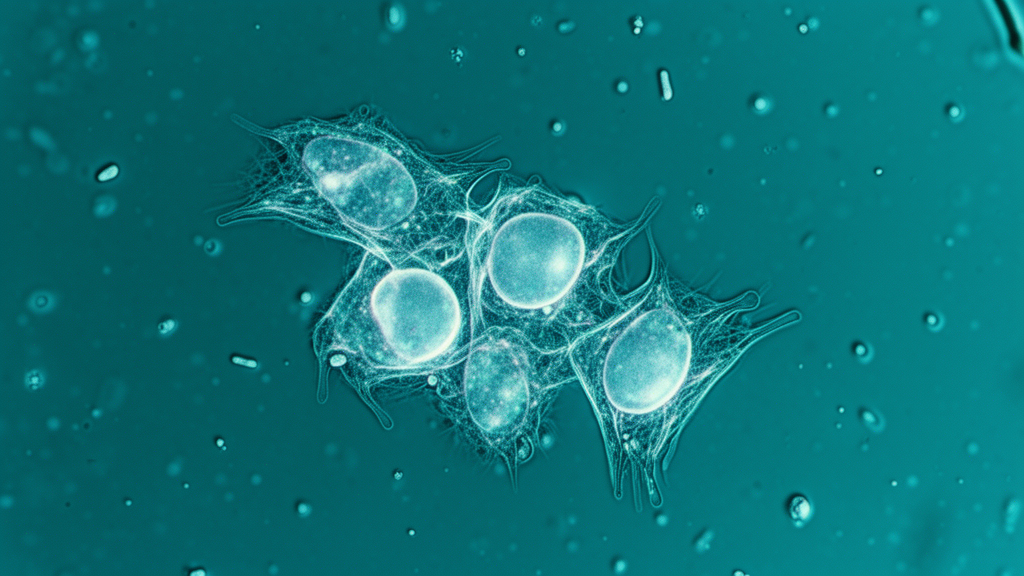
HeLa cells exposed to escalating concentrations of 5-ethynyl-2′-deoxyuridine develop resistance through a non-linear evolutionary trajectory culminating in complete transcriptomic desensitization rather than traditional repair pathways, according to research published in Cancer Cell International. The study demonstrated that HeLa cells subjected to adaptive laboratory evolution transition from acute replication stress to an unreactive transcriptional state, bypassing canonical DNA damage responses entirely while acquiring near-total resistance to drug-induced cell death.
Resistance to nucleoside-like compounds remains a formidable obstacle in oncology, particularly because the specific transcriptional pathways governing how tumor cells adapt under mounting drug pressure have not been sufficiently elucidated for several clinically promising agents. The investigational compound evaluated, 5-ethynyl-2′-deoxyuridine (EdU), is a thymidine analogue characterized by direct antitumor efficacy and the capacity to cross the blood-brain barrier. Under standard exposure conditions, EdU induces lethality by inhibiting the enzyme thymidylate synthase, arresting replication forks, and provoking a destructive, futile cycle mediated by nucleotide excision repair.
To delineate the evolutionary dynamics of resistance across progressive concentration thresholds, investigators implemented an adaptive laboratory evolution model using HeLa cell populations. Through this systematic exposure protocol, the research team generated six distinct resistant cell line stages, with resistance levels escalating incrementally from 0.1 µM to 80 µM EdU. Each staged cell line was subsequently profiled using cell viability testing, immune-slot blot quantification to measure EdU incorporation into genomic DNA, bright-field microscopy for morphological assessment, and high-throughput RNA sequencing conducted both under untreated conditions and following an acute 24-hour challenge with 10 µM EdU.
Transcriptomic profiling across the evolutionary timeline revealed five discrete mechanistic phases. The adaptation process commenced with an initial stress readiness phase, followed by persistent cell-like AP-1 and EGR arrest. Cells subsequently entered a third stage defined by AP-1 signaling re-stimulation and heightened transcriptional complexity, which progressed into a fourth phase where the integrated stress response governed by the transcription factor ATF4 reached its maximum activity. In the terminal evolutionary stage, the cell lines achieved a state of comprehensive transcriptional silence in their response to EdU exposure.
Remarkably, HeLa cells that acquired near-complete resistance to EdU-driven cell death exhibited no activation of canonical AP-1, inflammatory, or DNA damage-related transcriptional cascades following acute drug rechallenge. The researchers defined this silent state as transcriptomic desensitization, highlighting that it operates through principles fundamentally distinct from conventional nucleoside analogue resistance. Standard resistance frameworks typically depend on the compensatory upregulation of thymidylate synthase or the amplification of core DNA repair machinery, yet neither of these alterations occurred in the adapted cell lines.
Instead, mechanistic analysis revealed that the acquired resistance phenotype is anchored by two alternative molecular mechanisms: metabolic exclusion achieved via transcriptional suppression of the SLC22A17 transporter, and the progressive remodeling of cellular identity toward a partial epithelial-mesenchymal transition (EMT) phenotype. These findings make EdU resistance a useful and investigable model for studying transcriptional adaptation processes to genotoxic nucleoside analogues, particularly those directly associated with glioblastoma combination therapies.
The study was conducted by researchers Musa Tartik, Kaan Arslan, Barış Kerimoğlu, and Aziz Sancar, and appeared in Cancer Cell International in November 2026.
Subject of Research: Evolutionary mechanisms of HeLa cell resistance to the thymidine analogue 5-ethynyl-2'-deoxyuridine
Article Title: Evolutionary trajectory of 5-ethynyl-2’-deoxyuridine resistance in HeLa cells reveals a non-linear transition from acute replication stress to transcriptomic desensitization
Article References: Tartik, M., Arslan, K., Kerimoğlu, B., & Sancar, A. (2026). Evolutionary trajectory of 5-ethynyl-2’-deoxyuridine resistance in HeLa cells reveals a non-linear transition from acute replication stress to transcriptomic desensitization. Cancer Cell International. https://doi.org/10.1186/s12935-026-04509-7
Image Credits: AI Generated
DOI: 10.1186/s12935-026-04509-7
Keywords: 5-ethynyl-2'-deoxyuridine, EdU resistance, HeLa cells, transcriptomic desensitization, adaptive laboratory evolution, nucleoside analogues, SLC22A17 transporter, thymidylate synthase, replication fork arrest, nucleotide excision repair, ATF4 stress response, AP-1 signaling, epithelial-mesenchymal transition, DNA damage response, glioblastoma combination therapy, RNA sequencing
News Source: Nathaniel Bowman. (November 12, 2026). HeLa Cells Overcome EdU Toxicity via Stepwise Transcriptomic Desensitization. Scienmag.