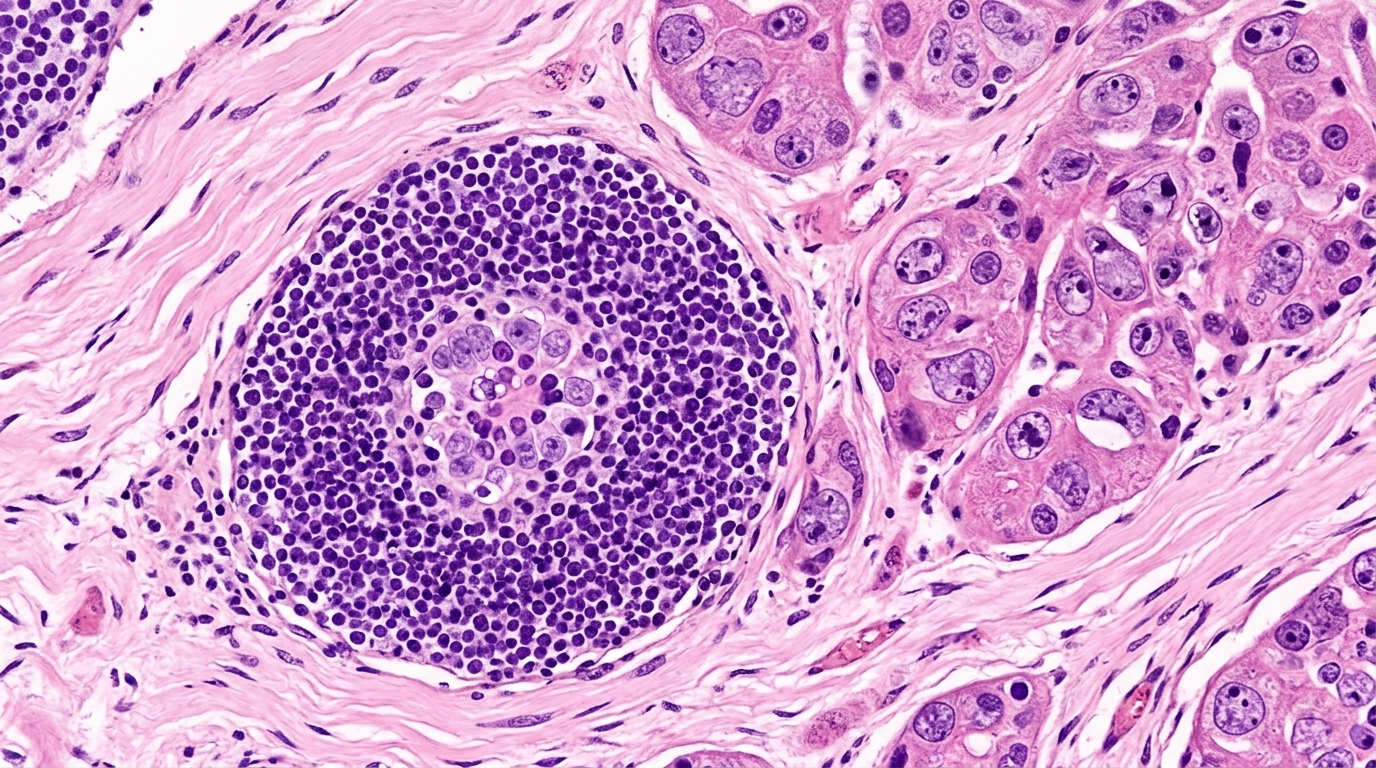
Tertiary lymphoid structures—organized clusters of immune cells that form inside tumors—appear to carry prognostic weight in HER2-low breast cancer, according to a study that combined public spatial transcriptomics and single-cell RNA sequencing data with an independent clinical cohort. The research, published in Cancer Immunology, Immunotherapy, identified 57 genes associated with these structures, traced many of them to specific immune and tumor cell types, and then tested whether the physical presence of key cellular components predicted disease-free survival in 27 patients with HER2-low invasive breast cancer.
The study adopted a strategy of integrating public data mining with independent clinical validation. The researchers drew on spatial transcriptomic data from a HER2-low sample in the GSE176078 dataset and the CID4535 dataset, alongside single-cell RNA sequencing data from eight HER2-low samples in GSE176078. By comparing gene expression profiles within and around tertiary lymphoid structures, they identified 57 differentially expressed genes linked to these immune niches. Single-cell analysis then allowed them to assign 15 of those genes to particular cell populations.
Among the assigned genes, several marked B cells, including IGLV3-19, IRF8, CCR7, MS4A1 and BLK. Others pointed to T cells (SELL, JAK3) and natural killer cells (AKNA, CORO1A, TBC1D10C). One gene, CCL20, was associated with macrophages, while a further group—SPRR3, SLPI, TUBA4A and S100A8—was tied to tumor cells themselves.
To test whether these molecular findings translated into clinical value, the team turned to a retrospective cohort of 27 patients with HER2-low invasive breast cancer. Using immunohistochemistry, they stained tissue sections for follicular dendritic cells, high endothelial venules and lymphocytes, then stratified patients by the presence or absence of each feature and compared disease-free survival using Kaplan–Meier curves and log-rank tests. The study was retrospectively registered in the Chinese Clinical Trial Registry in June 2024.
The validation produced several notable signals. Higher tertiary lymphoid structure grade showed a potential association with favorable disease-free survival, with a P value of 0.048. The presence of high endothelial venules—specialized blood vessels that parallel the presence of these immune structures—was associated with longer disease-free survival at P = 0.028. When the researchers separated tumors by the location of the structures, peritumoral ones, situated around the tumor, were associated with longer disease-free survival at P = 0.028, whereas intratumoral structures showed no significant association at P = 0.061 and stromal ones none at P = 0.248.
Correlation analysis added nuance to the relationship between blood vessels and immune architecture. Across tumors that contained tertiary lymphoid structures, total high endothelial venule density showed a nonsignificant positive correlation with the CD21+ follicular dendritic cell network score, with rho = 0.381 and P = 0.146. However, when the analysis focused specifically on peritumoral structures, the density of associated venules correlated significantly with the dendritic cell network score, with rho = 0.721 and P = 0.002.
Beyond the static histological picture, cell–cell communication analysis of the integrated data revealed that fibroblasts acted as the core signal senders within the tumor microenvironment, while endothelial cells served as major signal receivers. Chemokine signaling and extracellular matrix signaling dominated the communication network.
The authors concluded that integrating multi-omics data enabled systematic mapping of the molecular and cellular landscape of tertiary lymphoid structures in HER2-low breast cancer. Independent validation suggested that follicular dendritic cell integrity, B-cell activation and high endothelial venule density may serve as potential prognostic markers. They further proposed that combined assessment of these features could potentially outperform any single indicator, supporting the development of TLS-based precision pathology and immunotherapy strategies for this tumor subtype.
Subject of Research: Prognostic value of tertiary lymphoid structures and their cellular components in HER2-low breast cancer
Article Title: Integrated spatial and single-cell profiling reveals prognostic stromal-immune niches within tertiary lymphoid structures of HER2-low breast cancer
Article References: Meng, M., Li, W., Du, H., Zhou, X., Fu, R., Gu, Q., Zhou, X., & Li, Y. (2026). Integrated spatial and single-cell profiling reveals prognostic stromal-immune niches within tertiary lymphoid structures of HER2-low breast cancer. Cancer Immunology, Immunotherapy. https://doi.org/10.1007/s00262-026-04573-y
Image Credits: AI Generated
DOI: 10.1007/s00262-026-04573-y
Keywords: tertiary lymphoid structures, HER2-low breast cancer, spatial transcriptomics, single-cell RNA sequencing, high endothelial venules, follicular dendritic cells, disease-free survival, immunohistochemistry, tumor microenvironment, B-cell activation, prognostic markers, cell-cell communication
News Source: Scienmag.