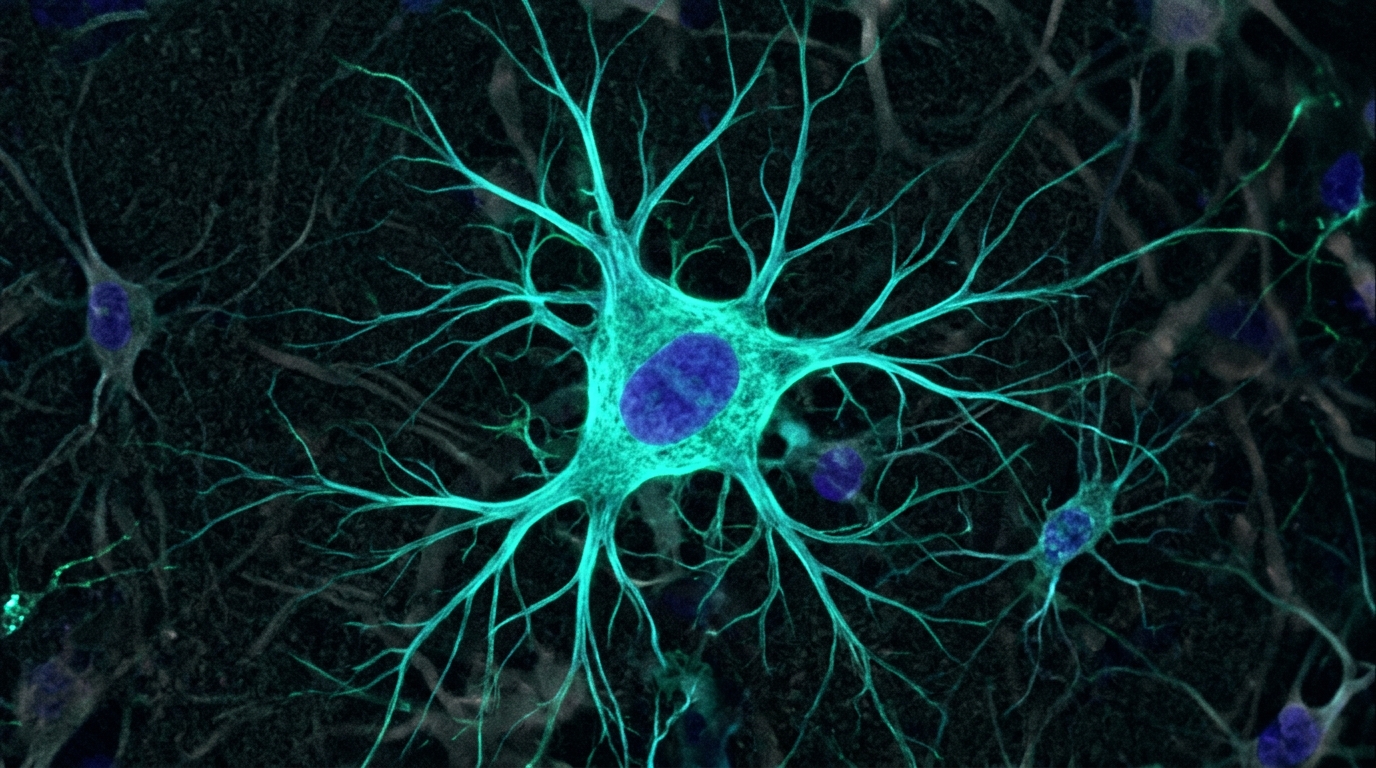
Scientists studying brain tissue from patients with drug-resistant temporal lobe epilepsy have found that a distinctive population of astrocytes—star-shaped support cells of the nervous system—carries twice the normal amount of DNA and shows a marked shift in its functional profile. The study, published in the journal Cellular and Molecular Neurobiology, set out to characterize these tetraploid astrocytes in both healthy brain tissue and in the cortex of people whose epilepsy does not respond to medication.
Epilepsy is among the most prevalent neurological diseases, and between 25 and 33 percent of patients develop drug-resistant epilepsy, a form in which available medications fail to control seizures. The precise causes of this drug resistance remain unidentified. Temporal lobe epilepsy is a common subtype, and recent work had already revealed an increase in tetraploid astrocytes in the drug-resistant form of this condition. The new research aimed to determine what these cells are actually doing.
The researchers obtained cortical samples from two sources: tissue adjacent to the epileptogenic zone removed during resective neurosurgery in patients with drug-resistant temporal lobe epilepsy, and postmortem cortical tissue from donors who had no neurodegenerative, neurological, or psychiatric disorders. This design allowed a direct comparison between the diseased cortex and tissue from brains without central nervous system disease.
To identify astrocytes, the team used NDRG2, a marker specific to these cells. Tetraploid cells are recognizable because they contain twice the DNA of ordinary diploid cells, a property that flow cytometry can detect. The researchers then probed the function of these cells by immunostaining for a panel of markers linked to distinct astrocyte roles: ALDH1L1 for metabolism, SOX9 for transport, NF1A for electrical function, and NFκB p65 and pSTAT3 for reactive, inflammation-associated states. Staining followed by flow cytometry allowed them to quantify how often tetraploid and diploid astrocytes expressed each marker in the two tissue groups.
The results showed that tetraploid astrocytes expressed all of the functional markers tested. In other words, the ability to carry out metabolic, transport, and electrical functions was preserved in these DNA-doubled cells, both in physiological conditions and in the drug-resistant epilepsy cortex. This finding addresses a basic question about polyploid glia: whether a cell with a doubled genome retains the specialized duties of its diploid counterparts. In this tissue, at least with respect to the markers examined, it does.
Two markers stood out as changed in disease. The percentage of tetraploid astrocytes expressing ALDH1L1, the metabolic marker, was significantly increased in drug-resistant temporal lobe epilepsy compared with controls, and the same was true for tetraploid cells expressing SOX9, the transport marker. By contrast, the proportion of tetraploid astrocytes expressing NF1A, the marker tied to electrical function, remained unchanged between the groups.
The inflammatory markers told a subtler story. pSTAT3 and NFκB p65, both associated with reactive astrocytes, showed an upward trend in tetraploid astrocytes in the epilepsy tissue. The trend did not reach the level of a statistically significant increase in this analysis, but its direction was consistent with a reactive shift. More striking was what happened in the ordinary diploid astrocytes: the percentage of diploid cells expressing these inflammatory markers was reduced in drug-resistant temporal lobe epilepsy. Taken together, the authors interpret this pattern as a functional shift toward polyploid cells in the epileptic cortex, with diploid astrocytes receding from inflammatory marker expression while their tetraploid counterparts trend upward.
The study’s conclusions are deliberately framed as suggestive rather than definitive. The findings point to tetraploid astrocytes as potential contributors to the mechanisms of drug-resistant temporal lobe epilepsy, not as proven drivers of it. The samples came from cortex adjacent to the epileptogenic zone rather than the seizure focus itself, and the postmortem control tissue, while carefully screened for neurological and psychiatric disease, differs in provenance from surgically resected tissue. The markers measured are proxies for cellular functions, and marker expression does not fully capture what a cell is doing in living tissue. The work is also an observational characterization of a limited number of tissue samples rather than an interventional test of any therapeutic idea.
Even with those limits, the study adds a concrete piece to a puzzle that has resisted explanation. Drug resistance in epilepsy affects a large fraction of patients, and the etiology remains unknown. If a subset of astrocytes with doubled genomes expands in the drug-resistant cortex and takes on a heightened metabolic and transport profile, that shift could alter the local environment of neurons in ways relevant to seizure control. The researchers suggest that the significant increase of astrocytes with metabolic and transporter markers in drug-resistant tissue, alongside the preserved functional marker expression in tetraploid cells, makes these polyploid glia a plausible subject for further investigation into why some epilepsies defy medication.
Subject of Research: Characterization of tetraploid astrocytes in drug-resistant temporal lobe epilepsy
Article Title: Molecular characterization of tetraploid astrocytes in drug-resistant temporal lobe epilepsy
Article References: Cerrada-Gálvez, L., López-Rodríguez, R., Gonzalez-Tarno, P., Navares-Gómez, M., Pulido, P., Torres-Díaz, C. V., & Ovejero-Benito, M. C. (2026). Molecular characterization of tetraploid astrocytes in drug-resistant temporal lobe epilepsy. Cellular and Molecular Neurobiology. https://doi.org/10.1007/s10571-026-01802-x
Image Credits: AI Generated
DOI: 10.1007/s10571-026-01802-x
Keywords: drug-resistant epilepsy, temporal lobe epilepsy, astrocytes, tetraploid cells, flow cytometry, NDRG2, ALDH1L1, SOX9, reactive astrocytes, neuroinflammation, glial cells, epilepsy surgery
News Source: Kendall Mcintyre. (November 6, 2026). Tetraploid Astrocytes Emerge as Potential Players in Drug-Resistant Temporal Lobe Epilepsy. Scienmag.