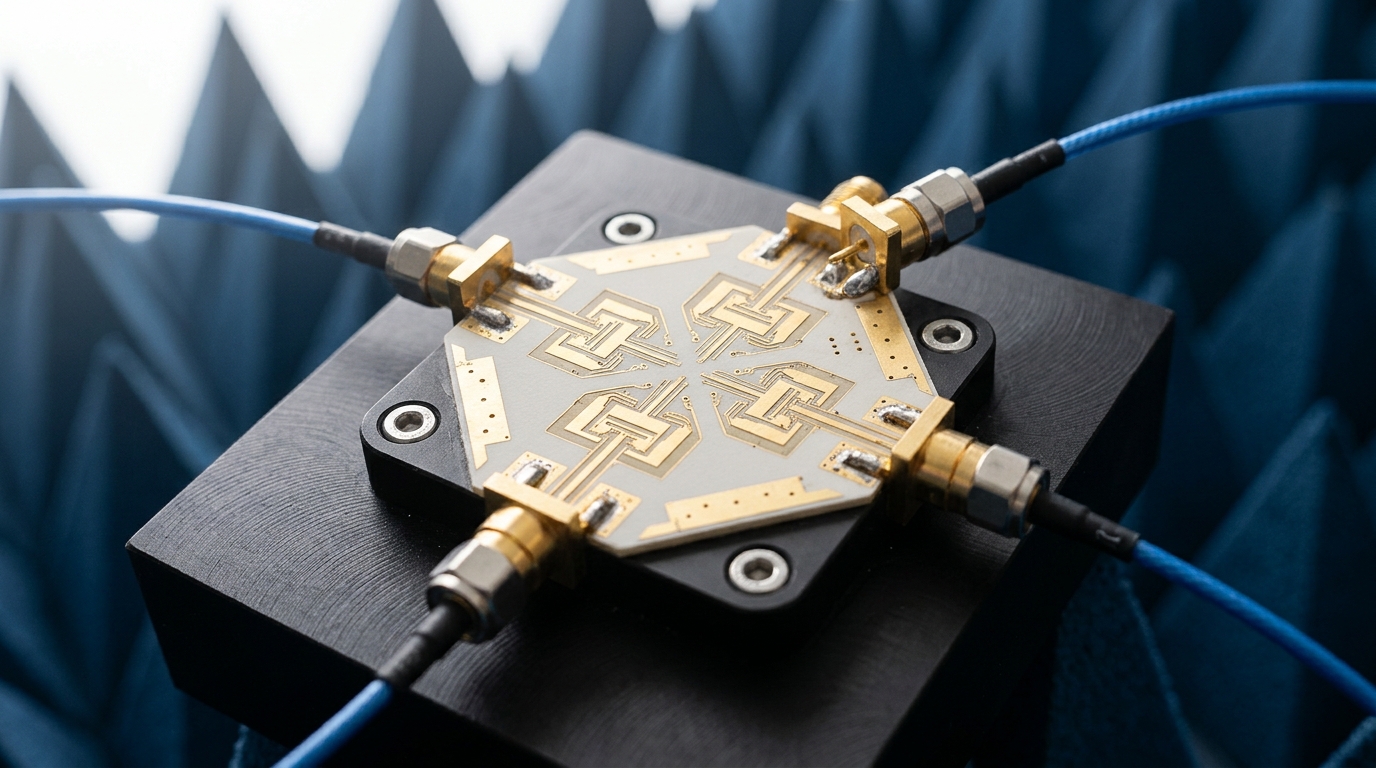
Engineers have unveiled a simulation-based design for a compact four-port 2×2 MIMO antenna that, on paper, keeps working across an extraordinary stretch of the radio spectrum: from millimetre-wave frequencies all the way into the sub-terahertz region. The study, published in Frontiers in Antennas and Propagation, describes how the antenna evolved step by step from a simple circular patch into a petal-like radiator built from five overlapping, rotated elliptical sections, and how that single element was then expanded into a four-port array small enough to fit comfortably on a fingertip.
The numbers reported by the research team are striking. Under the CST Studio Suite software used for the investigation, the conventional reflection coefficients stayed below −10 dB from 13.6 GHz to 151.91 GHz. That corresponds to a simulated impedance bandwidth of 138.31 GHz and a fractional bandwidth of roughly 167.1 percent, a range that spans the bands earmarked for fifth-generation networks, satellite links, radar and emerging short-range sub-THz communications. The transmission coefficients, which describe how much signal leaks from one port into another, remained mostly below −20 dB across the same span.
What makes the result notable is how the designers achieved the wide matching and low coupling. Rather than adding a defected ground structure, an electromagnetic band-gap structure, a metasurface or a dedicated decoupling element, the team relied on parametric tuning of the geometry itself. The radiator, the slots, the feed and matching sections, the partial ground plane, the substrate dimensions and the arrangement of the four elements were all adjusted iteratively to improve the simulated impedance matching and reduce inter-port coupling. The single-element footprint shrank from 10 × 10 mm² to 10 × 9 mm², while the complete four-port footprint was reduced from 24 × 24 mm² to 22 × 22 mm².
Radiation performance in the simulations was equally strong over much of the band. The peak realized gain reached 11.87 dBi, and the simulated radiation efficiency stayed mostly above 90 percent up to approximately 120 GHz before declining in the upper-frequency region. Surface-current and radiation-pattern analyses revealed a clear behavioural shift: at lower frequencies the currents and radiation distributions were comparatively broad, but as frequency rose the behaviour became increasingly localised, directional and multi-lobed, a familiar consequence of electrically larger apertures at shorter wavelengths.
Because the antenna is intended for MIMO operation, the researchers went beyond single-port metrics. Active reflection coefficients, which account for all four ports being driven simultaneously, showed that simultaneous four-port matching depends on the applied excitation amplitudes and relative phases, and does not fully coincide with the conventional individual-port bandwidth. In other words, the usable band when all ports operate together is not simply the band measured port by port, and system designers will need to account for the excitation scheme.
The diversity metrics, which gauge how independently the antenna elements can serve multiple data streams, were encouraging. The full-band S-parameter-based envelope correlation coefficient remained below approximately 0.005, while far-field ECC values calculated at 16, 58, 100 and 148 GHz ranged from 0.000042 to 0.010246. The corresponding diversity gain stayed close to 10 dB. The total active reflection coefficient reinforced the excitation dependence of simultaneous matching, and the channel capacity loss remained below 0.4 bit/s/Hz across the operating band, indicating that the four-port configuration should preserve high data throughput in a MIMO channel.
The authors are careful to frame the work as a numerical feasibility study. Every result comes from simulation under stated software assumptions; no prototype has yet been fabricated and no measurements have been taken. The team states that future work will focus on prototype fabrication and calibrated four-port mmWave-to-sub-THz measurements to evaluate practical antenna and communication-system performance. Real-world factors such as fabrication tolerances, connector transitions and measurement calibration will determine whether the simulated bandwidth and efficiency carry over to hardware.
Even so, the study offers a template for antenna designers facing the growing appetite for spectrum at the top of the usable range. Sub-terahertz frequencies promise enormous bandwidths for short-range links, but components there are notoriously difficult to match and to keep isolated from one another. Demonstrating, in simulation, a four-port MIMO element that covers 13.6 to 151.91 GHz in a 22 × 22 mm² footprint, without dedicated decoupling structures, suggests that careful geometric evolution alone can deliver both compactness and isolation.
The design path itself is instructive. Starting from a conventional circular patch, the researchers overlapped and rotated five elliptical sections to form a modified petal-like radiator, a shape that evidently supports a broader set of resonances than the original disc. Parametric sweeps then locked in the slot positions, feed geometry, matching sections and partial ground plane that produced the reported matching and coupling responses. The result is a design whose performance emerges from the radiator geometry and its integration, rather than from auxiliary isolation hardware, which keeps the structure simple and the footprint small.
For the moment, the antenna exists only as a model, and its headline figures should be read as simulated predictions rather than measured outcomes. But if fabrication and calibrated measurement confirm the behaviour, the approach could inform compact multiantenna modules for future mmWave and sub-THz systems, where every square millimetre of board space and every decibel of port isolation counts. The study’s authors and their institutions, spanning Ireland, Saudi Arabia and Iraq, present the work as a step toward practical sub-THz MIMO hardware, with the next milestone being a physical prototype put on a calibrated test bench.
Subject of Research: Simulation-based geometry evolution of a compact four-port 2×2 MIMO antenna covering mmWave to sub-THz frequencies
Article Title: Simulation-based geometry evolution and performance assessment of a compact ultra-wideband 2 × 2 MIMO antenna from mmWave to Sub-THz frequencies
Article References: Saleh, S., Saeidi, T., Timmons, N., Razzaz, F., Althuwayb, A. A., AlQahtani, D., & Hamad, Q. S. (2026). Simulation-based geometry evolution and performance assessment of a compact ultra-wideband 2 × 2 MIMO antenna from mmWave to Sub-THz frequencies. Frontiers in Antennas and Propagation, 4, Article 1958340. https://doi.org/10.3389/fanpr.2026.1958340
Image Credits: AI Generated
DOI: 10.3389/fanpr.2026.1958340
Keywords: MIMO antenna, mmWave, sub-terahertz, ultra-wideband, impedance bandwidth, envelope correlation coefficient, diversity gain, channel capacity loss, CST Studio Suite, antenna miniaturization, simulation study, geometry evolution
News Source: Denise Maddox. (November 6, 2026). Simulated four-port MIMO antenna stretches from mmWave to sub-THz. Scienmag.