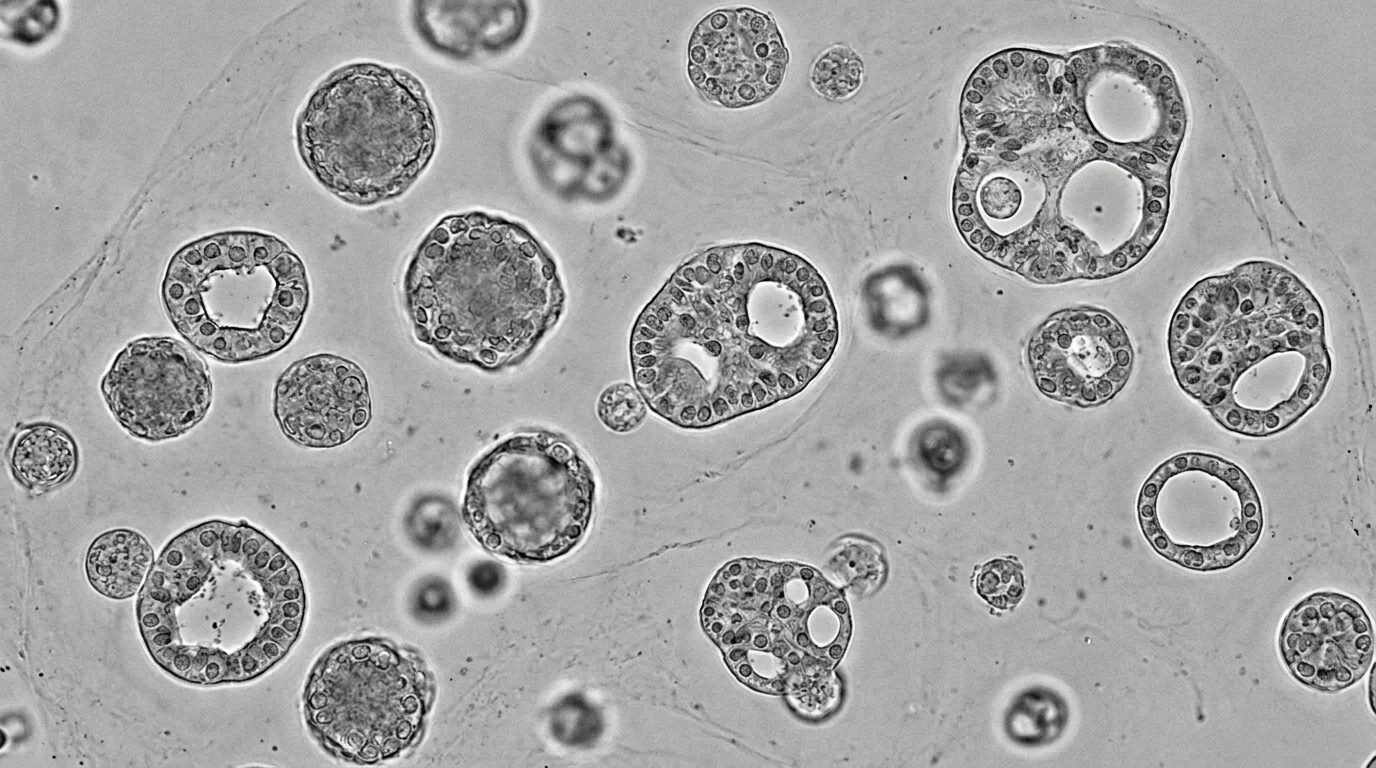
Gallbladder cancer remains one of the most lethal malignancies of the digestive system, and advanced cases carry a poor prognosis, high recurrence rates, and very limited treatment options. A research team working with patients in Chile has now built a panel of patient-derived organoids—miniature tumor cultures grown in the laboratory—that reproduce the histopathological and genetic features of the original tumors. The work, published in Biological Research, describes eight organoid lines established from Chilean patients with resectable advanced disease at stages IIIA and IIIB as well as metastatic stage IV gallbladder cancer, and shows that these cultures can be used to test adjuvant chemotherapy responses outside the patient.
The researchers established the organoids from surgical samples and succeeded in generating cultures from 66.7 percent of the samples, or 8 out of 12 patient tumors. To verify that the organoids were faithful copies of the cancers they came from, the team used three complementary approaches: histological analysis to compare tissue architecture, whole-exome sequencing to compare the mutation landscape, and confocal microscopy to examine cellular organization. Across these measurements, the organoids closely recapitulated the profiles of the parent tumors, confirming that the cultures preserved the biological identity of each patient’s cancer rather than drifting toward a generic laboratory phenotype.
Patient-derived organoids have attracted wide interest in cancer research because they mimic the epithelial architecture of tumors and offer a controlled system for studying cancer biology, drug resistance, and candidate therapies. Well-characterized gallbladder cancer organoids had been lacking, and their potential to reflect patient-specific adjuvant chemotherapy outcomes remained underexplored. The new study addresses that gap directly by pairing laboratory drug testing with the actual clinical courses of the patients who donated the tumor samples.
The team performed ex vivo drug response assays with three agents commonly used in biliary tract cancer treatment: 5-fluorouracil, cisplatin, and gemcitabine. In a preliminary proof-of-concept analysis involving four patients, in vitro sensitivity to 5-fluorouracil showed a promising biological trend that aligned with patient disease-free survival and tracked with overall survival following adjuvant capecitabine treatment, a drug converted in the body into 5-fluorouracil. The authors stress that this is a preliminary finding in a small sample, but it suggests that organoid drug sensitivity may carry information about how patients will respond to adjuvant therapy, which could eventually help oncologists tailor post-surgical treatment decisions.
A central aim of the study was to understand why some tumors resist gemcitabine, a chemotherapy backbone for biliary cancers. When the researchers exposed the organoid panel to the drug, they identified gemcitabine-resistant lines and then dissected their molecular makeup. The resistant organoids harbored concurrent mutations in three genes: APC, a regulator of the Wnt signaling pathway frequently altered in gastrointestinal cancers; TP53, the genome’s best-known tumor suppressor; and JAK2, a signaling kinase involved in cytokine-driven growth pathways. This combination of alterations marks a genetic signature associated with drug resistance in these cultures.
To look beyond DNA, the team turned to quantitative proteomics using tandem mass tag labeling, a technique that allows precise comparison of protein abundance across samples. The proteomic analysis of the chemoresistant organoids revealed enriched pathways related to epithelial-mesenchymal transition, the process by which cancer cells gain mobility and invasive traits; KRAS signaling, a core growth-promoting cascade; apical junction complexes that maintain epithelial structure; IL2-STAT5 signaling; and hypoxia, the low-oxygen state that tumors often exploit for survival. Together, these pathways sketch a coherent picture of how gallbladder cancer cells reorganize themselves when they stop responding to gemcitabine.
The proteomics screen also pinpointed six overexpressed proteins linked to the acquisition of a more malignant state: Vimentin, Fibronectin 1, Clusterin, Caveolin 1, Nestin, and TGF-β. Vimentin and Fibronectin 1 are classic markers of epithelial-mesenchymal transition, while Caveolin 1 and Clusterin have been tied to survival signaling and membrane dynamics in cancer cells. Nestin, an intermediate filament protein, and TGF-β, a potent growth factor, round out a protein signature that the authors identify as associated with gemcitabine resistance in gallbladder cancer organoids. These molecules now stand as candidate biomarkers and potential therapeutic targets that warrant further investigation.
Identifying resistance pathways is only useful if it points toward actionable drugs, so the researchers screened 103 FDA-approved compounds against the gemcitabine-resistant organoids. The screen produced a short list of hits: the resistant cultures showed sensitivity to Ixazomib citrate, a proteasome inhibitor; Panobinostat, a histone deacetylase inhibitor; and the tyrosine kinase inhibitors Lapatinib and Bosutinib. Because these drugs are already approved for other indications, the finding suggests potential repurposing opportunities for patients whose tumors show resistance signatures, although the authors emphasize that these are preclinical observations in organoid cultures and not demonstrated clinical benefits.
The study’s conclusions are deliberately measured. The authors state that the work identifies resistance pathways and key proteins associated with gemcitabine resistance in gallbladder cancer and provides potential therapeutic targets that warrant investigation to validate their role in guiding treatment strategies. The proof-of-concept link between organoid drug sensitivity and patient survival rests on only four patients, and the drug screen results come from laboratory cultures rather than clinical trials. Nevertheless, the panel of eight genetically faithful organoid lines gives gallbladder cancer researchers a durable experimental platform for testing adjuvant chemotherapy response ex vivo, probing resistance mechanisms, and prioritizing repurposed drugs for future studies in this aggressive and underserved cancer.
Subject of Research: Patient-derived gallbladder cancer organoids that mirror tumor genetics and enable ex vivo testing of chemotherapy response and resistance mechanisms
Article Title: Patient- derived gallbladder cancer organoids mirror tumor genetics and resistance phenotypes, enabling ex vivo testing of adjuvant chemotherapy response
Article References: Vergara-Gómez, L., Obreque, J., Vu, M. H., García, P., Owen, G. I., Roa, J. C., Nervi, B., Rojas-Hidalgo, A., Maracaja-Coutinho, V., Sepúlveda, S. A., Di Genova, A., Ávalos-Guajardo, Y., Castillo, A., Suárez, F., Santander, G. N., Babbitt, N., Muñoz, G., Macanas-Pirard, P., Aguayo, G., … Bizama, C. (2026). Patient- derived gallbladder cancer organoids mirror tumor genetics and resistance phenotypes, enabling ex vivo testing of adjuvant chemotherapy response. Biological Research. https://doi.org/10.1186/s40659-026-00727-5
Image Credits: AI Generated
DOI: 10.1186/s40659-026-00727-5
Keywords: gallbladder cancer, patient-derived organoids, gemcitabine resistance, proteomics, drug screening, 5-fluorouracil, epithelial-mesenchymal transition, TP53, drug repurposing, precision oncology, Chile, adjuvant chemotherapy
News Source: Nathaniel Bowman. (November 5, 2026). Lab-grown gallbladder cancer organoids reproduce tumor genetics and predict chemotherapy response. Scienmag.