Delirium superimposed on dementia is one of the most feared complications of surgery in older adults, and a new study reports that a minimally invasive form of vagus nerve stimulation can blunt its pathological signature in mice. In two Alzheimer’s disease mouse models, researchers at Duke University and collaborating institutions applied percutaneous vagus nerve stimulation, or pVNS, immediately after a tibia fracture surgery. The treatment prevented the sharp rise in amyloid-beta that normally follows the operation, preserved neurons from acute apoptosis, and protected the animals from a measurable decline in attention-like performance on the days after surgery. The findings, published in Bioelectronic Medicine, advance a perioperative neuromodulation strategy for patients at risk of delirium superimposed on dementia, though they remain preclinical and have not yet been tested in humans.
The clinical stakes are considerable. Delirium is an acute confusional state marked by inattentiveness, altered consciousness and cognitive deficits, and it develops especially often in patients with pre-existing dementia. According to the study’s background, delirium incidence in Alzheimer’s disease patients approaches 31 percent in people over 60 years old, and patients with delirium superimposed on dementia who undergo orthopedic surgery face nearly two-fold greater odds of one-year mortality. Despite these numbers, the mechanistic relationship between the two conditions has remained poorly understood, which has limited the development of effective interventions.
Conventional vagus nerve stimulation requires surgically implanting a cuff electrode around the cervical vagus nerve, an approach that is difficult to deploy for an acute neurological complication such as postoperative delirium. To get around this obstacle, the team used a percutaneous method previously established in their laboratory: under ultrasound guidance, a concentric bipolar needle electrode was positioned at the right cervical branch of the vagus nerve in anesthetized mice. Successful targeting was confirmed by a bradycardic response, with stimulation amplitude titrated to produce a 10 percent reduction in baseline heart rate. The frequency was then lowered to 10 Hz to eliminate bradycardia effects, and stimulation was maintained for 30 minutes. Sham animals underwent the identical procedure, including needle placement, without electrical current.
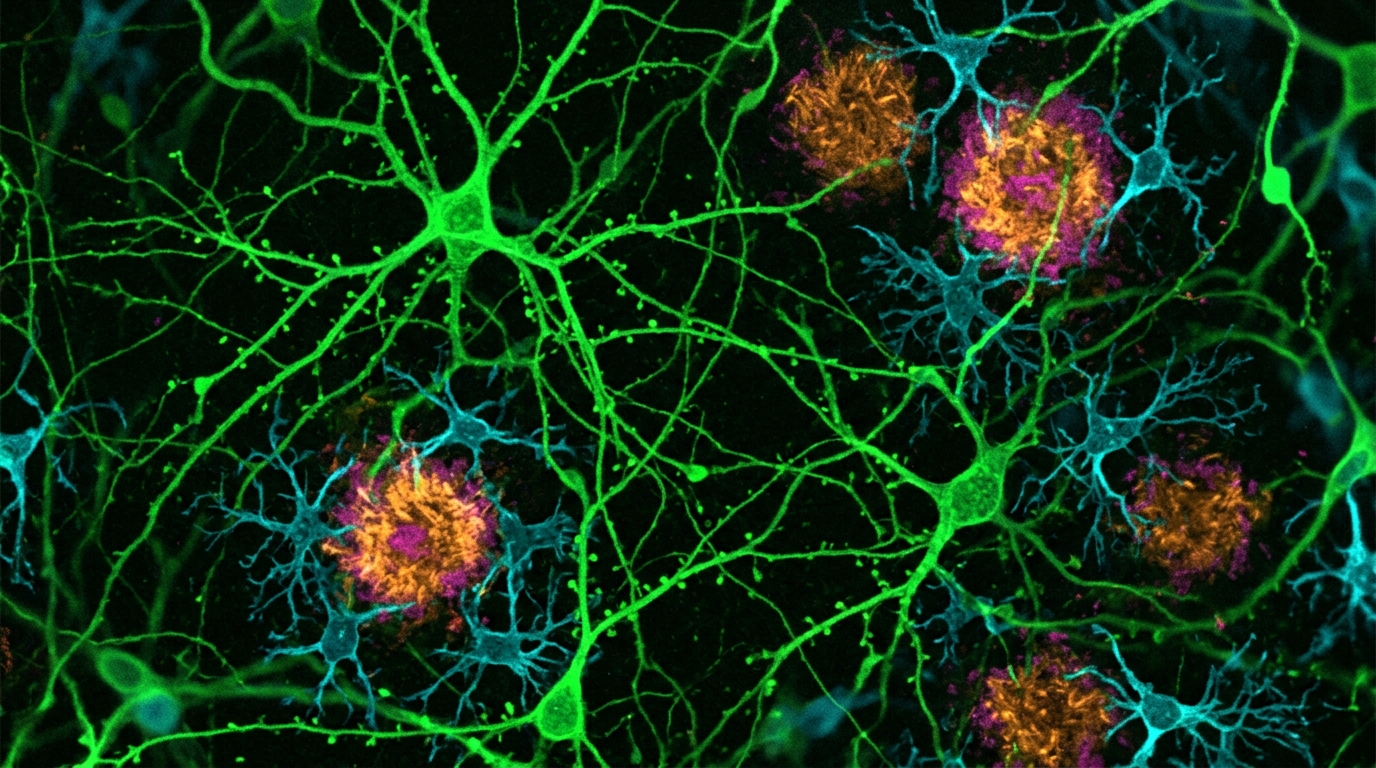
The experiments used 5xFAD mice at 6 months of age and CVN-AD mice at 12 months, both established models of Alzheimer-like pathology. Orthopedic surgery consisted of a tibial incision, muscle dissection, periosteal stripping and pinning of the tibia with a stainless steel rod, performed under sevoflurane anesthesia and buprenorphine analgesia. Within 24 hours, the surgery induced a rapid increase of both amyloid-beta, measured with a pan-marker antibody, and X-34, a core plaque marker derived from Congo red, in the hippocampus. Perioperative vagus nerve stimulation prevented this acute amyloid elevation. Three-dimensional reconstructions of the X-34 plaques further revealed that surgery altered plaque sphericity, and pVNS rescued these changes in plaque volume and shape in both the dentate gyrus of the hippocampus and the prefrontal cortex.
Behavioral evidence pointed in the same direction. The researchers assessed delirium-like inattention and vigilance with the 5-choice serial reaction time task, in which food-restricted mice nose-poke for sucrose rewards when one of five funnels is briefly illuminated. Before surgery, all mice had achieved at least an 80 percent success rate over three consecutive days. When performance after surgery was normalized to each animal’s own baseline, mice receiving pVNS showed significantly less decline on postoperative days 1 and 2 compared with mice that received surgery alone. Treated animals also responded faster, made fewer errors of omission, and showed a trend toward fewer incorrect choices. The authors note that a small but significant baseline difference existed between the groups before surgery, which is why the postoperative data were normalized to individual baselines.
Cell death assays reinforced the picture of acute, but potentially consequential, injury. TUNEL staining, which labels DNA fragments, revealed increased neuronal apoptosis in the dentate gyrus 24 hours after surgery, and this acute apoptosis was reduced by pVNS. Because delirium usually resolves within days, the team also examined whether the acute event drives lasting neurodegeneration. At one month after surgery, no differences between groups were observed for amyloid-beta, X-34 plaques or neuronal apoptosis, suggesting the amyloid changes are acute and likely immune-driven rather than part of the slow, decades-long course of classical Alzheimer’s dementia.
Microglia, the brain’s resident immune cells, emerged as a central target of the stimulation. Surgery pushed microglia toward a reactive, phagocytic state, and pVNS reversed this reactivity, particularly near amyloid-beta plaques, as shown in three-dimensional image reconstructions of Iba-1 and CD68 staining. When the researchers isolated CD11b-positive microglia from the hippocampus and profiled disease-associated microglial markers, surgery reduced the expression of several transcripts, including TFEB, TMEM119, MERTK, Clec7a and TREM2. Treatment with pVNS restored some of these transcripts to near-control levels, notably TMEM119, a gene also found in human microglia, and TFEB, a master transcriptional regulator of lysosomal biogenesis and autophagy implicated in amyloid-beta clearance. Similar protective effects on amyloid accumulation and microglial morphology were confirmed in the older CVN-AD mice, including near blood vessels.
To identify the peripheral signals driving these central changes, the researchers turned to interleukin-6, a cytokine commonly elevated in patients with delirium and in delirium superimposed on dementia after orthopedic surgery. Injecting IL-6 alone into 5xFAD mice at a dose comparable to circulating levels seen in postoperative delirium was sufficient to induce X-34-labeled plaque deposition within 24 hours, an effect comparable to that of tibia fracture surgery. When pVNS was delivered immediately after the IL-6 injection, levels of amyloid-beta and Iba-1 in the hippocampus were significantly reduced compared with untreated animals. These results indicate that a single peripheral cytokine can trigger the amyloid accumulation and microglial activation previously observed after surgery, and that vagus nerve stimulation can ameliorate the resulting central pathology.
A laboratory model helped explain how systemic inflammation might breach the brain’s defenses. The team built a transwell co-culture system with bEnd.3 brain endothelial cells grown on inserts above BV-2 microglial cells, then applied a cytokine cocktail of IL-1β, TNF-α and IFN-γ to the apical surface while adding amyloid-beta 42 monomers to the microglial compartment. Exposure to the cytokine mixture disrupted the endothelial monolayer, as measured by transendothelial electrical resistance, and only microglia cultured beneath cytokine-activated endothelium converted the amyloid monomers into higher-order fibrils and oligomers, detected by double immunoreactivity for 6E10 with OC or A11 antibodies. The co-cultures showed a 75 percent increase in fibril-like assembly under these conditions. In the mice, surgery-induced inflammation was paralleled by induction of vascular cell adhesion molecule 1, or VCAM1, in the hippocampus, pointing to endothelial activation as a plausible link between peripheral cytokines and amyloid aggregation in vivo.
The authors frame the work as establishing a role for neuromodulation in regulating perioperative immunity and as a new paradigm for perioperative interventions in patients at risk for delirium superimposed on dementia. Vagus nerve stimulation is already clinically established for epilepsy and chronic autoimmune disorders, and its anti-inflammatory effects are thought to run through the cholinergic anti-inflammatory pathway, in which vagal signaling ultimately suppresses TNFα production by splenic macrophages. The team previously showed that this percutaneous method reduces systemic TNFα and rescues microglial activation after endotoxemia. Because cytokines are essential for host defense and tissue healing outside the central nervous system, broadly suppressing them after surgery carries off-target risks; engaging the vagal reflex instead may offer a more targeted route. The specific mechanisms by which pVNS reduces amyloid and reshapes microglial states still require further investigation, and translating these mouse findings to older surgical patients will demand clinical trials. For now, the study offers a mechanistically grounded, device-based starting point for protecting a vulnerable brain at the moment it is most exposed.
Subject of Research: Percutaneous vagus nerve stimulation after orthopedic surgery reduced acute amyloid-beta pathology and delirium-like behavior in Alzheimer's disease model mice.
Article Title: Electrical stimulation of the vagus nerve improves amyloid pathology in delirium superimposed on dementia
Article References: Song, C., Wu, P. Y., Huffman, W. J., David-Bercholz, J., Bedolla, A., Velagapudi, R., Njoroge, A., Rodriguiz, R. M., Wetsel, W. C., Rendina, D., Bilbo, S. D., Chiang, W., Ogu, J. C., Gelbard, H. A., Yang, T., Grill, W. M., & Terrando, N. (2026). Electrical stimulation of the vagus nerve improves amyloid pathology in delirium superimposed on dementia. Bioelectronic Medicine, 12(1), Article 2. https://doi.org/10.1186/s42234-025-00194-5
Image Credits: AI Generated
DOI: 10.1186/s42234-025-00194-5
Keywords: vagus nerve stimulation, delirium, dementia, amyloid-beta, neuroinflammation, interleukin-6, postoperative delirium, Alzheimer's disease, microglia, blood-brain barrier, bioelectronic medicine, orthopedic surgery
News Source: Cassandra Pierce. (November 5, 2026). Vagus Nerve Stimulation Curbs Amyloid Buildup After Surgery in Mice With Alzheimer-Like Disease. Scienmag.