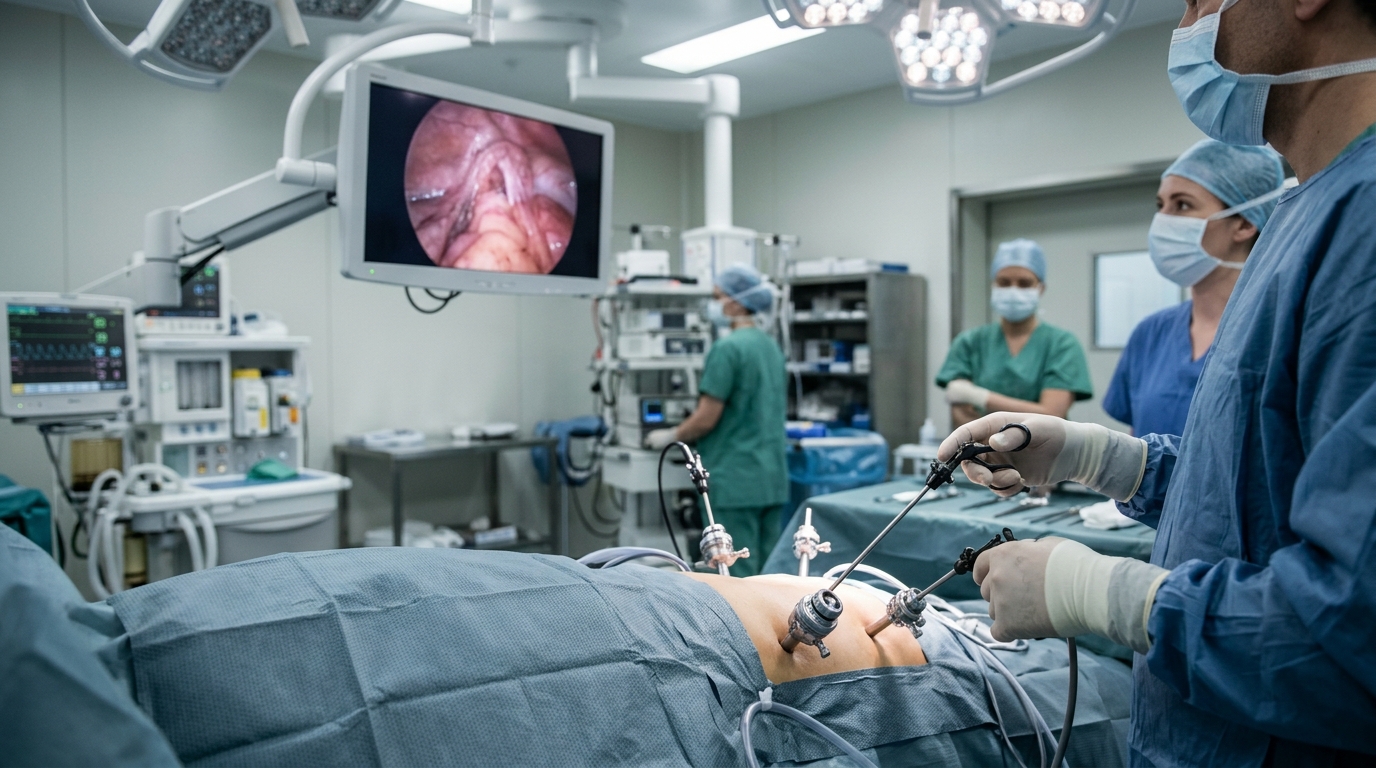
A validated nomogram incorporating five independent risk factors predicts the individualized risk of acute kidney injury following laparoscopic partial nephrectomy in patients with low-complexity renal tumors, according to a research study published in BMC Urology. Postoperative acute kidney injury commonly occurs after laparoscopic partial nephrectomy, prompting the investigators to identify independent risk factors and construct a practical prediction model. By analyzing both a training dataset and an external validation dataset, the researchers demonstrated that integrating clinical characteristics with an intraoperative surgical factor yields a validated nomogram designed to provide clinicians with a simple, quantitative tool for individualized risk prediction.
The investigation was conducted by retrospectively enrolling two distinct patient cohorts to develop and externally validate the predictive nomogram. Specifically, the training dataset comprised 266 patients who underwent laparoscopic partial nephrectomy, while the external validation dataset comprised 146 patients who underwent the same surgical procedure. Across both patient groups, the observed postoperative incidence of acute kidney injury was closely matched, reaching 29.3 percent in the training dataset and 29.5 percent in the external validation dataset. To determine the most relevant variables, the authors utilized least absolute shrinkage and selection operator regression alongside the Akaike information criterion for initial feature selection prior to multivariable analysis.
Multivariate logistic regression analysis successfully identified five independent risk factors for postoperative acute kidney injury: patient gender, body mass index, hypertension, duration of renal artery blockade, and cystatin C. The research findings highlighted the critical contribution of intraoperative surgical conditions, demonstrating that incorporating the duration of renal artery blockade as an intraoperative feature significantly improved the performance of the model. In statistical evaluations, adding this intraoperative factor yielded an integrated discrimination improvement of 7.36 percent (P < 0.001) and a net reclassification improvement of 16.2 percent (P = 0.008), confirming substantial gains in predictive accuracy.
The performance of the resulting nomogram was comprehensively evaluated using receiver operating characteristic curves, calibration curves, decision curve analysis, as well as net reclassification improvement and integrated discrimination improvement. The nomogram model developed from the multivariable analysis results achieved an area under the receiver operating characteristic curve of 0.833, with a 95 percent confidence interval of 0.78 to 0.89, in the primary training dataset. In the external validation dataset of 146 patients, the nomogram demonstrated an area under the curve of 0.78, with a 95 percent confidence interval of 0.70 to 0.86, confirming robust and consistent predictive discrimination.
In addition to discriminative metrics, calibration curves and decision curve analysis demonstrated the clinical reliability of the proposed tool. Both the calibration curves and decision curve analysis indicated favorable calibration and net clinical benefit across the evaluated datasets. The authors concluded that the nomogram model, developed from five readily available independent risk factors, provides clinicians with a simple and intuitive tool for the precise and quantitative assessment of acute kidney injury risk following laparoscopic partial nephrectomy in patients with low-complexity renal tumors.
Subject of Research: Nomogram for predicting acute kidney injury after laparoscopic partial nephrectomy
Article Title: Development and validation of a nomogram for predicting acute kidney injury after laparoscopic partial nephrectomy
Article References: Liu, Y., Li, J., Gao, H., Feng, L., Liu, Y., Liu, W., Chen, H., Lv, Y., Huo, J., Yu, Y., & Xu, L. (2026). Development and validation of a nomogram for predicting acute kidney injury after laparoscopic partial nephrectomy. BMC Urology. https://doi.org/10.1186/s12894-026-02445-2
Image Credits: AI Generated
DOI: 10.1186/s12894-026-02445-2
Keywords: acute kidney injury, laparoscopic partial nephrectomy, nomogram, risk prediction, renal tumors, cystatin C, renal artery blockade, urology, Development, validation, predicting, acute
News Source: Ophelia Keating. (November 5, 2026). Nomogram Predicts Acute Kidney Injury Risk After Laparoscopic Partial Nephrectomy. Scienmag.