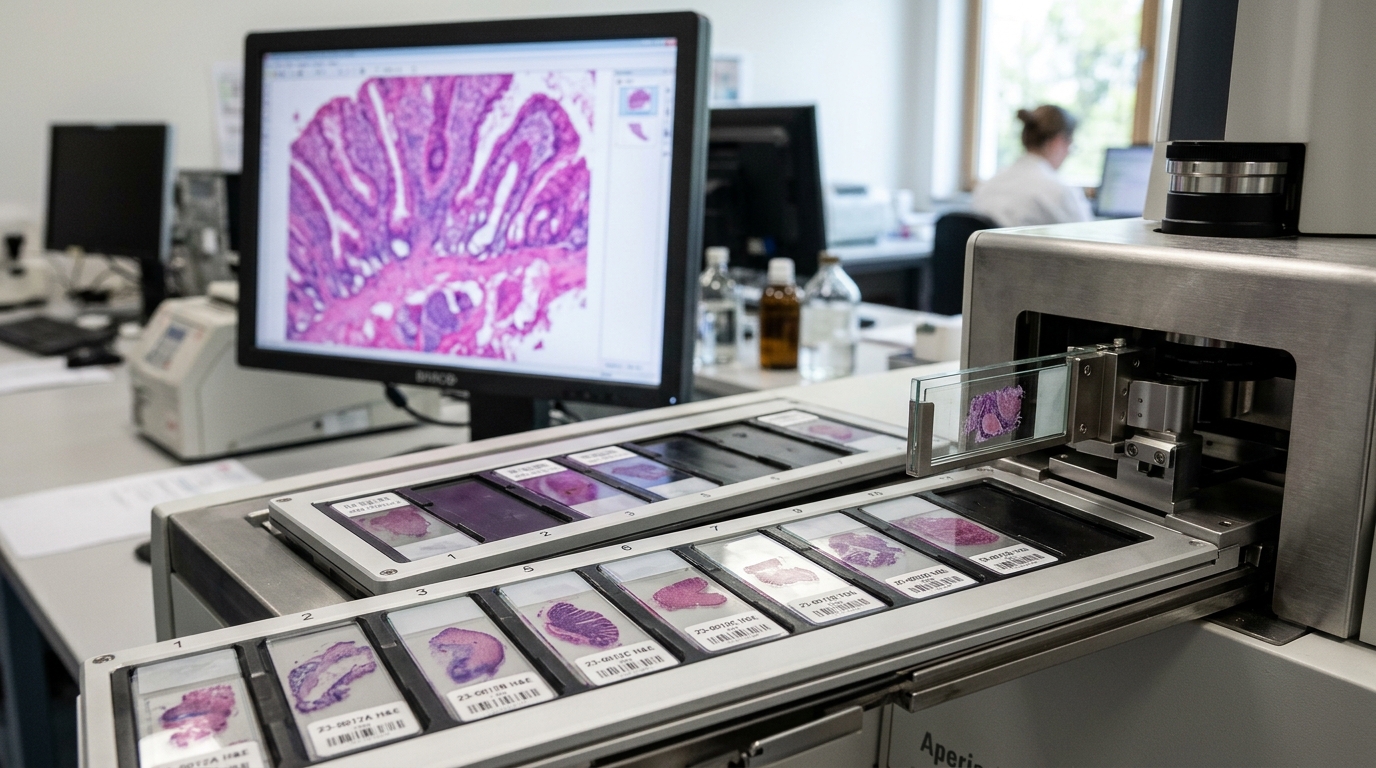
Saudi Arabia is undergoing a rapid expansion in digital pathology adoption, driven by the broader digitization of healthcare services, according to a review published in Diagnostic Pathology. The paper examines how emerging technologies, including the Internet of Things, artificial intelligence and cloud infrastructure, are accelerating the transformation of diagnostic services, alongside the nationwide implementation of electronic health records and a rising cancer incidence that increases demand for pathology capacity.
Digital pathology replaces the traditional microscope with whole-slide imaging, in which glass tissue slides are scanned at high resolution and interpreted on computer screens. Once slides exist as digital images, they can be shared between institutions, archived in large databases and analyzed by algorithms trained to detect features such as tumor cells or grading patterns. Artificial intelligence models in pathology typically learn from annotated images, meaning that pathologists or technicians must first label regions of interest before the software can be validated for diagnostic use.
The review, authored by Wajd Althakfi, frames this transformation within the framework of Vision 2030, the national reform program that includes ambitious healthcare modernization goals. The author argues that digital pathology and AI integration could support those objectives, but identifies significant barriers that remain before the technology can deliver its promised benefits for diagnostic accuracy and workflow efficiency.
Among the most concrete obstacles is cost. The review cites prohibitive expenses of roughly $100,000 to $200,000 per digital pathology system, a figure that covers the scanning hardware and associated infrastructure needed to acquire, store and display gigapixel-scale slide images. For laboratories weighing an investment of that size, the expected gains in speed and accuracy must be weighed against procurement, maintenance and data storage costs.
Workforce constraints compound the financial ones. The review identifies an insufficient number of trained pathologists as a key barrier, noting that digital transformation requires specialists who are not only competent in conventional diagnosis but also comfortable with digital workflows and, in some cases, with the computational tools built on top of them. Without enough trained staff, digitized slides cannot be reviewed at the volume or quality that the technology is meant to enable.
A further bottleneck lies in the data itself. AI models in histopathology depend on large, well-annotated image collections, and the review highlights the limited availability of annotated histopathology datasets in the Saudi context. Because model performance is bounded by the quality and diversity of the data used for training, this shortage directly affects how reliably algorithms can be developed and validated for local patient populations.
Regulatory incompleteness presents another challenge. The review notes that frameworks governing the clinical use of AI-assisted diagnostics remain unfinished, leaving questions about validation standards, accountability and approval pathways unresolved. Clear rules matter because diagnostic errors carry direct clinical consequences, and regulators worldwide are still defining how algorithmic tools should be evaluated before deployment.
Against these barriers, the review documents notable national progress. Initiatives cited include SDAIA, the Saudi Data and Artificial Intelligence Authority, which coordinates national data and AI strategy; the Seha Virtual Hospital, a telemedicine platform that connects facilities remotely; and the National Strategy for Data and AI, which sets out the country’s plan for building a data-driven economy. These programs provide institutional scaffolding that the review identifies as relevant to sustainable digital pathology implementation.
The author concludes that successful implementation requires coordinated investment across four areas: infrastructure, workforce development, validation research and regulatory refinement. With strategic planning along those lines, the review argues, Saudi Arabia could leverage these technologies to achieve Vision 2030 healthcare objectives and emerge as a regional leader in digital health innovation. The paper is a review article, published open access on 4 November 2026, and its recommendations reflect a synthesis of existing literature rather than new experimental findings.
Subject of Research: Opportunities and challenges of implementing digital pathology and artificial intelligence in Saudi Arabia within the Vision 2030 framework
Article Title: Implementing digital pathology and AI in Saudi Arabia; a milestone achievement for the vision 2030: opportunities and challenges
Article References: Althakfi, W. (2026). Implementing digital pathology and AI in Saudi Arabia; a milestone achievement for the vision 2030: opportunities and challenges. Diagnostic Pathology. https://doi.org/10.1186/s13000-026-01869-6
Image Credits: AI Generated
DOI: 10.1186/s13000-026-01869-6
Keywords: digital pathology, artificial intelligence, Saudi Arabia, Vision 2030, whole-slide imaging, histopathology, Seha Virtual Hospital, SDAIA, healthcare digitization, regulatory frameworks, annotated datasets, workforce development
News Source: Ophelia Keating. (November 6, 2026). Digital pathology and AI push in Saudi Arabia faces cost, workforce and data hurdles. Scienmag.