Alzheimer’s disease research has been dominated for decades by the amyloid cascade hypothesis, which places the accumulation of amyloid-beta protein at the center of the disease process. With recent advances in anti-amyloid therapies, disease-modifying strategies have largely followed this framework. Yet a new commentary published in the journal Cellular and Molecular Neurobiology argues that this focus may be too narrow, and proposes a different way of thinking about how the disease begins and progresses.
The commentary, authored by Raji Rajesh Lenin, Santosh Nandalal, and Bibin Gnanadhason Anand, was published on 21 September 2026 and is available as an open access article. Rather than presenting new laboratory data, the authors put forward a conceptual reframing of Alzheimer’s pathogenesis, suggesting that a mitochondrial protein called PINK1 could act as a direct “amyloid switch” within a broader network of cellular stress responses.
The authors acknowledge that the amyloid cascade hypothesis rests on strong genetic evidence. Mutations in the APP, PSEN1, and PSEN2 genes support a causal role for amyloid processing in early-onset familial Alzheimer’s disease, a rare inherited form of the condition. However, they point out that most Alzheimer’s cases are sporadic, meaning they arise without these inherited mutations, and are likely to emerge from multifactorial cellular stress pathways that extend well beyond amyloid accumulation alone.
According to the commentary, increasing evidence suggests that in sporadic Alzheimer’s disease, amyloid-beta accumulation may be a downstream consequence of neuronal stress rather than the sole initiating event. In this view, the protein build-up that has long been considered the primary driver of the disease could instead be a secondary effect of deeper cellular dysfunction occurring inside neurons.
The authors identify several interconnected processes now recognized as early events in Alzheimer’s pathogenesis. These include mitochondrial dysfunction, oxidative stress, lysosomal dysfunction, rupture of the blood-brain barrier, microglial transition states, and impaired protein clearance. Rather than operating in isolation, these mechanisms are described as forming an interconnected cascade of signaling events that together shape the course of the disease.
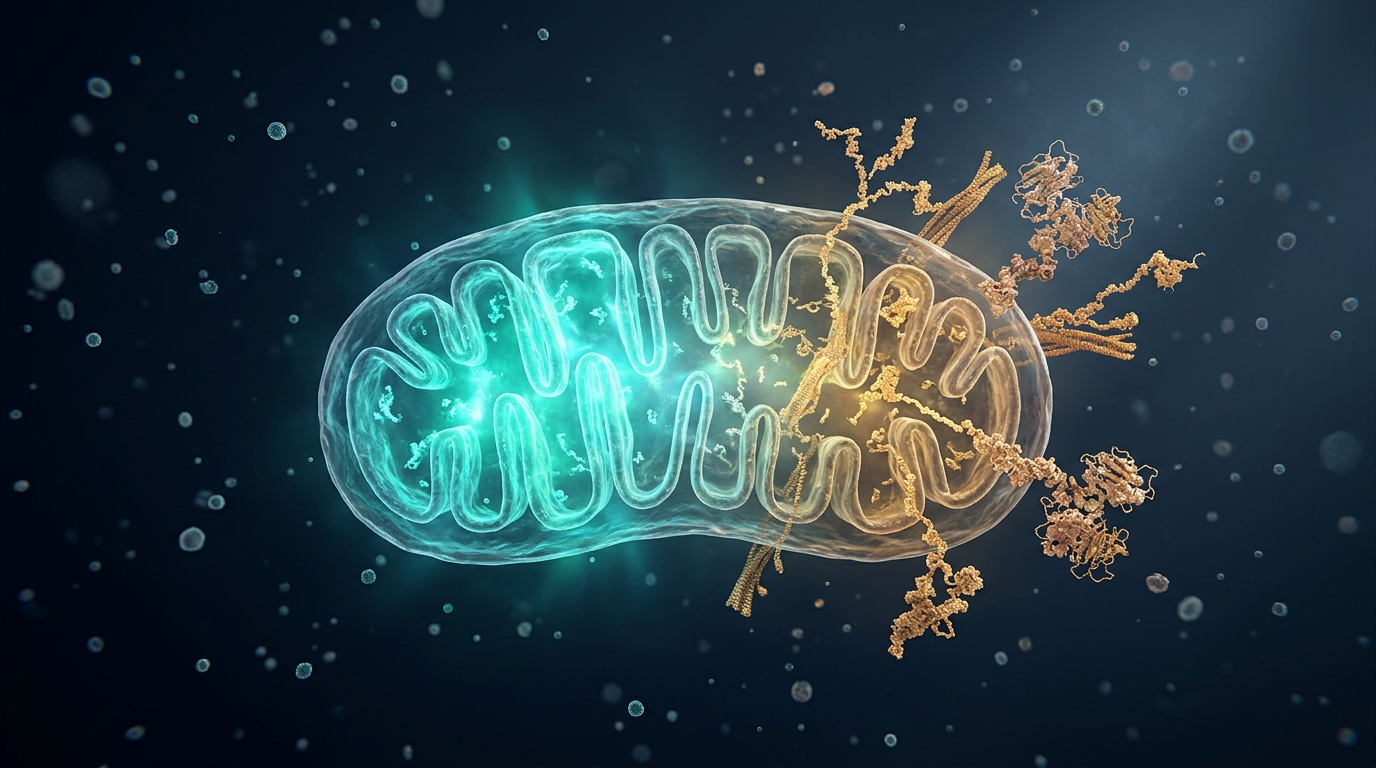
At the center of the proposed framework is PTEN-induced kinase 1, commonly known as PINK1. This protein is a central regulator of mitophagy, the cellular process by which damaged mitochondria are identified and removed to maintain the health of the mitochondrial network. PINK1 has gained attention for its role in maintaining both mitochondrial and cellular homeostasis, and mutations in the PINK1 gene are already known from research into Parkinson’s disease, though the current commentary focuses specifically on its relevance to Alzheimer’s disease.
The authors propose that PINK1 could function as a direct “amyloid switch,” a molecular point of control that influences whether amyloid accumulation proceeds. They frame this switch as part of broader cellular resilience cascading signaling events, suggesting that the state of the mitochondrial quality control system may help determine how neurons respond to the stresses that accumulate with age and disease.
The commentary also raises a practical question for therapeutic development. The authors note that the optimal therapeutic interventions for Alzheimer’s disease remain a matter of ongoing debate, and it is still unclear whether targeting the amyloid cascade alone is sufficient or whether a multitargeted therapeutic approach is obligatory. This question is particularly important because effective long-term disease-modifying therapies for the condition continue to be limited, despite the recent arrival of anti-amyloid treatments.
By shifting attention from amyloid as the sole initiating event to a wider network of cellular stress pathways, with PINK1 positioned as a potential regulatory node, the commentary offers a conceptual framework intended to accommodate both the genetic evidence from familial cases and the multifactorial nature of sporadic disease. The authors present this as a hypothesis for the field to test, proposing that mitochondrial quality control through PINK1 may represent a point where the amyloid cascade and broader cellular resilience mechanisms intersect.
Subject of Research: A proposed role for the mitochondrial mitophagy regulator PINK1 as an amyloid switch in Alzheimer's disease pathogenesis.
Article Title: Reframing Alzheimer’s Disease Pathogenesis from the Amyloid Cascade Hypothesis to Mitochondrial PINK1 Centric Perspective
Article References: Lenin, R. R., Nandalal, S., & Anand, B. G. (2026). Reframing Alzheimer’s Disease Pathogenesis from the Amyloid Cascade Hypothesis to Mitochondrial PINK1 Centric Perspective. Cellular and Molecular Neurobiology. https://doi.org/10.1007/s10571-026-01820-9
Image Credits: AI Generated
DOI: 10.1007/s10571-026-01820-9
Keywords: Alzheimer's disease, PINK1, mitophagy, amyloid cascade hypothesis, mitochondrial dysfunction, sporadic Alzheimer's, cellular stress, blood-brain barrier, oxidative stress, lysosomal dysfunction, microglia, disease-modifying therapies
News Source: Diana Fleming. (November 4, 2026). Alzheimer’s Researchers Propose Mitochondrial PINK1 as an “Amyloid Switch” in Disease Pathogenesis. Scienmag.