• HOME
  • NEWS
  • EXPLORE
    • CAREER
      • Companies
      • Jobs
    • EVENTS
    • iGEM
      • News
      • Team
    • PHOTOS
    • VIDEO
    • WIKI
  • BLOG
  • COMMUNITY
    • FACEBOOK
    • INSTAGRAM
    • TWITTER
Thursday, October 29, 2026
BIOENGINEER.ORG
No Result
View All Result
  • Login
  • HOME
  • NEWS
  • EXPLORE
    • CAREER
      • Companies
      • Jobs
        • Lecturer
        • PhD Studentship
        • Postdoc
        • Research Assistant
    • EVENTS
    • iGEM
      • News
      • Team
    • PHOTOS
    • VIDEO
    • WIKI
  • BLOG
  • COMMUNITY
    • FACEBOOK
    • INSTAGRAM
    • TWITTER
No Result
View All Result
Bioengineer.org
No Result
View All Result
Home NEWS Science News Technology

Rice Husk, Coconut Husk, and Charcoal Powder Composite Absorbs Over 98% of Microwave Radiation

by
October 29, 2026
in Technology
Reading Time: 2 mins read
0
Rice Husk, Coconut Husk, and Charcoal Powder Composite Absorbs Over 98% of Microwave Radiation

Rice Husk, Coconut Husk, and Charcoal Powder Composite Absorbs Over 98% of Microwave Radiation

Share on FacebookShare on TwitterShare on LinkedinShare on RedditShare on Telegram

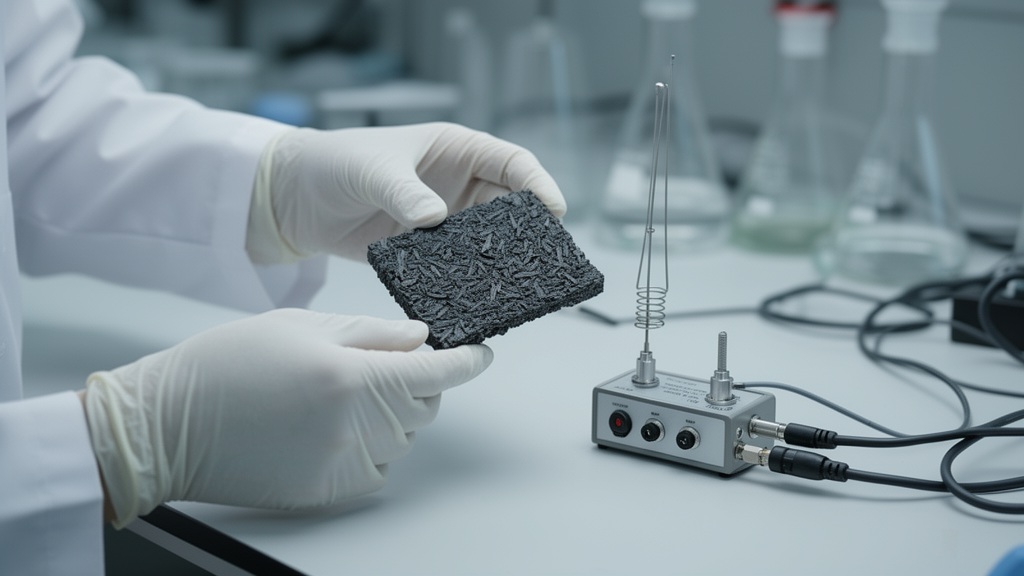
Researchers have fabricated a lightweight microwave absorber from agricultural waste, combining rice husk, coconut husk, and charcoal powder into a green composite designed to reduce electromagnetic pollution. Reported in Discover Applied Sciences, the work by Soumya Sundar Pattanayak and Swagatadeb Sahoo targets the 1–20 GHz frequency range with an inexpensive, environmentally friendly material made from residues that would otherwise be discarded.

The team prepared samples with different compositions of the three ingredients and measured their dielectric properties and reflective qualities using the open-ended coaxial probe technique. They also modeled the proposed structure in CST MWS 3D electromagnetic simulation software, then compared the experimental coaxial-probe results against the simulation output to check how well the two approaches agreed.

The best performance came from the sample with the highest charcoal content, at 11.11 wt%. This composition delivered a maximum return loss of -37.27 dB at 10.6236 GHz and an average return loss of -18.01 dB, corresponding to an absorption rate of more than 98%.

According to the authors, the close agreement between the simulated and measured results validates the universality of the simulation approach, suggesting the modeling workflow can be relied on when designing further iterations of the absorber.

The study proposes the composite, made from agricultural residues, as a microwave absorber intended to help achieve minimum electromagnetic pollution. As with any laboratory demonstration, performance was established for the fabricated samples under the reported measurement and simulation conditions, and the open-access article notes that the shared early version is subject to further edits before the final Version of Record.

Subject of Research: A lightweight microwave absorber made from rice husk, coconut husk, and charcoal powder for the 1–20 GHz range

Article Title: Design and development of rice husk, coconut husk, and charcoal powder based microwave absorber

Article References: Pattanayak, S. S., & Sahoo, S. (2026). Design and development of rice husk, coconut husk, and charcoal powder based microwave absorber. Discover Applied Sciences. https://doi.org/10.1007/s42452-026-09776-7

Image Credits: AI Generated

DOI: 10.1007/s42452-026-09776-7

Keywords: microwave absorber, rice husk, coconut husk, charcoal powder, green composite, dielectric properties, return loss, electromagnetic interference, open-ended coaxial probe, CST MWS simulation, agricultural waste, Design

News Source: Alan Morgan. (October 29, 2026). Rice Husk, Coconut Husk, and Charcoal Powder Composite Absorbs Over 98% of Microwave Radiation. Scienmag.


Tags: agricultural wastecharcoal powdercoconut huskCST MWS simulationdesigndielectric propertieselectromagnetic interferencegreen compositemicrowave absorberopen-ended coaxial probereturn lossrice husk
Share12Tweet7Share2ShareShareShare1

Related Posts

Digital Twin Falls Short: Physics-Based Blood Pressure Model Fails Rigorous Stress Test

Digital Twin Falls Short: Physics-Based Blood Pressure Model Fails Rigorous Stress Test

October 29, 2026
Fe₃Si-Enhanced Carbon Fiber Composite Lightens Synchronous Reluctance Motor Rotors

Fe₃Si-Enhanced Carbon Fiber Composite Lightens Synchronous Reluctance Motor Rotors

October 29, 2026

Dynamic Graph AI Model Hits Nearly 96% Accuracy in Traffic Congestion Prediction

October 29, 2026

Silver-based additive reconfigures interfaces in anode-free lithium metal batteries

October 29, 2026

POPULAR NEWS

  • Acid-loving bacteria strip methane in hot biotrickling filters for 700 days

    Acid-loving bacteria strip methane in hot biotrickling filters for 700 days

    29 shares
    Share 12 Tweet 7
  • Early Mitochondrial Changes Emerge Before Disease in Arrhythmogenic Cardiomyopathy Model

    29 shares
    Share 12 Tweet 7
  • Optogenetics offers a precise window into neural circuits behind neurodegenerative disease

    29 shares
    Share 12 Tweet 7
  • Olive Bark Beetle Discovered in Czech Republic Raises Fears of a Central European Spread

    29 shares
    Share 12 Tweet 7

About

We bring you the latest biotechnology news from best research centers and universities around the world. Check our website.

Follow us

Recent News

Emerging Neuroscientists Map Body, Brain and Behaviour Across the Lifespan

Digital Twin Falls Short: Physics-Based Blood Pressure Model Fails Rigorous Stress Test

Astragaloside IV Improves Cognition After Brain Injury in Mice, Study Finds

Subscribe to Blog via Email

Enter your email address to subscribe to this blog and receive notifications of new posts by email.

Join 84 other subscribers
  • Contact Us

Bioengineer.org © Copyright 2023 All Rights Reserved.

Welcome Back!

Login to your account below

Forgotten Password?

Retrieve your password

Please enter your username or email address to reset your password.

Log In
No Result
View All Result
  • Homepages
    • Home Page 1
    • Home Page 2
  • News
  • National
  • Business
  • Health
  • Lifestyle
  • Science

Bioengineer.org © Copyright 2023 All Rights Reserved.