Researchers have fabricated a lightweight microwave absorber from agricultural waste, combining rice husk, coconut husk, and charcoal powder into a green composite designed to reduce electromagnetic pollution. Reported in Discover Applied Sciences, the work by Soumya Sundar Pattanayak and Swagatadeb Sahoo targets the 1–20 GHz frequency range with an inexpensive, environmentally friendly material made from residues that would otherwise be discarded.
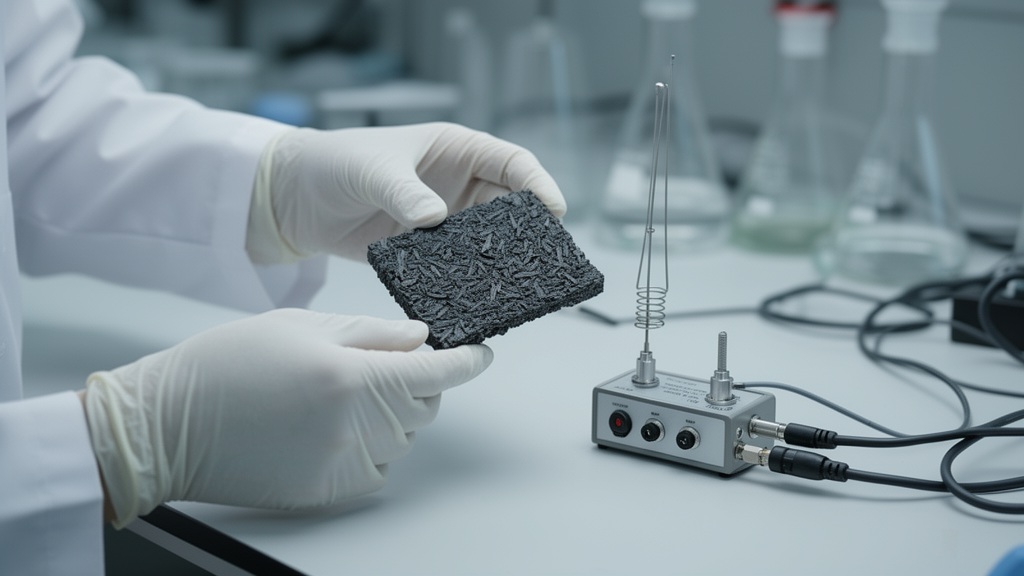
The team prepared samples with different compositions of the three ingredients and measured their dielectric properties and reflective qualities using the open-ended coaxial probe technique. They also modeled the proposed structure in CST MWS 3D electromagnetic simulation software, then compared the experimental coaxial-probe results against the simulation output to check how well the two approaches agreed.
The best performance came from the sample with the highest charcoal content, at 11.11 wt%. This composition delivered a maximum return loss of -37.27 dB at 10.6236 GHz and an average return loss of -18.01 dB, corresponding to an absorption rate of more than 98%.
According to the authors, the close agreement between the simulated and measured results validates the universality of the simulation approach, suggesting the modeling workflow can be relied on when designing further iterations of the absorber.
The study proposes the composite, made from agricultural residues, as a microwave absorber intended to help achieve minimum electromagnetic pollution. As with any laboratory demonstration, performance was established for the fabricated samples under the reported measurement and simulation conditions, and the open-access article notes that the shared early version is subject to further edits before the final Version of Record.
Subject of Research: A lightweight microwave absorber made from rice husk, coconut husk, and charcoal powder for the 1–20 GHz range
Article Title: Design and development of rice husk, coconut husk, and charcoal powder based microwave absorber
Article References: Pattanayak, S. S., & Sahoo, S. (2026). Design and development of rice husk, coconut husk, and charcoal powder based microwave absorber. Discover Applied Sciences. https://doi.org/10.1007/s42452-026-09776-7
Image Credits: AI Generated
DOI: 10.1007/s42452-026-09776-7
Keywords: microwave absorber, rice husk, coconut husk, charcoal powder, green composite, dielectric properties, return loss, electromagnetic interference, open-ended coaxial probe, CST MWS simulation, agricultural waste, Design
News Source: Alan Morgan. (October 29, 2026). Rice Husk, Coconut Husk, and Charcoal Powder Composite Absorbs Over 98% of Microwave Radiation. Scienmag.