


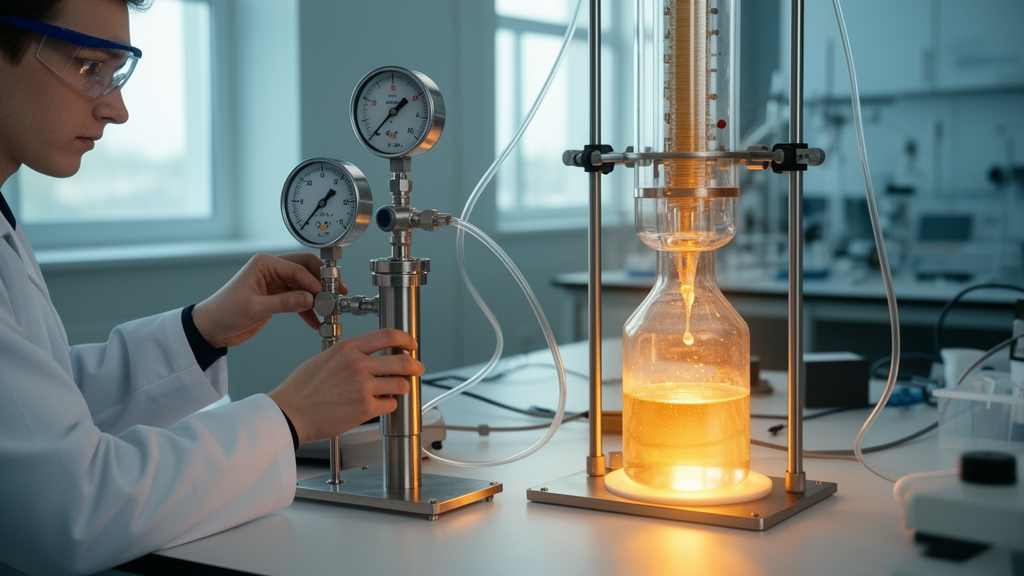
Chemists have mapped how a simple variable—the rate at which air is blown through hot fuel oil—changes the outcome of oxidative cracking, a process that breaks heavy residual oil into lighter, more valuable fractions. In experiments reported in Discover Chemical Engineering, a team led by Makhmudov Mukhtor Jamolovich investigated the air-assisted oxidative conversion of fuel oil at 440 °C, supplying air at flow rates between 0.2 and 1.0 litres per minute per kilogram of feedstock and, in additional runs, at pressures from 0.5 to 1.0 MPa.
The feedstock was fuel oil containing fractions boiling up to 360 °C. The key measured response was the yield of light fractions boiling below 360 °C. Raising the air flow rate from 0.2 to 0.8 l min⁻¹ kg⁻¹ increased that yield from 24.5 to 44.5 wt%—a gain of twenty percentage points that the authors interpret as consistent with oxygen-mediated radical-chain reactions combined with thermal decomposition. Pushing the flow rate further to 1.0 l min⁻¹ kg⁻¹, however, produced a slight decline, to 43.8 wt%, indicating that more air is not always better.
Pressure mattered as well. Among the pressures investigated, the highest liquid-product yield at an air flow rate of 0.8 l min⁻¹ kg⁻¹ was obtained at 0.8 MPa. Combining these optima, the authors selected 440 °C, 0.8 MPa and 0.8 l min⁻¹ kg⁻¹ as their operating conditions and closed the material balance: 3.4 wt% gases, 23.7 wt% gasoline-range fraction, 9.5 wt% kerosene-range fraction, 18.4 wt% diesel-range fraction and 45.0 wt% oxidized residue.
Those numbers show that the gasoline-, kerosene- and diesel-range fractions together account for 51.6 wt% of the material balance, while a substantial oxidized residue remains. The product spans gasoline-, kerosene- and diesel-range cuts, indicating a mixed light product rather than a single target fraction.
To characterize the liquid products, the researchers used Fourier-transform infrared spectroscopy. The FTIR analysis indicated the presence of aliphatic, aromatic, olefinic and oxygen-containing functional groups, a signature consistent with partial oxidation accompanying the thermal cracking chemistry.
Mechanistically, the authors interpret the enhancement of light-fraction formation as consistent with oxygen-mediated radical-chain reactions operating alongside thermal decomposition.
The study is explicitly framed as a demonstration of potential: controlled air addition can intensify the conversion of fuel oil into light fractions under comparatively mild pressurized conditions.
Important caveats accompany the findings. The work was performed on a single feedstock specification at laboratory scale, and the abstract notes that further physicochemical characterization and a techno-economic assessment are required before commercial application can be evaluated. The published version is also an early-release, peer-reviewed accepted manuscript carrying a permanent DOI, subject to further edits before the final Version of Record. Within those limits, the paper delivers a clean dose–response relationship: air flow rate, pressure and temperature jointly set the light-fraction yield, with 0.8 l min⁻¹ kg⁻¹ and 0.8 MPa emerging as the sweet spot in the explored window.
Subject of Research: Experimental study of air-assisted oxidative conversion of fuel oil into light fractions at varying air flow rates and pressures.
Article Title: Effect of air flow rate on oxidative cracking of fuel and formation of chemical transformation products
Article References: Jamolovich, M. M., Ismatovich, M. F., Ibodullayevich, N. K., Fayzullayevich, K. A., Bakhtiyorovich, S. B., Omarovich, S. S., Abdurashitovich, A. A., Askarovich, R. U., Mauletbaevna, A. D., & Ilxombekovich, K. R. (2026). Effect of air flow rate on oxidative cracking of fuel and formation of chemical transformation products. Discover Chemical Engineering. https://doi.org/10.1007/s43938-026-00143-x
Image Credits: AI Generated
DOI: 10.1007/s43938-026-00143-x
Keywords: fuel oil, oxidative cracking, air flow rate, light fractions, radical-chain reactions, FTIR analysis, petroleum refining, material balance, Effect, flow, rate, oxidative
News Source: Bethany Barker. (October 29, 2026). Air Flow Rate Controls Light-Fraction Yields in Oxidative Cracking of Fuel Oil. Scienmag.



