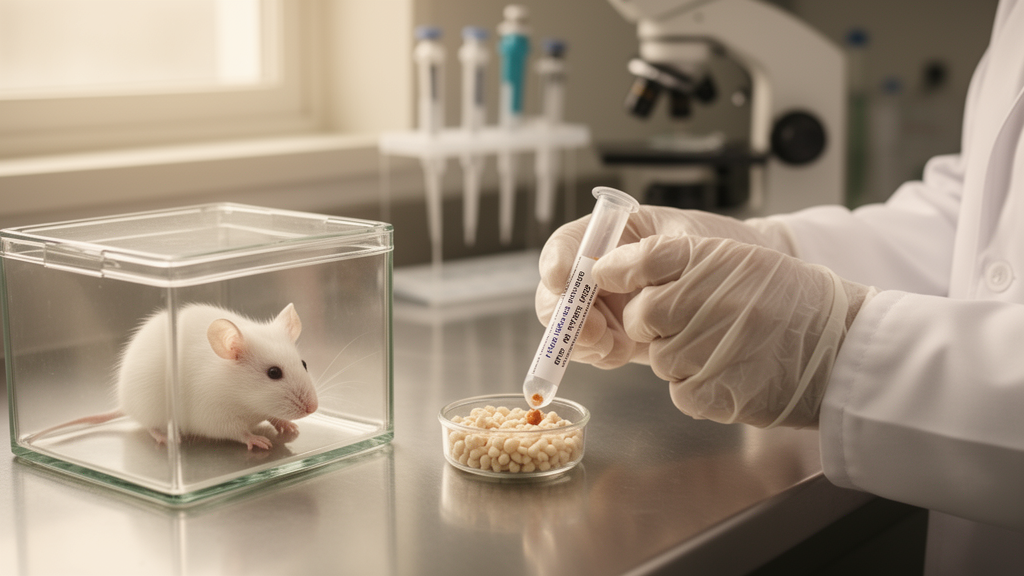
A dense longitudinal study in mice has mapped how a high-fat diet restructures the gut microbiota over time, revealing that the reorganization unfolds in distinct phases rather than as a single gradual drift. Researchers assigned mice to a normal diet (19 animals, four to five per cage) or a high-fat diet (20 animals, five per cage) and collected 468 fecal samples at 12 timepoints across 70 days, spanning acute, early, mid, and late phases. Microbial communities were profiled with 16S rRNA V3-V4 gene sequencing, and the work was published open access in BMC Microbiology on 26 October 2026.
The high-fat diet significantly reduced alpha diversity, with a mean Shannon index of 4.58 ± 0.53 in high-fat-fed mice versus 5.03 ± 0.34 in normal-diet controls (p < 0.001), and altered overall community composition, with diet explaining roughly 18% of the variance in a PERMANOVA test (R² = 0.177, p = 0.001). Two independent differential abundance methods, ANCOM-BC2 and MaAsLin3, converged on five diet-responsive genera: Lactococcus and Taurinivorans were enriched in high-fat-fed mice (log2 fold changes of 6.31 and 4.41), while Duncaniella, Lepagella, and CAG-873 were depleted (log2 fold changes of −3.22, −2.82, and −2.71), with large effect sizes (|Cohen’s d| = 1.22–2.24). Per-mouse correlations tied these taxa to body weight, with absolute Spearman coefficients of 0.67–0.82 (all adjusted p < 0.001).
Temporal analysis was the study’s central contribution. Lactococcus expanded rapidly during the acute phase, while Duncaniella showed progressive depletion. Cross-correlation lag analysis suggested an ordering of events: Duncaniella depletion preceded weight gain, peaking at a lag of −2 with a modest correlation (r = −0.31), whereas Taurinivorans enrichment followed weight gain, peaking at a lag of +1 (r = +0.31). Community state modeling identified two distinct configurations, and high-fat-fed mice shifted between them more often than controls, with transition rates of 15.8% versus 7.1%, indicating greater community instability. Indicator species analysis flagged 23 genera as phase-specific, with Lactococcus the strongest chronic-phase indicator (IndVal = 0.924). Four of the five diet-responsive genera ranked among the top ten network hubs by degree centrality in co-occurrence analysis.
Functional prediction with PICRUSt2 pointed to broad metabolic reprogramming: 342 predicted pathways were significantly altered, 63% of those tested, with enrichment of simple carbohydrate degradation and depletion of complex polysaccharide utilization, consistent with the taxonomic shifts. The authors propose a multi-phasic model in which rapid, taxon-specific acute responses give way to progressive compositional change and chronic instability, and they frame Duncaniella depletion as a candidate temporal precursor of weight gain while treating Taurinivorans enrichment as secondary to metabolic deterioration. The findings are specific to this mouse model and 16S-based profiling, and the lag-based ordering is correlational, so causal direction in the diet–microbiota–weight relationship remains to be tested. The authors suggest the identified taxa and temporal windows could serve as targets for future intervention studies, though no intervention was performed in this work.
Subject of Research: Temporal dynamics of gut microbiota restructuring in a mouse model of diet-induced obesity
Article Title: Gut microbiota restructuring during diet-induced obesity: a dense longitudinal study reveals phasic perturbation, network hubs, and temporally ordered taxonomic shifts
Article References: Li, R., Deng, L., Yang, X., Luo, G., & Hu, J. (2026). Gut microbiota restructuring during diet-induced obesity: a dense longitudinal study reveals phasic perturbation, network hubs, and temporally ordered taxonomic shifts. BMC Microbiology. https://doi.org/10.1186/s12866-026-05800-3
Image Credits: AI Generated
DOI: 10.1186/s12866-026-05800-3
Keywords: gut microbiota, high-fat diet, obesity, mice, longitudinal study, 16S rRNA sequencing, Lactococcus, Duncaniella, Taurinivorans, community dynamics, PICRUSt2, BMC Microbiology
News Source: Morgan Morrow. (October 29, 2026). High-Fat Diet Reshapes the Mouse Gut Microbiome in Distinct, Timed Phases. Scienmag.