


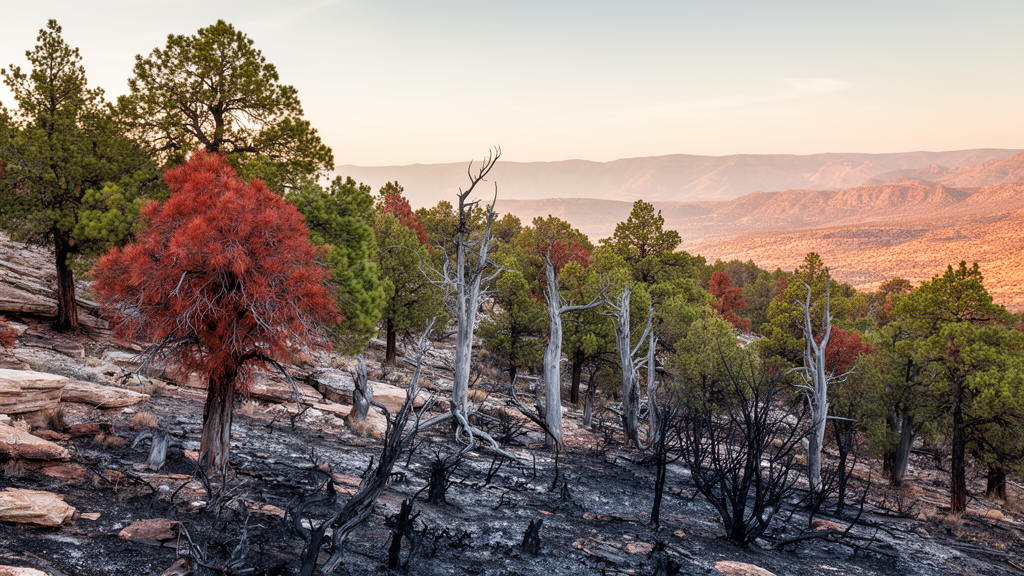
In the high country of Big Bend National Park, Texas, two decades of forest monitoring have captured a rare, unflinching account of what happens when a record drought is followed by wildfire. Using permanent plots established in 2003 and 2008 and remeasured through 2023, researchers documented how the severe 2011 Texas drought and the 2021 South Rim 4 Fire reshaped piñon-juniper-oak forests in the Chisos Mountains. The findings, published in Fire Ecology, show losses so large that in some burned stands almost nothing living remained above ground.
The drought alone was devastating. In unburned plots, live tree density fell from roughly 1,687 to 766 trees per hectare between the pre-disturbance census and the 2019 post-drought measurement, a decline of 52.8 percent. Basal area, a measure of the total cross-sectional area of tree stems and a standard index of forest standing stock, dropped from 31.0 to 15.6 square meters per hectare, a loss of 49.1 percent. After 2019, unburned plots changed little, suggesting the drought had done most of its damage in a single, brutal pulse.
The burned plots told a harsher story. Of the 56 monitoring plots that burned in the South Rim 4 Fire, which ignited on April 8, 2021 and consumed 541 hectares of the Chisos high country over two weeks, field crews classified 17 as low fire effect, 20 as moderate, and 19 as high, based on the percentage of pre-fire trees killed. High-severity plots had already lost 70.7 percent of their tree density to drought, falling from about 1,713 to 502 trees per hectare by 2019. After the fire, they retained only around 75 trees per hectare. Cumulative basal-area loss in those plots reached approximately 92 percent, with basal area falling from 31.1 to 10.3 square meters per hectare after drought and then to just 2.47 after fire.
Species responded unevenly, and the differences carry real ecological weight. Mexican piñon pine, the region’s signature conifer, collapsed to near-zero densities in moderate- and high-severity plots. In high-severity stands, piñon declined from 729 to roughly 10 trees per hectare, a reduction of about 99 percent. Junipers fell from 347 to about 27 trees per hectare, roughly 92 percent, and oaks from 79 to about 5 trees per hectare, about 89 percent. Piñon’s extreme vulnerability fits its physiology: unlike thicker-barked, self-pruning ponderosa pines, piñons lack traits that allow survival even of moderate-severity fire, and under drought stress they close their stomata to conserve water, a strategy that halts photosynthesis and cannot be sustained.
Statistical modeling reinforced the pattern. The researchers fitted zero-inflated negative binomial mixed-effects models, selected after diagnostics showed simpler Poisson models violated assumptions of overdispersion and excess zeros. These models revealed significant interactions between timestep and fire severity for tree density, basal area, and juvenile abundance, all at p < 0.001, meaning post-disturbance trajectories diverged sharply among severity classes. Declines from pre-disturbance to post-drought were significant across all plots, while additional post-fire losses occurred primarily in high-severity plots.
One result stands out for what it did not show. When the team binned stems into 5-centimeter diameter classes and tested whether mortality concentrated in particular sizes, the timestep-by-size-class interaction was not significant for all trees, junipers, oaks, or piñons. Tree losses occurred broadly across the size distribution rather than selectively culling small or large stems. Complete mortality of all trees in a plot occurred in 7 of 107 plots, about 7 percent, after drought, with only two additional plots suffering complete loss after fire.
The understory responded differently from the overstory. Juvenile trees, tallied as seedlings and resprouts under 5 centimeters in diameter in nested subplots, did not uniformly decline after drought; oak juveniles actually increased in some unburned plots, rising from 565 to 902 stems per hectare. Fire, however, cut juvenile densities substantially in burned plots, with the strongest reductions in high-severity areas, where densities fell from 803 to 314 stems per hectare. Piñon juveniles declined strongly, juniper juveniles remained relatively stable, and oaks showed only limited persistence in high-severity patches. Notably, the researchers observed little of the vigorous oak resprouting after top-kill that has been documented elsewhere in the Sky Islands, hinting that oak persistence here may depend on local species composition, pre-fire stress, and post-fire conditions.
The authors are careful about interpretation, and rightly so. Because their fire-effect classes were defined by total tree mortality, they treated contrasts among classes descriptively rather than as independent causal tests of fire severity. They also note that remotely sensed burn-severity indices from Landsat 8 and Sentinel-2 correlated poorly with field assessments, so the field classifications were used instead. The interaction between drought and fire, they conclude, reflects compounding disturbance effects: drought thinned forests broadly, and high-severity fire then imposed an additional filter on already weakened stands, rather than drought mortality directly predicting where the fire burned hottest.
The cumulative losses appear large even against other long-term piñon-juniper studies. Compared with comparable work near Flagstaff, Arizona, the Chisos Mountains experienced greater drought-associated mortality and even larger cumulative losses where drought was followed by high-severity fire. The resulting landscape is now a heterogeneous mosaic ranging from closed-canopy forest that escaped both disturbances, to drought-thinned woodland, to open post-fire savanna, to severely burned patches with almost no living overstory. Such structural variety will likely reshape regeneration, understory communities, and wildlife habitat, since avian and mammal habitat use in piñon-juniper systems tracks canopy cover and snag abundance.
What comes next is uncertain, and the researchers frame the future through the Resist-Accept-Direct management framework. Sparser forests might, in principle, buffer surviving trees against future drought by reducing competition, making low-density stands a plausible new normal. But sustained mortality and weak juvenile regeneration could instead represent a bottleneck for long-term forest persistence, potentially pushing these woodlands toward shrubland or grassland. With climate projections pointing to a hotter, drier, more flammable Southwest, the authors argue that long-term monitoring is the only way to know whether these forests recover between disturbances or simply lose them.
Subject of Research: Combined impacts of a severe drought and a subsequent wildfire on piñon-juniper-oak forest structure in the Chisos Mountains, Texas
Article Title: From drying to frying: drought and fire as interacting drivers of vegetation change in piñon-juniper-oak forests of the Chisos Mountains, Big Bend National Park, USA
Article References: Poulos, H. M., & Barton, A. M. (2026). From drying to frying: drought and fire as interacting drivers of vegetation change in piñon-juniper-oak forests of the Chisos Mountains, Big Bend National Park, USA. Fire Ecology, 22(1), Article 144. https://doi.org/10.1186/s42408-026-00582-5
Image Credits: AI Generated
DOI: 10.1186/s42408-026-00582-5
Keywords: piñon-juniper forests, drought mortality, wildfire, Big Bend National Park, fire severity, tree density, basal area, forest monitoring, Chisos Mountains, climate change, regeneration, South Rim 4 Fire
News Source: Drew Townsend. (October 30, 2026). Drought Then Fire Pushed Big Bend’s Piñon-Juniper Forests Toward Collapse. Scienmag.



