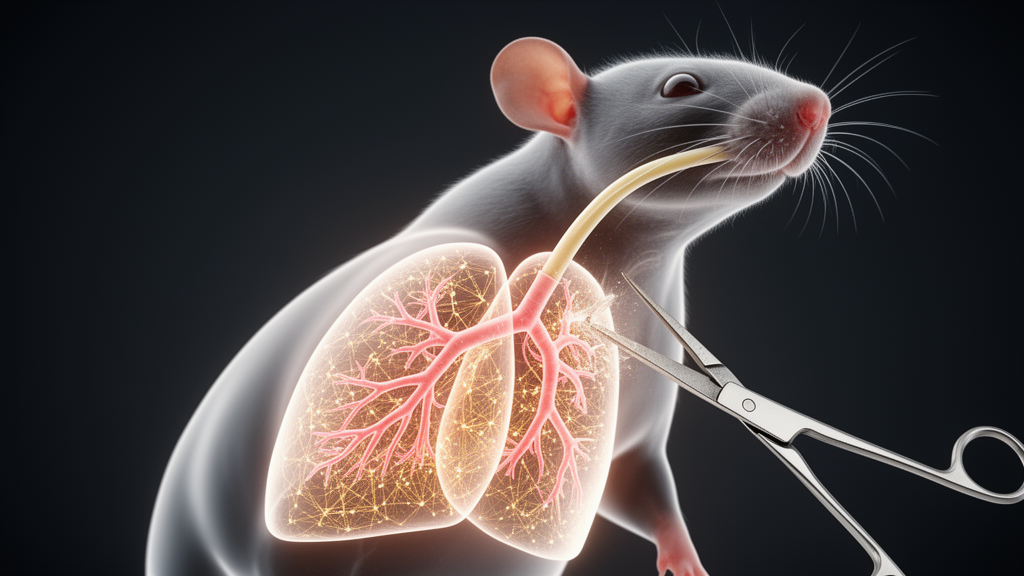
Severing a small nerve in the neck can ease the signs of pulmonary arterial hypertension in rats, and a new study now traces how that surgical intervention reshapes gene activity in the lung. The research, published in Frontiers in Cardiovascular Medicine, combined hemodynamic measurements, lung histology and whole transcriptome sequencing to map the molecular consequences of transecting the cervical sympathetic trunk, a procedure the authors use as an animal model of long-lasting sympathetic nerve blockade.
Pulmonary arterial hypertension is a progressive disorder defined by a sustained rise in mean pulmonary arterial pressure above 20 mmHg at rest, driven largely by excessive pulmonary vasoconstriction and maladaptive remodeling of the pulmonary vessels. The resulting increase in pulmonary vascular resistance raises the afterload on the right ventricle, which can ultimately fail. Current drugs target the prostacyclin, endothelin-1 and nitric oxide pathways; they improve quality of life and exercise capacity, but their long-term survival benefits remain limited, which is one reason the search for new therapeutic strategies continues.
The sympathetic nervous system has emerged as a plausible target. Pulmonary vessels receive sympathetic, parasympathetic and sensory innervation, and sympathetic nerves raise vascular resistance mainly through alpha-adrenergic receptors. Elevated sympathetic activity in patients with pulmonary arterial hypertension correlates with poor prognosis and may even act as an independent predictor of clinical worsening. Existing approaches to dampen this activity, such as renal denervation and pulmonary artery denervation, have shown some promise in experimental and clinical settings, but their mechanisms are incompletely understood and radiofrequency ablation carries risks of vascular stenosis or unintended damage to parasympathetic nerves.
In the new work, a team at the General Hospital of Ningxia Medical University used adult male Sprague-Dawley rats given a single subcutaneous injection of monocrotaline, a toxin that reliably induces pulmonary hypertension in rodents. The animals were divided into four groups of eight: a normal control receiving saline, a pulmonary hypertension group, a group that also underwent sham surgery in which the cervical sympathetic trunk was exposed but left intact, and a group in which the left trunk was ligated and transected on the same day as the toxin injection. Successful denervation was confirmed within 24 hours by the appearance of Horner’s syndrome on the operated side, marked by ptosis, miosis and enophthalmos. All animals were sacrificed 28 days after the monocrotaline injection, 21 days after the nerve procedure.
The intervention worked at the organ and tissue level. Compared with controls, rats in the disease and sham groups showed damaged alveolar structure, thickened pulmonary interstitium and small pulmonary arterial walls, narrowed vessel lumens, disrupted endothelial continuity and proliferating, disorganized medial smooth muscle. In the transected group these features were notably improved, with relatively preserved alveolar architecture. Hemodynamically, mean pulmonary arterial pressure and right ventricular systolic pressure, both markedly elevated in the diseased animals, fell significantly after nerve transection, and right ventricular hypertrophy, measured as the ratio of right ventricular weight to left ventricular plus septal weight, was also ameliorated.
To find out what changed molecularly, the researchers sequenced RNA from lung tissue of the sham and transected groups with three biological replicates each. Principal component analysis showed substantial shifts in gene expression profiles between the two groups. In total, 500 differentially expressed genes emerged, of which 61 were upregulated and 439 downregulated. Enrichment analysis pointed in a coherent direction: upregulated genes were associated with protein binding, inflammatory and immune responses, apoptosis and cytokine-cytokine receptor interaction signaling, while downregulated genes clustered around calcium ion binding, calcium-dependent protein binding, positive regulation of cytosolic calcium concentration, cell proliferation, and pathways including calcium signaling, complement cascade, PPAR, AMPK and PI3K-Akt.
Because transcription factors act as molecular switches linking external signals to gene expression, the team intersected their differentially expressed genes with a curated rat transcription factor database and identified 15 differentially expressed transcription factors. Six, including Zbtb16, Nkx2-8, Klf2, Nr1d1, Dbp and Zfp683, were upregulated, while nine, among them Bhlha15, Tcf24, Barx2, Pax9, Foxa3, Nr1i2, Tbxt and Elf3, were downregulated. Genes co-expressed with these factors were enriched in inflammatory response, positive regulation of cell proliferation and calcium-mediated signaling. Notably, six genes with established roles in driving pulmonary arterial hypertension—Bmp2, Ptgs2, Cxcl13, Wnt7b, Tacr1 and Adra1d—were all significantly downregulated after the nerve cut.
The authors themselves urge caution about one of those genes. The BMP2/BMPRII axis is generally considered protective in the pulmonary vasculature, exerting antiproliferative effects through the PPARγ/apoE pathway, and impaired BMPRII signaling is a well-documented feature of the monocrotaline model. The observed downregulation of Bmp2 should therefore not be read in isolation as a direct therapeutic benefit; the team suggests it likely reflects a broader remodeling of BMP signaling whose significance depends on receptor expression and downstream Smad1/5/8 activity. By contrast, the other downregulated genes fit a deleterious profile: COX-2, encoded by Ptgs2, promotes smooth muscle proliferation through an increased TXA2/PGI2 ratio; Wnt7b drives pulmonary artery smooth muscle precursor proliferation and is highly expressed in patient lung tissue; CXCL13 is elevated in vascular lesions and serum of patients with idiopathic disease; and ADRA1D and TACR1 are calcium signaling factors whose silencing or blockade attenuates hypertension and right ventricular hypertrophy in rat models.
One regulatory axis received the closest scrutiny. Screening for transcription factors with predicted binding sites in the promoters of Adra1d and Tacr1, and intersecting the results with the downregulated gene list, singled out Foxa3 as a candidate regulator of both. Motif analysis identified multiple potential binding sites for the FOXA3 DNA-binding motif in both promoters, and co-expression analysis showed strong positive correlations between Foxa3 and Adra1d (r = 0.96) and Tacr1 (r = 0.95). Quantitative PCR confirmed that Foxa3, Adra1d, Tacr1 and Plcb1, which encodes the phospholipase C enzyme that generates the second messenger IP3, were all reduced in lung tissue after nerve transection, western blotting confirmed reduced FOXA3 protein, and ELISA showed significantly lower IP3 concentrations. Since elevated cytosolic calcium activates pro-inflammatory transcription factors such as NF-κB and NFAT, the authors argue that suppressing this pathway may dampen proliferative and inflammatory processes simultaneously.
The study also looked beyond gene expression levels to gene processing. Alternative splicing analysis identified numerous differential splicing events between the groups, dominated by intron retention and alternative 5′ and 3′ splice sites, and 14 differentially expressed RNA-binding proteins, including Zbtb16, Zfp683, Tent5c, Enpp3, Rab6b, Ttc21a and Aicda, were linked to these events in a co-expression network. Three genes relevant to pulmonary hypertension showed significant splicing changes: Aldh2 showed decreased alternative 3′ splice site usage, while Il1rn and Foxm1 showed increased alternative 5′ and 3′ splice site usage respectively. The authors note, however, that the transcription factor and RNA-binding protein networks rest primarily on bioinformatic predictions that would need validation by methods such as ChIP-qPCR, reporter assays or RNA immunoprecipitation, and that the monocrotaline model, driven mainly by endothelial injury and inflammation, does not fully recapitulate the heterogeneity of human disease. Sympathetic activity was not directly quantified, so the link between the molecular effects and reduced sympathetic tone remains inferential, and clinical translation of a permanent nerve transection faces obvious hurdles, with reversible or minimally invasive blockade strategies proposed as more realistic future directions.
Subject of Research: A rat study of how transecting the cervical sympathetic trunk relieves pulmonary arterial hypertension through transcriptional and post-transcriptional changes
Article Title: Transection of the cervical sympathetic trunk ameliorates pulmonary arterial hypertension by reprogramming transcription factor networks and alternative splicing in rat model
Article References: Hao, Y., Li, P., Cheng, H., Yan, N., Zhang, H., & Ma, X. (2026). Transection of the cervical sympathetic trunk ameliorates pulmonary arterial hypertension by reprogramming transcription factor networks and alternative splicing in rat model. Frontiers in Cardiovascular Medicine, 13, 1967847. https://doi.org/10.3389/fcvm.2026.1967847
Image Credits: AI Generated
DOI: 10.3389/fcvm.2026.1967847
Keywords: pulmonary arterial hypertension, cervical sympathetic trunk, sympathetic nervous system, monocrotaline rat model, transcription factors, alternative splicing, calcium signaling, RNA-binding proteins, RNA sequencing, Foxa3, gene expression, neuromodulation
News Source: Juliet Wilcox. (October 28, 2026). Cutting a Neck Nerve Rewires Gene Networks to Ease Rat Lung Hypertension. Scienmag.