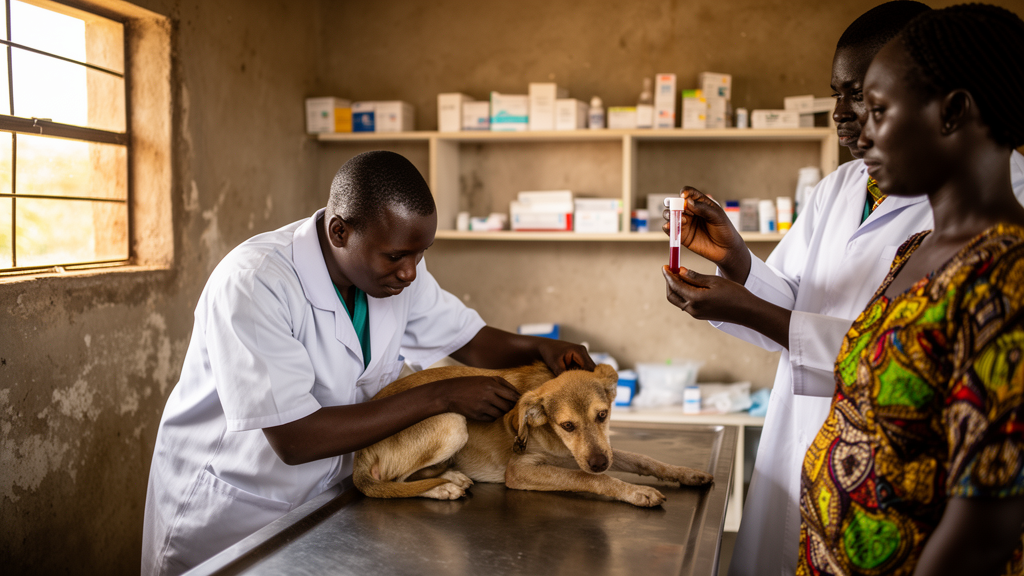
A molecular survey of dogs in the urban commune of Labé, in the Middle Guinea region of Guinea, has detected canine parvovirus type 2 (CPV-2) in 10.8 percent of the animals tested, confirming active circulation of the virus in a West African city where epidemiological information on the disease had previously been almost entirely absent. The findings, published in the journal Companion Animal Health and Genetics, come from a cross-sectional study conducted between September and November 2024 among 102 dogs drawn from seven neighborhoods of the commune.
The research team, led by Noumouké Kante of the Higher Institute of Veterinary Science and Medicine, collected rectal swab samples from each dog after obtaining owner consent and analyzed the material using real-time polymerase chain reaction (qPCR) targeting the VP2 gene of the virus. Samples with cycle threshold values of 38 or lower were classified as positive according to the laboratory protocol. The qPCR approach was chosen because, compared with rapid fecal antigen tests, it offers greater sensitivity for detecting viral genetic material, particularly during early infection or when viral loads are low.
Of the 102 dogs examined, 11 tested positive for CPV-2 DNA, yielding the overall prevalence of 10.8 percent. The authors note that although this rate is not extremely high, it reveals a significant level of exposure in the community, particularly in a context where vaccination coverage is low and dog health management is limited. The study was designed as a descriptive, analytical, cross-sectional investigation, with a minimum sample size of 96 dogs calculated using a standard prevalence formula that assumed a 50 percent expected prevalence, a 10 percent precision level and a 95 percent confidence interval; 102 dogs were ultimately included to improve representativeness and account for potential sampling losses.
Recruitment followed a non-probabilistic convenience sampling approach combined with simple random selection of study sites, with neighborhoods identified using OpenEpi software and approximately fourteen dogs sampled from each of the seven selected neighborhoods. Dogs were eligible if their owners were at least 18 years old and consented to both the questionnaire and the rectal swab collection. Free-roaming, chained and caged owned dogs were all included regardless of sex, age or breed. Before sampling, each dog underwent a clinical examination using standard semiological methods, including auscultation, palpation, percussion and temperature measurement, and some dogs were asymptomatic at the time of sampling while others showed signs compatible with infection, particularly bloody diarrhea. Fever was observed in all clinically affected dogs, but definitive positive cases were established exclusively on the basis of qPCR detection of viral genetic material.
Prevalence varied across age groups, ranging from 6.9 percent in dogs younger than one year to 20.0 percent in dogs aged 6 to 10 years, with dogs aged 1 to 5 years showing an intermediate rate of 11.1 percent. The authors suggest that the higher prevalence among older dogs may reflect prolonged cumulative exposure to contaminated environments and infected animals over time, while the lower rate among puppies could relate to maternal immunity, the relatively small number of young dogs in the sample, or differences in owner management practices. They caution, however, that the confidence intervals were wide, particularly in the 6 to 10 years group, where the interval spanned 2.5 to 55.6 percent, indicating limited precision of the estimates due to the small sample size within that category.
Male dogs showed a higher prevalence than females, at 11.9 percent versus 5.6 percent, a difference the authors attribute in part to behavioral and management factors rather than biological sex alone. In many African urban settings, male dogs are more frequently allowed to roam freely for guarding, breeding or territorial purposes, which may increase their contact with contaminated feces and other infected dogs. The authors also note that some studies have suggested hormonal factors, particularly testosterone, may influence immune responses and susceptibility to certain infectious diseases. They emphasize that the wide confidence interval observed among female dogs, spanning 0.1 to 27.3 percent, reflects the small number of females included and that the difference between the sexes should be interpreted cautiously because of overlapping confidence intervals.
Lifestyle also appeared to shape the pattern of detection, though not in a statistically significant way. Most dogs in the study were either free-roaming, at 51.0 percent, or chained, at 44.1 percent, while only 3.9 percent were caged. Prevalence was slightly higher among free-roaming dogs, at 11.5 percent, than among chained dogs, at 11.1 percent, and no positive case was detected among the four caged dogs. The authors stress that the absence of positives among caged animals should be interpreted with great caution because of the very small number in that category, and they note that chained dogs may remain exposed through poor hygiene conditions and indirect contact with contaminated materials. In the urban commune of Labé, dogs frequently move within neighborhoods, markets and public areas, which may contribute to the environmental dissemination of a virus that is notably resistant and can remain infectious for prolonged periods.
Geographically, prevalence ranged from 7.1 percent in the neighborhood of Daka 2 to 14.3 percent in Kouroula and Tata, with intermediate rates in Labico at 11.1 percent and Pounthioun at 12.5 percent, and lower values of 7.7 percent in Madina and Safatou 1. The authors describe this heterogeneous spatial distribution as suggesting the existence of localized transmission areas within the commune, potentially associated with higher dog density, uncontrolled roaming or reduced access to preventive veterinary care in the higher-prevalence neighborhoods. They again caution that the wide confidence intervals obtained for individual neighborhoods reflect limited precision arising from small sample sizes within each locality.
Crucially, none of the investigated factors reached statistical significance. Logistic regression analysis found no significant association between CPV-2 infection and age, sex or lifestyle, with p values of 0.51 for age, 0.43 for sex and 0.84 for lifestyle, all above the 0.05 threshold. The authors attribute the lack of significant associations to the relatively small sample size and the limited number of positive cases, which reduced the statistical power needed to detect such relationships. They conclude that viral exposure in the study area is likely influenced by multiple interacting environmental and management factors rather than by a single demographic characteristic, and that although male dogs and older animals showed higher odds ratios, the confidence intervals remained wide.
Beyond the prevalence estimates, the survey revealed a striking gap in owner knowledge. Most respondents demonstrated little or no awareness of canine parvovirus, a finding the authors link to limited veterinary public education, poor access to veterinary services, the absence of routine vaccination programs and the low prioritization of companion animal health in Guinea, where dogs are often kept mainly for security or hunting purposes. Vaccination against CPV-2 is not routinely practiced in the country, and the disease is not considered a major priority in veterinary public health programs. The authors recommend strengthening vaccination programs, improving owner awareness, promoting responsible dog management and reinforcing epidemiological surveillance to reduce viral transmission and associated canine health losses. They acknowledge several limitations, including the small sample size, reliance on owner-reported vaccination status, the absence of serological analyses, the inability of the PCR protocol to differentiate between the CPV-2a and CPV-2b antigenic variants, and the possibility that contamination could have produced false-positive results. They call for further large-scale molecular and serological investigations to better understand circulation dynamics, characterize circulating viral variants and support the development of effective prevention and control strategies in Guinea.
Subject of Research: A cross-sectional molecular survey of canine parvovirus prevalence and associated risk factors among dogs in the urban commune of Labé, Guinea.
Article Title: Epidemiological survey on canine parvovirus in the Urban Commune of Labé, Guinea
Article References: Kante, N., Kaba, L., Sanou, M., Barry, F. B., Ouedraogo, N., Camara, A. O. D., Camara, A. D., Konate, Y., Haba, F. F., Diallo, A. O. S., Sidime, Y., Barro, N., & Traore, A. K. (2026). Epidemiological survey on canine parvovirus in the Urban Commune of Labé, Guinea. Companion Animal Health and Genetics, 13(1), Article 5. https://doi.org/10.1186/s40575-026-00154-5
Image Credits: AI Generated
DOI: 10.1186/s40575-026-00154-5
Keywords: canine parvovirus, CPV-2, Guinea, Labé, dogs, qPCR, prevalence, cross-sectional study, vaccination, veterinary epidemiology, free-roaming dogs, public awareness
News Source: William Thompson. (October 28, 2026). Canine Parvovirus Detected in One in Ten Dogs Surveyed in Labé, Guinea. Scienmag.