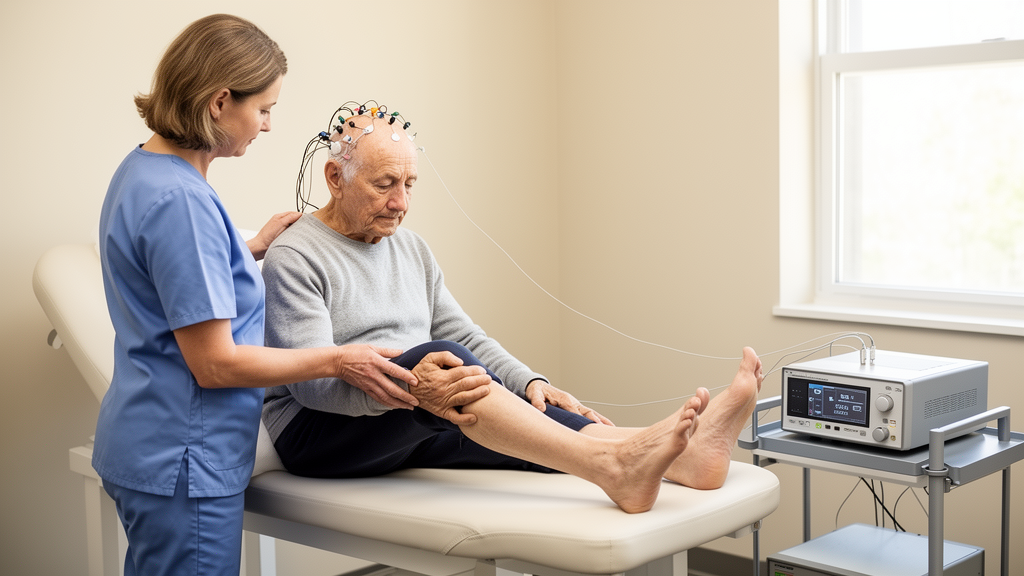
Non-invasive brain stimulation combined with exercise training has been promoted as a promising approach for knee osteoarthritis, but a new systematic review and meta-analysis finds that the evidence for its benefits is far more limited than enthusiasts might hope. The review, published in Frontiers in Human Neuroscience, pooled data from randomized controlled trials to assess whether pairing techniques such as transcranial stimulation with structured exercise improves pain and physical function in people with knee osteoarthritis.
The researchers searched PubMed, Embase, the Cochrane Library and Web of Science from inception to December 9, 2025, identifying randomized controlled trials that tested the combined intervention against control conditions. Their primary outcomes were pain and physical function, with gait speed and quality of life as secondary outcomes. In total, eight studies covering 340 participants met the inclusion criteria.
On the review’s primary pain outcome, the results were sobering. When pain was measured with a numerical rating scale or a visual analog scale, the combined intervention showed a favorable but statistically non-significant effect compared with control, with a standardized mean difference of −0.41 and a 95% confidence interval spanning from −0.83 to 0.01, at a p-value of 0.0566. Heterogeneity between studies was substantial, with an I-squared of 67.3%, indicating that the trial results varied considerably.
Subgroup analyses by assessment time point, stimulation site and brain stimulation modality failed to identify any statistically significant effects on pain. In other words, no particular timing of assessment, target of stimulation or type of non-invasive brain stimulation emerged as clearly superior for reducing rated pain in this evidence base.
Physical function told a somewhat different story. The combined intervention significantly reduced the total score on the Western Ontario and McMaster Universities Osteoarthritis Index, a widely used self-report measure of osteoarthritis disability, with a mean difference of −6.76 points and a 95% confidence interval of −11.85 to −1.68, at p = 0.0091 and moderate heterogeneity of I-squared 51.3%. Subgroup analyses suggested larger benefits when follow-up lasted at least 12 weeks, with a mean difference of −11.44 and no heterogeneity, and when repetitive transcranial magnetic stimulation was paired with exercise training, with a mean difference of −10.70 and low heterogeneity of 19.5%.
However, the authors added an important statistical caveat to these findings. When they accounted for within-study correlations across the multiple WOMAC outcomes reported by the same trials, using three-level meta-analytic models and robust variance estimation, the statistical support became weaker, with significance less consistently observed across the alternative analyses. This means the apparent benefit for physical function should be interpreted with caution, since the result depended partly on how correlated outcomes within each study were handled statistically.
The secondary outcomes offered further nuance. The available evidence suggested a beneficial effect on gait speed, one of the review's secondary outcomes. By contrast, no clear improvement in quality of life was observed across the included trials, leaving the value of the combined intervention for broader well-being unresolved.
The certainty of the evidence, as graded by the review team, was moderate for physical function but low for pain, gait speed and quality of life. Low certainty means that further research could substantially change the estimates reported here, and the small overall sample of 340 participants across only eight trials reinforces that caution.
The authors concluded that the combined intervention may not significantly reduce pain scores on the numerical rating scale or visual analog scale, while remaining associated with reduced WOMAC total scores, albeit with weaker statistical support once within-study correlations were modeled. They called for further high-quality randomized controlled trials to clarify these effects and to optimize both the brain stimulation and exercise training protocols.
Subject of Research: Effects of non-invasive brain stimulation combined with exercise training on pain and physical function in knee osteoarthritis
Article Title: Effects of non-invasive brain stimulation combined with exercise training on pain and physical function in knee osteoarthritis: a systematic review and meta-analysis
Article References: Liu, M., Lai, Y., Chen, P., Song, Z., Ma, W., Yu, J., Chen, B., & Meng, Z. (2026). Effects of non-invasive brain stimulation combined with exercise training on pain and physical function in knee osteoarthritis: a systematic review and meta-analysis. Frontiers in Human Neuroscience, 20, Article 1902298. https://doi.org/10.3389/fnhum.2026.1902298
Image Credits: AI Generated
DOI: 10.3389/fnhum.2026.1902298
Keywords: knee osteoarthritis, non-invasive brain stimulation, exercise training, systematic review, meta-analysis, pain, physical function, gait speed, quality of life, rTMS, WOMAC, randomized controlled trials
News Source: Cassandra Pierce. (October 28, 2026). Brain Stimulation Plus Exercise Shows Mixed Results for Knee Osteoarthritis Pain. Scienmag.