Chemists have synthesized a series of bis-coumarinyl methane derivatives and identified one member of the series as a notably potent inhibitor of tyrosinase, the enzyme whose overactivity drives hyperpigmentation problems in dermatology and in the food industry. The work, published as an open access research article in BMC Chemistry on 28 October 2026, combines synthesis, enzyme assays, kinetic analysis and computational modeling to map how structural changes across the series affect inhibitory power.
The research team, comprising Zahra Najafi, Mohammad Amin Jafari-Nasab, Asrin Bahmani, Gholamabbas Chehardoli and Aida Iraji, prepared sixteen compounds designated 14a through 14p and evaluated each against tyrosinase. Among the tested compounds, the derivative labeled 14e emerged as the most potent, with an IC50 value of 10.29 ± 1.80 µM. That measurement was significantly lower than the value obtained for kojic acid, the reference inhibitor used for comparison, which showed an IC50 of 27.56 ± 1.27 µM under the same assay conditions.
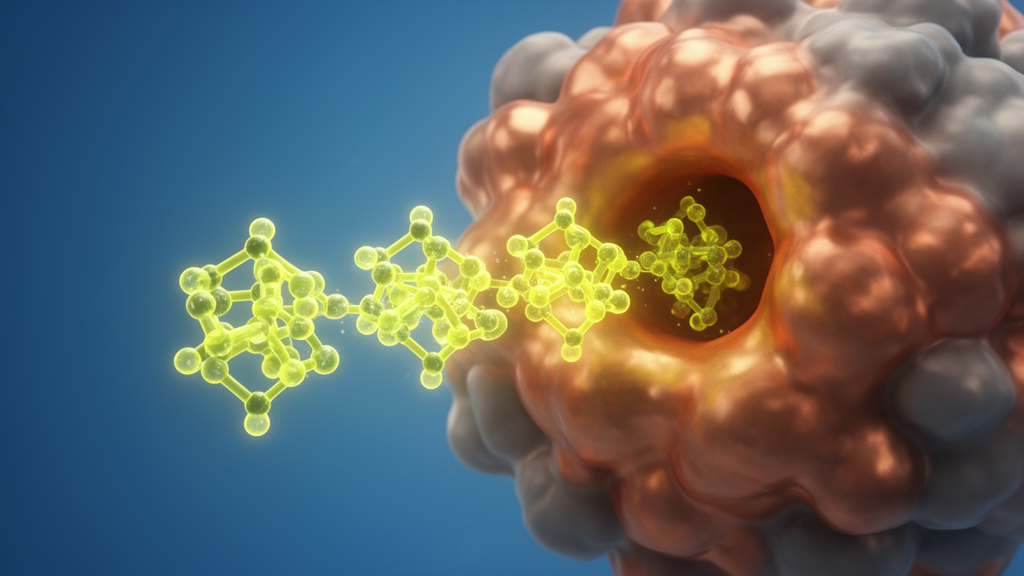
To understand how 14e slows the enzyme, the researchers performed enzyme kinetic analysis. The results indicated that 14e acts as a competitive inhibitor, meaning it competes with the natural substrate for binding at the enzyme’s active site. The inhibition constant derived from the kinetic study was 5.99 µM, a figure consistent with the compound’s strong performance in the potency screen.
Computational work provided a structural picture of the interaction.
The stability of that modeled complex was then tested over time.
Structure-activity relationship studies across the sixteen-compound series revealed a clear chemical pattern: para-halogen substitution on the terminal phenyl ring was essential for enhancing potency. This finding gives synthetic chemists a concrete handle for designing next-generation analogues, since it identifies the specific substitution pattern on the outer aromatic ring that correlates with stronger enzyme inhibition.
The authors present these results as evidence of 14e’s potential as a lead candidate for anti-hyperpigmentation therapy.
As with any early-stage study, the findings rest on in vitro enzyme assays and computational models rather than clinical testing. Nevertheless, the combination of a measured IC50 well below that of kojic acid, a defined competitive mechanism, and a structurally grounded explanation for potency makes 14e a concrete starting point for further development of coumarin-based tyrosinase inhibitors aimed at controlling excess pigmentation.
Subject of Research: Synthesis of bis-coumarinyl methane derivatives as tyrosinase inhibitors
Article Title: New bis-coumarinyl methane derivatives as efficient inhibitors of tyrosinase: synthesis and structure-activity relationships
Article References: Najafi, Z., Jafari-Nasab, M. A., Bahmani, A., Chehardoli, G., & Iraji, A. (2026). New bis-coumarinyl methane derivatives as efficient inhibitors of tyrosinase: synthesis and structure-activity relationships. BMC Chemistry. https://doi.org/10.1186/s13065-026-01949-0
Image Credits: AI Generated
DOI: 10.1186/s13065-026-01949-0
Keywords: tyrosinase, bis-coumarinyl methane, enzyme inhibition, hyperpigmentation, kojic acid, molecular docking, molecular dynamics, structure-activity relationship, ADMET, BMC Chemistry, competitive inhibitor, coumarin derivatives
News Source: Bethany Barker. (October 28, 2026). New Bis-Coumarinyl Compounds Show Strong Tyrosinase Inhibition. Scienmag.