Turning carbon dioxide back into useful fuels and chemicals with renewable electricity is one of the most tempting prizes in electrochemistry, and one of the most stubborn. A newly published review in the journal Catal argues that the key to cracking the problem lies not in new bulk materials but in the deliberate engineering of catalyst interfaces at the atomic scale, where individual atoms, vacancies and local electric fields decide which reaction pathway carbon dioxide actually takes.
The review, authored by Youzeng Li, Huan Wang and Ke Chen, frames electrocatalytic carbon dioxide reduction, or CO2RR, as a technology with enormous promise and equally enormous obstacles. Driven by renewable power, CO2RR can convert waste CO2 into value-added fuels and feedstocks, closing the carbon loop. Yet the reaction is hampered by the chemical inertness of the CO2 molecule, whose carbon-oxygen double bond carries an energy of about 750 kilojoules per mole, by a tangle of competing proton-coupled electron transfer steps, and by the ever-present hydrogen evolution reaction that steals electrons to make hydrogen instead of carbon products. The authors contend that low energy and carbon efficiencies remain the central barriers to industrial deployment, and that understanding and harnessing interfacial effects through atomic-level catalyst modulation is the way forward.
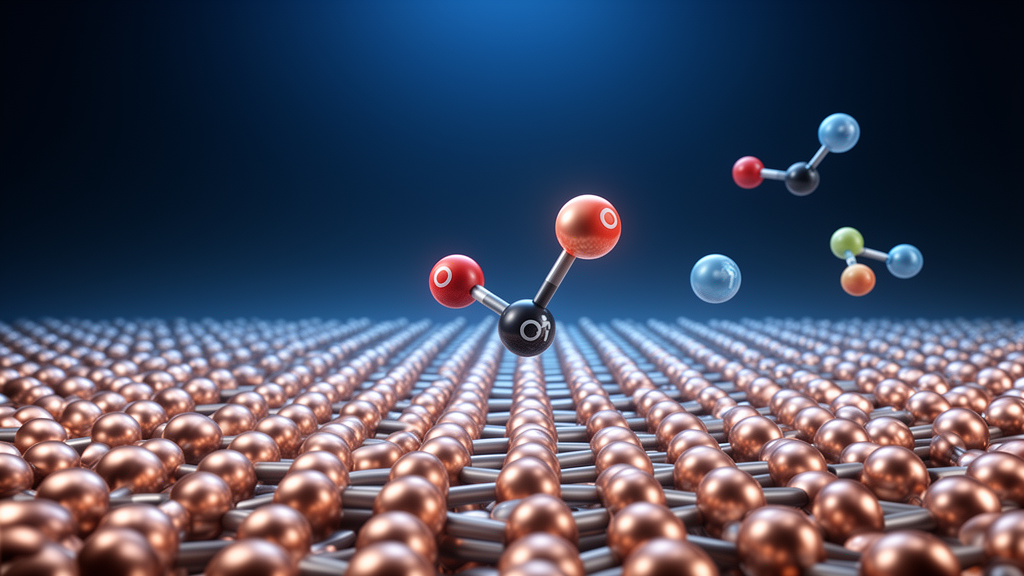
At the heart of the argument is a simple mechanistic picture. Before CO2 can be reduced, it must adsorb and activate on the catalyst surface, forming a charged CO2 intermediate. From there, the pathway forks. If the catalyst binds the carbon atom, a *COOH intermediate forms and is stripped of its hydroxyl group to yield adsorbed *CO, which can be further reduced to carbon monoxide, methane, ethylene, ethanol or methanol. If the catalyst binds the oxygen atom instead, an *OCHO intermediate forms and evolves into formic acid. Which branch dominates depends exquisitely on the surface structure, and the review’s central claim is that by engineering the atomic arrangement of that surface, researchers can steer the binding strength of intermediates such as *CO, *OCHO and *OCCO, and with it the product distribution.
The first family of strategies the authors survey involves breaking the local symmetry of the catalyst to create asymmetric sites with a charge density gradient. Heteroatom doping is the workhorse here. When Wu and colleagues interstitially incorporated indium into bismuth oxide, the dopant lowered the Gibbs free energy for CO2 activation and delivered a formate Faradaic efficiency exceeding 90 percent across a wide potential window. Sulfur doping of tin surfaces, meanwhile, leaves the surface positively charged, strengthening the adsorption of the electron-rich *OCHO intermediate and favoring selective formate production. Tellurium doping of bismuth shifted the potential-determining step for formate formation, and sulfur incorporation into bismuth was shown to drive water dissociation, supplying protons that accelerate CO2 protonation. The authors caution, however, that excessive water dissociation can backfire by feeding the competing hydrogen evolution reaction, so the balance between proton supply and hydrogen suppression is delicate.
Single-atom catalysts take the same logic to its extreme. Isolated metal atoms anchored, typically, on nitrogen-doped carbon supports can be tuned by their coordination environment. Wang and colleagues varied the number of nitrogen atoms around nickel centers, building Ni-N2, Ni-N3 and Ni-N4 sites, and found that Ni-N3C sites with asymmetric charge distribution best balanced *COOH formation against *CO desorption, avoiding the site poisoning seen when *CO desorption becomes energetically uphill. Axial coordination offers another lever: Li and colleagues built zinc-nitrogen sites modified by an axial sulfur ligand surrounded by phosphorus atoms, inducing electron redistribution that lowered the *COOH formation barrier to 0.74 electronvolts and pushed the carbon monoxide Faradaic efficiency close to 100 percent.
Defects provide a third route to asymmetric active sites. Bismuth vacancies on bismuth surfaces create double-coordinated sites that adsorb *OCHO exothermically rather than through a high-energy rate-determining step, and vacancy-rich defective bismuth nanosheets showed lowered free energies for both *CO2 and *OCHO formation. On copper sulfide, Zheng and colleagues identified double sulfur vacancies as efficient centers for forming the key C3 intermediate of n-propanol, achieving a Faradaic efficiency of 15.4 plus or minus 1 percent. Oxygen vacancies on copper, acting as charge carriers, facilitate electron transfer to adsorbed *CO, boosting carbon-carbon coupling and C2+ selectivity. Bimetallic alloying rounds out this section: single silver atoms doped into copper balance *CO binding against *CO dimerization to favor C2+ products, while Cu-In single-atom alloys showed a striking host-guest switching of selectivity, with Cu99In1 favoring carbon monoxide and Cu1In99 favoring formate.
The second broad category is geometric: the arrangement of atoms on the surface itself. Well-defined single-crystal studies show that copper facets dictate selectivity, with Cu(100) favoring ethylene through a lower *CO dimerization barrier and Cu(111) favoring C1 products such as methane. Single-crystal copper foil electrodes confirmed that facet orientation correlates with product distribution, and catalysts with the highest Cu(100)-to-Cu(110) ratio yielded the highest C2+ selectivity. Grain boundaries matter too: rich Cu(111)/Cu(200) grain boundaries boost CO2 activation and ethylene formation, while introducing grain boundaries into Cu(100) shifts selectivity from ethylene toward ethanol. Stepped surfaces, with their low-coordinated atoms and upshifted d-band centers, raised the hydrogen evolution barrier and steered copper toward formate, achieving a formate Faradaic efficiency of 95.9 percent, and theoretical screening identified Cu(433) high-index facets as the most favorable for n-propanol. Heterostructure interfaces add compositional synergy, with mixed-valence Cu+/Cu0 interfaces delivering C2+ Faradaic efficiencies of up to 86.4 plus or minus 2.4 percent, and Cu@Ag interfaces enabling rapid *CO spillover from silver to copper for high C2+ selectivity at industrially relevant currents.
Geometry also works through confinement and curvature. Hollow hierarchical copper catalysts concentrate *CO locally to promote dimerization, and hollowed nickel nanocages achieved near-unity CO Faradaic efficiency in acidic media by controlling proton diffusion through shell thickness and cavity size. An Au@Cu2O yolk-shell structure demonstrated that cavity dimensions dynamically control *CO coverage, switching the methane Faradaic efficiency from 23.26 to 65.54 percent while ethylene fell from 33.87 to 6.51 percent. Curved surfaces add another twist: cobalt phthalocyanine molecules draped over curved carbon nanotubes bind *CO strongly enough to reduce it to methanol, whereas flat molecules simply release CO, and curved bismuth nanotubes sustain high formate selectivity by concentrating CO2 near the surface.
Finally, the review turns to the reaction microenvironment itself. Ordered copper nanoneedle arrays generate stronger local electric fields than disordered ones, accumulating potassium ions and favoring both *CO adsorption and carbon-carbon coupling. Covalently anchored cationic groups repel protons electrostatically while stabilizing polar intermediates, yielding a 94 percent CO Faradaic efficiency in acidic media. Superhydrophobic hierarchical copper nanowire arrays with microgrooves manage the three-phase interface to promote carbon-carbon bond formation, hydrophobic copper supraparticles with hierarchical porosity sustain ampere-level electrolysis, and PTFE-tailored interfaces reached a 59.3 percent multi-carbon Faradaic efficiency. Local pH engineering completes the picture: a porous carbon coating that traps hydroxide ions created a localized alkaline interface, lifting the ethylene Faradaic efficiency to 70 percent even in acidic electrolyte.
The authors close with a forward-looking agenda: atomic-level precision manufacturing such as atomic layer deposition and molecular beam epitaxy to build identical active units, integration of artificial intelligence with experimental and computational data, and multi-technique in situ characterization to capture metastable intermediates that current spectroscopies miss. Their stated goal is a complete causal chain from atomic-level manufacturing through tailored interfaces and precise pathway control to industrial-scale performance. As a review, the article synthesizes published findings rather than reporting new experiments, but its synthesis makes a coherent case: the future of carbon dioxide electroreduction may be decided one atom at a time, at the interface where the reaction actually happens.
Subject of Research: Atomic-level interface engineering strategies for electrocatalytic CO2 reduction
Article Title: Engineering atomic-level interface for electrocatalytic CO2 reduction
Article References: Li, Y., Wang, H., & Chen, K. (2026). Engineering atomic-level interface for electrocatalytic CO2 reduction. Catal, 2(1), Article 19. https://doi.org/10.1007/s44422-026-00032-y
Image Credits: AI Generated
DOI: 10.1007/s44422-026-00032-y
Keywords: CO2 reduction, electrocatalysis, single-atom catalysts, heteroatom doping, defect engineering, bimetallic alloys, crystal facets, interface engineering, Faradaic efficiency, copper catalysts, formate, carbon neutrality
News Source: Denise Maddox. (October 28, 2026). Atomic-Level Interface Engineering Steers CO2 Electroreduction Toward Desired Products. Scienmag.