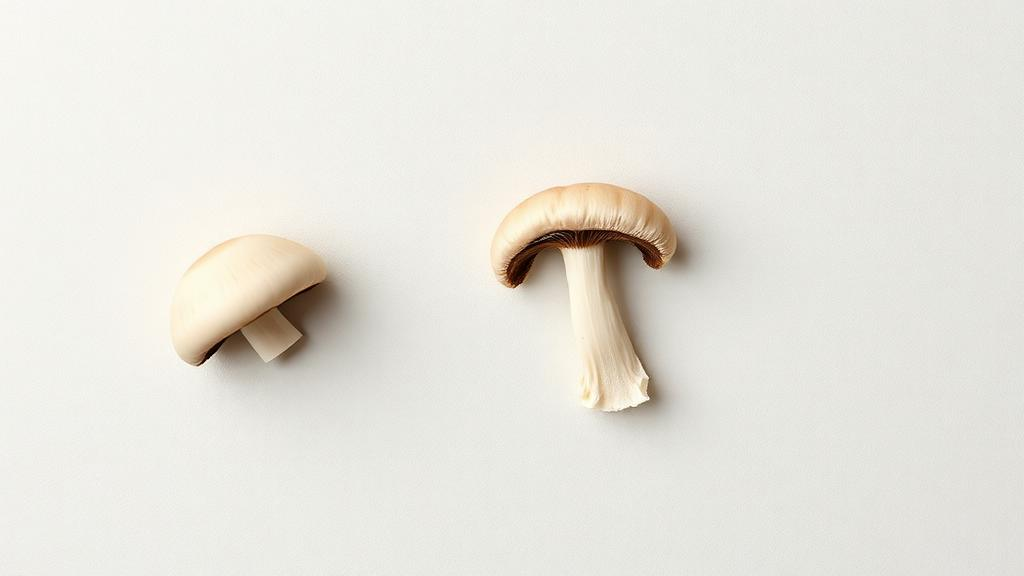
A leather-like material made from white button mushrooms has been engineered to match the toughness and tensile strength of cow leather, using nothing more than a household blender, an alkaline bath, vacuum filtration and a dash of glycerol. The material, described in the journal Fashion and Textiles, was developed by researchers at a laboratory in the Republic of Korea and built entirely from Agaricus bisporus, the common white button mushroom sold in grocery stores. Unlike most synthetic leather substitutes on the market today, the new biocomposite contains no petroleum-based polymers or adhesives, can be broken down in soil within weeks, and can be dissolved back into water and reformed into a fresh sheet once its useful life is over.
The team, led by Ha Eun Bang, Soyoung Park and Yaewon Park, set out to address a gap in the growing field of fungal materials. Mycelium-based composites, in which fungal threads are grown through substrates and then pressed or molded, have attracted considerable attention in recent years. Whole mushrooms, however, have remained comparatively underexplored, despite being rich in natural polysaccharides such as chitin and beta-glucan and being easy to process. The researchers reasoned that the structural components of mushrooms, which also include proteins, could be disassembled and reassembled into a laminated architecture resembling the layered microstructures that give natural materials like nacre their legendary toughness.
The fabrication route is deliberately simple and entirely water-based, avoiding organic solvents altogether. Frozen mushrooms were thawed, blended with deionized water in a one-to-one ratio, and heated on a hot plate at 150 degrees Celsius for 30 minutes. After centrifugation, the sedimented material was mixed with a 3 percent sodium hydroxide solution and heated at 100 degrees Celsius for six hours, an alkaline treatment that removes a substantial fraction of proteins and soluble constituents and leaves behind a chitin- and beta-glucan-rich feedstock. This mixture was then combined with a dilute aqueous glycerol solution, sonicated, and poured through a stainless-steel mesh filter under vacuum. The residue, dried first in a conventional oven at 50 degrees Celsius and then in a vacuum oven at 40 degrees Celsius, peeled away from the mesh as a freestanding sheet the researchers call toughened mushroom, or TM.
Microscopy revealed why the material performs the way it does. The mushroom slurry consists of thin, elongated sheets roughly 102 micrometers long and 8 micrometers wide, with a thickness of only about 200 nanometers, giving them an extremely high aspect ratio. During vacuum filtration, the pressure difference across the filter medium compacts these suspended sheets layer by layer onto the filter surface, producing a stacked, laminated architecture reminiscent of brick-and-mortar biological structures. Scanning electron microscopy of the finished surface showed multiple thin sheets piled on top of one another, and atomic force microscopy confirmed the submicron thickness of the individual building blocks.
Glycerol plays the decisive role in the material’s mechanical behavior. Inspired by nacre, in which soft layers between brittle mineral plates dissipate energy, the researchers hypothesized that glycerol forms a lubricating layer between the stacked mushroom sheets, allowing them to slide past one another under load. The comparison was stark: without glycerol, the material was brittle and fractured immediately under tensile loading, with a relatively clean fracture surface. With glycerol, the fractured cross-section showed protruding and pulled-out sheets, evidence that the layers had slid and separated during deformation, absorbing energy in the process.
Confocal fluorescence microscopy captured this realignment directly. Before stretching, the mushroom sheets within the material displayed a nearly random in-plane orientation, with an orientational order parameter of 0.28, close to the theoretical value of 0.25 for a random distribution. After the material was stretched to 23 percent strain, near the fracture point of the specimen, the order parameter rose to 0.70, confirming that the sheets had aligned along the loading direction. This strain-induced alignment facilitates load transfer and energy dissipation through sheet sliding, pull-out and crack bridging. The liquid phase between the sheets, recovered from the filtration filtrate, showed shear-thinning behavior, meaning its viscosity drops as the shear rate increases, so it deforms more readily than the sheets themselves.
The measured mechanical properties place the material in genuinely competitive territory. Toughened mushroom exhibited a toughness of 1.94 plus or minus 0.21 newtons per square millimeter and a tensile strength of 14.50 plus or minus 3.15 newtons per square millimeter, with a breaking strain of 22.46 plus or minus 3.84 percent. The commonly reported tensile strength range for cow leather spans 5 to 20 megapascals, though the authors note this varies with processing conditions, humidity and the choice of leather layers. Their own measurements on two commercial cow leather products yielded toughness values of 2.17 plus or minus 0.60 and 3.37 plus or minus 0.74 newtons per square millimeter and tensile strengths of 6.36 plus or minus 0.85 and 11.93 plus or minus 1.38 newtons per square millimeter. Cow leather stretched considerably further before breaking, with breaking strains above 65 percent, but the toughness and tensile strength of the mushroom material fell within the same range. The researchers also modeled the toughening quantitatively, attributing the toughness primarily to viscous dissipation within the liquid layers between sliding sheets, and estimated an effective sheet length of roughly 3 millimeters, far larger than any individual sheet, which suggests multiple sheets may move collectively. The authors caution that this estimate rests on simplifying assumptions and does not independently prove cooperative motion.
Practical demonstrations showed the material can survive real-world handling. It withstood punctures from sewing machine needles and was fashioned into a dog collar, a leash and a coin purse with a sewn zipper and a fabric lining. A triple-folded collar, made from sheets 0.87 millimeters thick, bore the force of dragging a 246-gram plush toy and showed no visible damage when an additional 1-kilogram load was added. The researchers emphasize, however, that no formal repeated-bending or cyclic-loading tests were performed, and that further cyclic testing is needed to quantify long-term durability. Unlike the commercial vegan leathers examined in the study, which contained polyurethane or textile backing, the mushroom material achieved its toughness without multiple layers or synthetic binders.
Recyclability sets the material apart from most leather alternatives. Scraps left over from cutting and sewing were simply cut into small pieces, mixed with deionized water, refiltered and redried to yield a regenerated sheet, with water as the only added processing medium. No fresh glycerol was needed because the original material retained enough of it to stay flexible; the glycerol content, estimated by water extraction, fell from roughly 53 percent by weight in the original to about 34 percent after regeneration. Mechanical testing showed the regenerated material had slightly lower breaking stress and toughness but a higher average breaking strain of 24.94 plus or minus 4.08 percent, indicating that recycling enhances ductility while modestly compromising strength. The same water sensitivity that enables recycling is also a limitation: because glycerol is highly water-soluble, prolonged exposure to water or humidity leaches it out and alters mechanical properties, a behavior also reported for other glycerol-plasticized fungal leather materials. The authors suggest future surface coatings or chemical crosslinking could improve water resistance, though such modifications must be balanced against preserving regenerability.
Biodegradability testing provided the final piece of the sustainability picture. In a 49-day soil-burial test using natural soil collected in Seoul, specimens of the mushroom material lost up to 88 percent of their initial dry weight, while commercial vegan leathers marketed as Hanji, cactus and corn leather lost substantially less over the same period, likely because of the synthetic materials they contain. The authors note that degradation behavior in aquatic environments remains untested and that biodegradation rates can vary considerably with the surrounding microbial community, so freshwater and marine degradation studies are needed. The sheets produced so far measure roughly A5 size, limited mainly by the volume of slurry and the capacity of the filtration and drying equipment, which the researchers say could be scaled up. If those engineering hurdles are cleared, the strategy of disassembling cheap agricultural commodities into high-aspect-ratio sheets and reassembling them into nacre-like laminates could extend beyond mushrooms to other biopolymer systems, offering a route to soft, durable composites whose end of life is a return to the soil rather than a landfill.
Subject of Research: A laminated biocomposite made from white button mushroom sheets and glycerol that serves as a tough, biodegradable and recyclable alternative to leather.
Article Title: Bioinspired lamination of mushroom-derived submicron sheets for sustainable and recyclable leather alternatives
Article References: Bang, H. E., Park, S., & Park, Y. (2026). Bioinspired lamination of mushroom-derived submicron sheets for sustainable and recyclable leather alternatives. Fashion and Textiles, 13(1), Article 39. https://doi.org/10.1186/s40691-026-00489-4
Image Credits: AI Generated
DOI: 10.1186/s40691-026-00489-4
Keywords: mushroom leather, Agaricus bisporus, biocomposite, nacre-inspired materials, glycerol plasticization, vacuum filtration, biodegradable textiles, sustainable materials, chitin, recyclability, vegan leather, toughness engineering
News Source: Denise Maddox. (October 28, 2026). Mushroom Sheets Laminated with Glycerol Form Tough, Recyclable Leather Alternative. Scienmag.