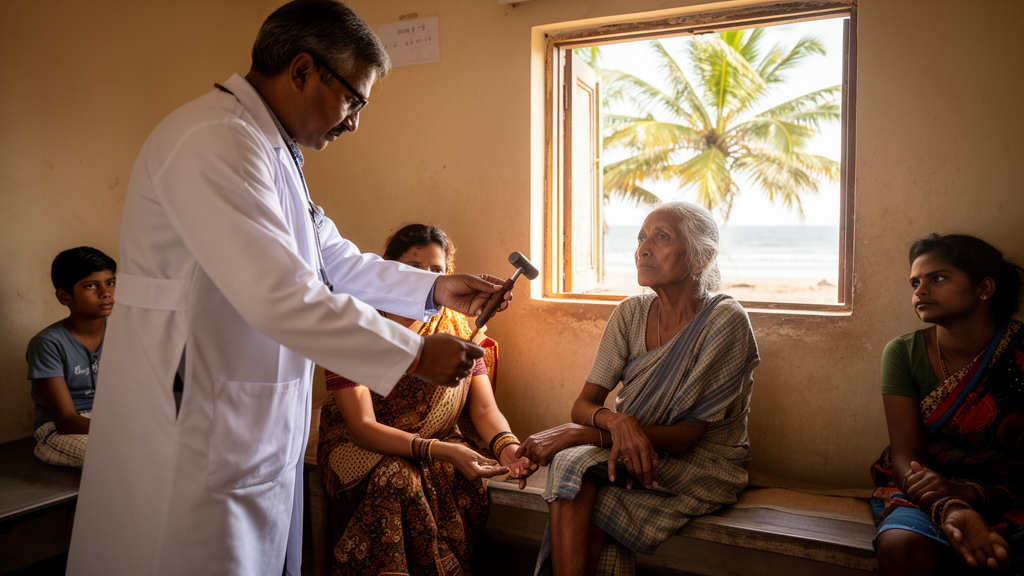
More than one adult in every fourteen in a coastal taluk of South India lives with a non-communicable neurological disorder, according to a community-based cross-sectional study published in BMC Public Health. Researchers surveyed 2,633 eligible adult residents across 1,118 households in Udupi taluk, Karnataka, between 20 January 2024 and 30 November 2024, and estimated an overall prevalence of 7.06% for these conditions. The figure is notable because non-communicable neurological disorders, or NCNDs, are a major and growing contributor to global morbidity and disability, particularly in low- and middle-income countries undergoing rapid epidemiological transition, yet community-based evidence on their burden in India has remained limited.
Participants were screened using the validated NIMHANS protocol, and any positive screens were followed by specialist confirmation. Data on socio-demographic, behavioural and health-related factors were collected with a structured questionnaire. Among the confirmed cases, stroke was the most common condition, accounting for 32.2% of NCNDs, followed by migraine at 28.0% and neuropathic pain at 17.7%.
To identify which characteristics were independently associated with NCNDs, the researchers first ran univariate logistic regression and carried forward variables with a p value below 0.20 into a multivariable logistic regression model. In that final analysis, sedentary lifestyle showed the strongest association, with a 5.74-fold increase in odds (95% CI 1.91–17.2). Unemployment was associated with a 2.29-fold increase in odds (95% CI 1.28–4.11), as was tobacco use (AOR 1.98; 95% CI 1.01–3.88). Hypertension was associated with a 1.53-fold increase in odds (95% CI 1.02–2.30). Moderate to severe stress, poor sleep quality and suboptimal dietary practices were also independently associated with increased odds of NCNDs.
Not every association pointed toward risk. Unmarried individuals had significantly lower odds of NCNDs, with an adjusted odds ratio of 0.35 (95% CI 0.13–0.92). The authors describe the overall pattern as a burden driven by modifiable behavioural and metabolic risk factors, and they suggest strengthening community-based screening and integrating neurological health into existing non-communicable disease programs to improve early detection and prevention strategies.
The study’s design shapes what its findings can and cannot support. As a cross-sectional survey, it measured exposure and outcome at the same point in time, so the reported associations identify predictors and determinants but cannot establish temporal sequence or causation. The estimates also apply to adults in one coastal taluk, and the confidence intervals around some associations, such as that for sedentary lifestyle, are wide, reflecting limited precision.
The community-based approach, however, offers a strength that hospital-based studies lack: by approaching households directly rather than relying on clinic attendance, it captures conditions that never reach a specialist, which supports the authors’ argument that the 7.06% prevalence reflects the burden in this population more faithfully than clinic-based counts would.
The concentration of the burden among adults with hypertension, tobacco use, sedentary routines, psychological stress, poor sleep and suboptimal diets gives health planners a concrete set of targets for screening and prevention in the community, the researchers conclude. Because these factors are already the focus of existing non-communicable disease programs in India, the authors argue that adding neurological screening to such programs could improve early detection without building entirely new infrastructure.
The researchers conclude that NCNDs impose a substantial and under-recognised public health burden in South India. With stroke, migraine and neuropathic pain together accounting for the majority of cases identified in Udupi taluk, the study provides one of the few household-level estimates of neurological disease burden in the region and a baseline for future community-based work.
Subject of Research: Prevalence and determinants of non-communicable neurological disorders among adults in coastal South India
Article Title: Burden and determinants of non-communicable neurological disorders among adults in a coastal region of South India: a community-based cross-sectional study
Article References: K, J. J., Prabhu, D. A., B, S. K., Prabhu, A. N., & Kunder, M. A. (2026). Burden and determinants of non-communicable neurological disorders among adults in a coastal region of South India: a community-based cross-sectional study. BMC Public Health. https://doi.org/10.1186/s12889-026-29676-0
Image Credits: AI Generated
DOI: 10.1186/s12889-026-29676-0
Keywords: neurological disorders, India, cross-sectional study, stroke, migraine, neuropathic pain, hypertension, tobacco use, sedentary lifestyle, public health, risk factors, Udupi
News Source: Phoebe Ingram. (October 26, 2026). Community survey reveals heavy neurological disorder burden in coastal South India. Scienmag.