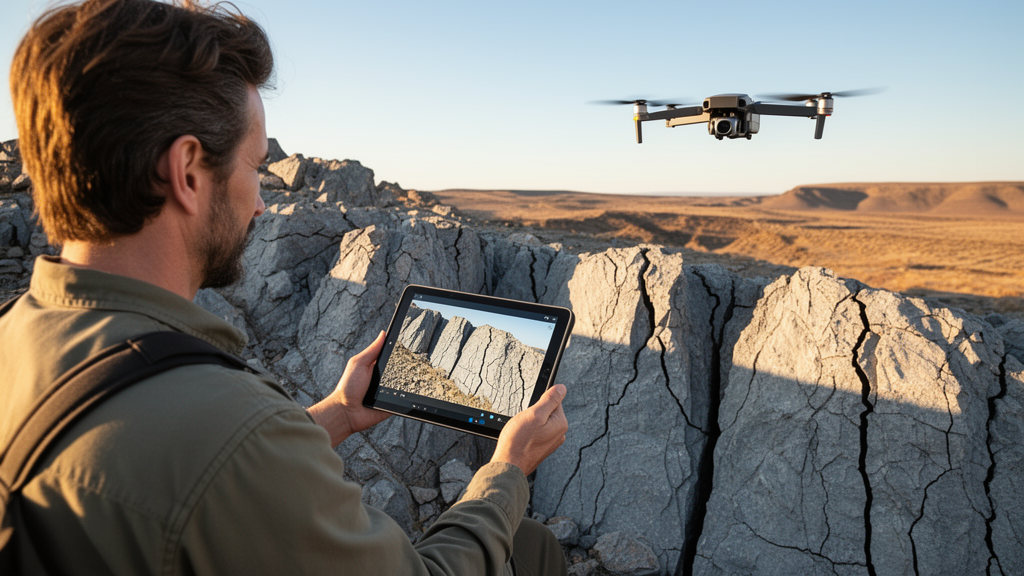
Extracting fracture networks from drone photogrammetry with far less manual labeling is the aim of a workflow described in Scientific Reports. Jiayu Wang and Gongquan Li developed an informatics pipeline that transfers segmentation knowledge from a large source dataset, GeoCrack, to a small, site-specific UAV dataset called RockCrack, addressing the scarcity of pixel-level fracture annotations for newly surveyed areas. The challenge is substantial.
Outcrop fractures are typically thin, low-contrast, and discontinuous, and they are easily confused with heterogeneous textures, weathering patterns, and shadows in aerial imagery. Labeling such imagery pixel by pixel is labor-intensive, which means each new survey site traditionally requires extensive annotation before machine-learning models can be applied. The new workflow treats GeoCrack as the source domain and RockCrack as the target domain, using feature-space analysis to identify a measurable discrepancy between the two datasets.
At the core of the workflow is GRNet, a segmentation model that combines Deformable Large-Kernel Attention at the bottleneck with Spatial-Channel Squeeze-and-Excitation mechanisms in the encoder. The performance figures show the effect of pretraining. On GeoCrack itself, GRNet achieves an intersection-over-union (IoU) of 66.84% and an F1-score of 80.12%.
When trained from scratch on the small RockCrack dataset, it reaches a five-fold mean crack-class IoU of 56.69 ± 4.34% and an F1-score of 72.28 ± 3.61%. After GeoCrack pretraining followed by target-domain fine-tuning, the best-performing configuration improves to a mean IoU of 58.96 ± 3.64% and an F1-score of 74.13 ± 2.93%. Fine-tuning outperformed direct source-only deployment in the reported experiments, indicating that source-domain knowledge contributed to the gains on the target site.
The authors note, however, that differences between the leading transfer strategies are small and fold-dependent, meaning the ranking of top configurations may vary with the particular data split used for evaluation. The workflow produces pixel-level fracture maps that can feed subsequent processing steps, including skeletonization, trace vectorization, and fracture-network characterization. These downstream products are what ultimately support discontinuity mapping, rock-mass characterization, and geotechnical interpretation of outcrop imagery collected during UAV surveys.
The researchers are explicit about the limits of their results. They state that further spatial calibration, uncertainty assessment, and geological validation are required before the outputs can be used for quantitative rock-mass analysis or engineering decisions. The fracture maps are therefore an intermediate product that still requires expert geological judgment in safety-relevant applications.
The study reports a workflow for applying deep segmentation models in settings where labeled geological imagery is limited. By quantifying the domain gap through feature-space analysis and reporting measured performance gains from cross-domain pretraining, the authors document an approach to label-scarce fracture mapping, with the reported uncertainty ranges and stated validation requirements framing the results as research findings rather than deployment-ready outputs.
Subject of Research: Label-scarce cross-domain deep learning segmentation of geological outcrop fractures from UAV photogrammetric imagery
Article Title: An informatics workflow for label-scarce cross-domain segmentation of geological outcrop fractures from UAV photogrammetric imagery
Article References: Wang, J., & Li, G. (2026). An informatics workflow for label-scarce cross-domain segmentation of geological outcrop fractures from UAV photogrammetric imagery. Scientific Reports. https://doi.org/10.1038/s41598-026-77360-5
Image Credits: AI Generated
DOI: 10.1038/s41598-026-77360-5
Keywords: UAV photogrammetry, geological fractures, image segmentation, deep learning, GRNet, GeoCrack, RockCrack, domain adaptation, rock-mass characterization, label scarcity, fracture networks, informatics
News Source: Denise Maddox. (October 26, 2026). AI Workflow Maps Rock Fractures from Drone Images with Scarce Labels. Scienmag.