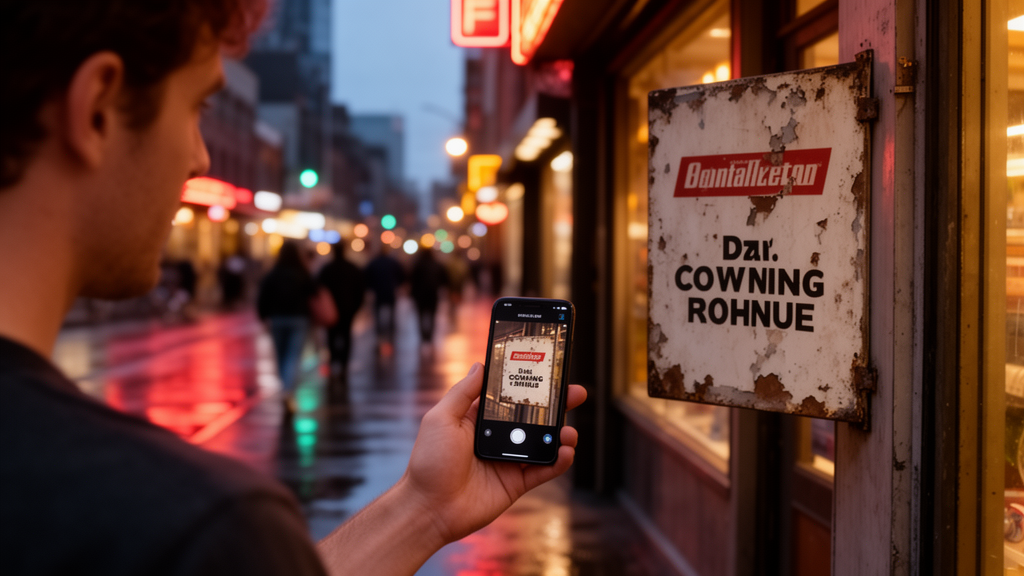
Reading text embedded in photographs of streets, shopfronts and natural scenes remains one of the harder problems in computer vision. Text can appear at almost any angle, its strokes may be thin and easily lost, and backgrounds are often cluttered or low in contrast. A new open-access study in Scientific Reports proposes a detector built to handle exactly these difficulties, reporting strong accuracy while keeping the model small enough for resource-limited settings.
The model, called YOLO-FWF, is an improved version of the lightweight YOLO11n architecture. The researchers introduce three modules that reshape how the network processes visual information. The first, C3k2_FrequencyCM, sits in the backbone and combines Fourier-domain amplitude compensation with spatial high-frequency feature enhancement. In practical terms, it strengthens the fine-grained cues that distinguish text strokes, edges and weak textures from surrounding clutter, making the network more sensitive to the fine structures that define written characters.
The second module, C2PSA_WDAM, replaces the original C2PSA attention block. It uses a wavelet transform to split features into low-frequency semantic components, which carry broad meaning, and high-frequency detail components, which carry fine structure. The high-frequency information then guides attention modeling, helping the network focus on text-like detail while suppressing background interference. This wavelet-guided attention is the study’s central mechanism for separating genuine text regions from visually similar but irrelevant content.
The third contribution, the Fourier Angle Alignment Fusion module, addresses orientation. Text in real scenes is often inclined, curved or otherwise irregular, and standard multi-scale feature fusion does not account for this. The module estimates dominant local orientations in the frequency domain and aligns high-level semantic features with low-level structural features before fusing them, which the authors report improves detection of slanted and irregular text instances.
Evaluation was carried out on two Roboflow-hosted scene text datasets. On the text scene computer vision dataset, YOLO-FWF reached 86.8 percent mAP50 and 64.2 percent mAP50:95, with only 2.89 million parameters and 6.7 GFLOPs of computation. On the text detection dataset, it achieved 54.7 percent mAP50 and 34.6 percent mAP50:95. According to the study, these results outperform YOLO11n and several other mainstream detectors evaluated under the same setting, while the model retains a lightweight structure suitable for efficient deployment.
The reported numbers indicate that frequency-domain enhancement, wavelet-guided attention and direction-aware feature fusion each contribute measurable gains on the evaluated data. The combination of a small parameter count with competitive accuracy is notable, since scene text detection models often trade size for performance. A detector in the low-millions of parameters could, in principle, run on hardware where larger models are impractical, although the study itself does not report deployment benchmarks.
The authors are explicit about a key limitation: the current experiments do not include standard public scene-text benchmarks, so broader generalization remains to be verified. The two evaluation datasets also differ considerably in difficulty, as shown by the gap between the 86.8 percent and 54.7 percent mAP50 scores, suggesting that performance depends strongly on dataset characteristics such as background complexity and text appearance.
Within that scope, the study offers a concrete demonstration that explicitly modeling frequency content, rather than relying only on learned spatial features, can sharpen a detector’s sensitivity to the thin strokes and varied orientations that make scene text hard to find. The findings verify the effectiveness of the three proposed modules on the datasets evaluated, and future work on standard benchmarks will determine how widely the approach carries.
Subject of Research: A lightweight frequency–wavelet feature fusion network for robust scene text detection
Article Title: YOLO-FWF: a lightweight frequency–wavelet feature fusion network for robust scene text detection
Article References: Zhao, M., Zheng, Z., Ye, Q., Fan, J., & Zhao, J. (2026). YOLO-FWF: a lightweight frequency–wavelet feature fusion network for robust scene text detection. Scientific Reports. https://doi.org/10.1038/s41598-026-75132-9
Image Credits: AI Generated
DOI: 10.1038/s41598-026-75132-9
Keywords: scene text detection, computer vision, deep learning, wavelet transform, Fourier analysis, YOLO, lightweight neural networks, feature fusion, YOLO-FWF, attention mechanism, lightweight, frequency
News Source: Blake Davidson. (October 26, 2026). Frequency and Wavelet Cues Give Lightweight Detector an Edge in Scene Text Detection. Scienmag.