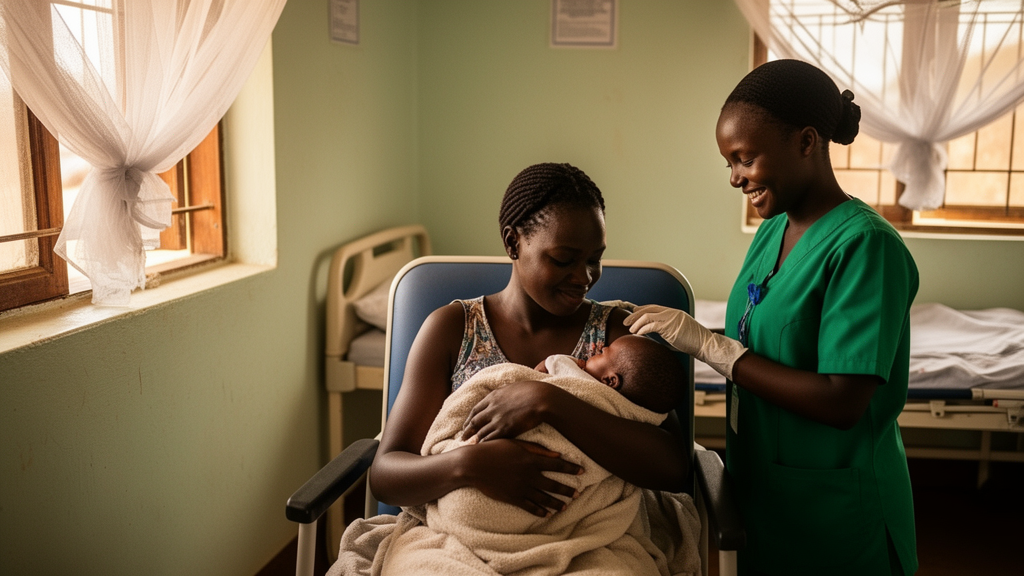
Kangaroo mother care — the practice of holding a preterm or low birth weight infant skin-to-skin against a caregiver’s chest — is an effective, low-cost intervention for improving outcomes among vulnerable newborns. Yet in many low- and middle-income countries, its implementation remains inconsistent. A new quality improvement study at a rural Kenyan hospital, published in BMC Health Services Research, shows how a structured, multi-component implementation strategy changed that picture: the proportion of newborns starting kangaroo mother care within 24 hours of birth jumped from 8.3 percent at baseline to 83.3 percent after the first round of interventions, a change the researchers report as statistically significant (P < 0.001), and the gains were sustained through subsequent cycles of the project.
The study was organized as three sequential six-week improvement cycles, each targeting barriers that had kept kangaroo mother care from being practiced consistently. The interventions addressed three broad problem areas identified by the team: gaps in health care provider knowledge, low caregiver engagement, and environmental constraints within the hospital itself. Rather than testing a single drug or device, the researchers treated kangaroo mother care delivery as a systems problem, measuring whether changes to training, caregiver support and the care environment could shift day-to-day practice on the neonatal ward. A total of 45 neonates were enrolled over the course of the study.
The primary outcomes were initiation of kangaroo mother care within 24 hours of delivery and the mean daily duration of the practice. Beyond the rise in early initiation, the team documented steady gains in how long infants were actually held each day. Mean daily duration climbed from 0.2 hours per day in Cycle 1 to 2.0 hours per day in Cycle 2 (P < 0.001), and then rose again to 4.1 hours per day in Cycle 3 (P = 0.02). Secondary outcomes told a similar story: the proportion of eligible hospital days on which neonates received at least one hour of kangaroo mother care increased from 7.7 percent to over 80 percent.
One of the study’s most technically revealing findings concerned prolonged care. Reaching at least eight hours of kangaroo mother care per day was achieved only after the team made environmental and infrastructure modifications to the ward. In other words, education and caregiver engagement alone were sufficient to raise initiation and short daily sessions, but sustaining the practice for most of the day required changes to the physical and organizational conditions of the hospital itself. This distinction between behavioral and structural barriers is central to the paper’s argument that kangaroo mother care uptake in resource-limited settings depends on system-level design, not merely on persuading individual providers and mothers.
The authors conclude that a structured, multi-component implementation strategy substantially improved both the initiation and the duration of kangaroo mother care in a rural, resource-limited setting. They suggest that low-cost, system-level interventions of this kind can strengthen neonatal care delivery more broadly and offer a scalable model for improving kangaroo mother care uptake in similar low- and middle-income contexts. The findings arrive against a sobering global backdrop: neonatal mortality remains a leading contributor to under-five mortality worldwide, and the burden falls disproportionately on low- and middle-income countries, precisely where consistent implementation of proven interventions has been hardest to achieve.
Several caveats frame the results. This was a quality improvement study conducted at a single rural hospital with 45 enrolled neonates, not a multi-site randomized trial, so the findings demonstrate feasibility and improvement within one setting rather than generalizable effectiveness across health systems. The project was retrospectively registered with the Pan African Clinical Trials Registry on 20 December 2025 under identifier PACTR202601794718541, and the published version notes that the work was a quality improvement study rather than a clinical trial. The article was shared as an open-access, peer-reviewed accepted manuscript ahead of the final Version of Record. Even with those limitations, the trajectory documented across the three cycles — from an 8.3 percent early-initiation rate and barely 12 minutes of daily skin-to-skin contact to sustained initiation above 80 percent and more than four hours of care per day — offers a concrete, quantified demonstration that inexpensive organizational changes, applied cycle by cycle, can move a proven neonatal intervention from policy to practice in one of the settings where it matters most.
Subject of Research: A multi-component implementation strategy for kangaroo mother care in neonatal care delivery at a rural Kenyan hospital
Article Title: Improving kangaroo mother care in a rural Kenyan hospital: a multi-component implementation strategy to strengthen neonatal care delivery
Article References: Strutner, J., Ash, N., & Hayden, G. (2026). Improving kangaroo mother care in a rural Kenyan hospital: a multi-component implementation strategy to strengthen neonatal care delivery. BMC Health Services Research. https://doi.org/10.1186/s12913-026-15526-7
Image Credits: AI Generated
DOI: 10.1186/s12913-026-15526-7
Keywords: kangaroo mother care, neonatal mortality, preterm infants, low birth weight, Kenya, quality improvement, implementation science, global health, low- and middle-income countries, neonatal care, Improving, kangaroo
News Source: Harold Sullivan. (October 26, 2026). Kangaroo Mother Care Soars in Rural Kenya With Low-Cost Hospital Overhaul. Scienmag.